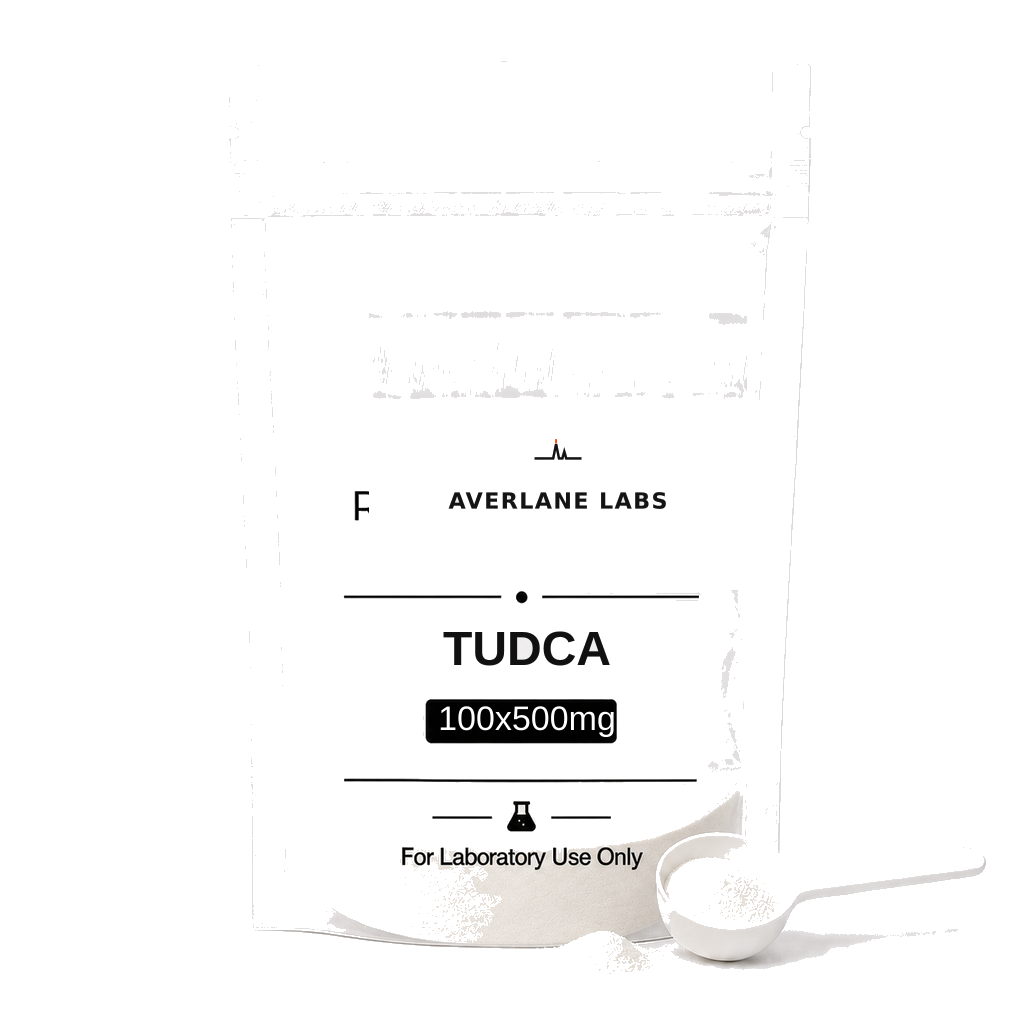
TUDCA 100x500mg
Certificate of Analysis available on request for the current lot.
Complete the setup
Reconstitution and bench supplies researchers pair with TUDCA 100x500mg
NOT FOR HUMAN CONSUMPTION
TUDCA is the taurine-conjugated form of ursodeoxycholic acid (UDCA), a hydrophilic, cytoprotective bile acid that acts as a chemical chaperone to relieve endoplasmic-reticulum (ER) stress, stabilizes mitochondria (anti-apoptotic), and modulates bile-acid receptors (notably TGR5; very weak FXR activity). Clinically, UDCA is widely used for cholestatic liver disease; TUDCA is available as a drug in some countries and as a supplement in others. Interest spans liver, metabolic, neurologic, and ocular indications.
Additional Benefits of TUDCA Now Under Investigation
| Benefit | Key take-aways |
|---|---|
| 1 NAFLD/MASH support | Small RCTs and pilots show ALT/AST reductions, MRI-PDFF liver-fat decreases, and improved insulin sensitivity, likely via ER-stress relief and improved hepatocellular bile-acid handling. <br/><em>Hepatology; Liver International</em> |
| 2 Cholestatic cytoprotection | Intrahepatic cholestasis and drug-induced cholestasis models show reduced hepatocyte apoptosisand better cholestatic labs; human data are strongest for UDCA, with TUDCA as mechanistic adjunct. <br/><em>Journal of Hepatology; Alimentary Pharmacology & Therapeutics</em> |
| 3 Neurodegeneration (ALS, PD, HD) | TUDCA crosses the BBB; multiple early-/mid-phase studies suggest slower functional decline or biomarker improvement in ALS/Parkinson’s/Huntington’s; larger confirmatory trials are mixed but ongoing. <br/><em>Neurology; Annals of Neurology</em> |
| 4 Diabetes/insulin resistance | In obese/insulin-resistant adults, TUDCA improves hepatic and peripheral insulin signaling (↑ insulin sensitivity) and lowers inflammatory markers. <br/><em>Diabetes; JCEM</em> |
| 5 Retinal/ocular protection | In retinitis-pigmentosa and diabetic-retinopathy models, TUDCA reduces photoreceptor apoptosis and preserves ERG function; small human feasibility work is underway. <br/><em>Investigative Ophthalmology & Visual Science; Experimental Eye Research</em> |
| 6 Bariatric/metabolic surgery adjuvant | May attenuate post-operative liver stress and improve bile-acid pool hydrophilicity; mechanistic/biomarker signals predominate. <br/><em>Obesity Surgery; Metabolism</em> |
| 7 Mitochondrial disease & myopathy signals | Anti-apoptotic and mitochondrial-stabilizing actions (↓ Bax translocation, ↓ cytochrome-c release) show functional benefits in models. <br/><em>Cell Death & Disease; Journal of Physiology</em> |
| 8 Gut barrier & microbiome | Hydrophilic bile-acid enrichment can reduce bile toxicity, improve intestinal tight junctions, and favorably shift bile-acid–microbiota crosstalk. <br/><em>Gut; Gastroenterology</em> |
| 9 Drug-induced liver injury (DILI) adjunct | Case series and small studies suggest faster enzyme normalization in selected cholestatic DILI phenotypes (evidence still preliminary; UDCA remains the reference). <br/><em>Hepatology Communications; Clinical Gastroenterology & Hepatology</em> |
2. Molecular Mechanism of Action
2.1 Pharmacodynamics
-
ER-stress “chemical chaperone”: TUDCA stabilizes protein folding, normalizes the unfolded-protein response (UPR) (PERK/eIF2α, IRE1/XBP1, ATF6), and reduces CHOP-mediated apoptosis.
-
Mitochondrial protection: Inhibits Bax activation/translocation, preserves ΔΨm, reduces ROS, and limits caspase-9/3 activation.
-
Bile-acid signaling: Predominantly TGR5 agonism (↑ cAMP; GLP-1 and energy-expenditure signals in some tissues); minimal FXR agonism compared with chenodeoxycholic acid/obeticholic acid.
-
Membrane/cytoprotection: Renders the bile-acid pool more hydrophilic, reducing detergent injury to hepatocytes/cholangiocytes.
2.2 Down-stream Biology
| Pathway | Functional outcome | Context |
|---|---|---|
| UPR rebalancing (PERK/IRE1/ATF6) | ↓ ER-stress, ↓ apoptosis | Liver, β-cell, neurons |
| Bax–caspase axis inhibition | Mitochondrial integrity ↑ | Hepatocyte/neuronal survival |
| TGR5 signaling | GLP-1 ↑, thermogenic/anti-inflammatory cues | Enteroendocrine, adipose, immune |
| Bile-acid pool hydrophilicity | Cholestatic injury ↓ | Liver/biliary epithelium |
3. Pharmacokinetics
-
Route: Oral (capsules, tablets); also IV in some research settings.
-
Absorption: Variable; enhanced with food; undergoes enterohepatic recirculation.
-
Distribution: Concentrates in bile and liver; modest CNS penetration reported.
-
Metabolism: Bile-salt transporters mediate cycling; intestinal deconjugation/reconjugation by microbiota.
-
Half-life: Several hours with multi-peak profile due to recirculation; functional exposure persists with divided dosing.
4. Clinical Evidence (high-level)
-
NAFLD/MASH: Small RCTs/controlled studies show enzyme and fat-fraction improvements; histologic endpoints remain limited vs lifestyle/GLP-1 class.
-
Cholestatic disease: Strongest human evidence still favors UDCA as standard; TUDCA provides mechanistic overlap and is used regionally; head-to-head outcome superiority is unproven.
-
Type 2 diabetes/IR: Proof-of-concept studies demonstrate improved insulin sensitivity (clamp data) and inflammatory/oxidative markers.
-
Neuro: ALS/PD/HD trials show signals (slower functional decline/biomarkers) but mixed outcomes in larger programs; research continues (including combinations).
-
Eye: Human data are early; robust animal protection against photoreceptor death.
Evidence quality note: Solid mechanistic and translational base; moderate human evidence for metabolic and hepatobiliary endpoints; emerging/variable in neuro/ocular fields.
5. Practical Use (research & real-world patterns)
-
Doses used in studies: 250–1,500 mg/day, often 10–15 mg/kg/day in divided doses with meals.
-
Use cases (off-label/supplement): NAFLD/MASH adjunct, metabolic syndrome/IR, cholestatic tendencies, “neuro-support” (investigational).
-
Stacking considerations:
-
Liver/metabolic: Diet + exercise, weight-loss pharmacotherapy if indicated; vitamin D, omega-3; avoid hepatotoxins.
-
Neuro: Antioxidants/mitochondrial supports are investigational; avoid claims beyond evidence.
-
6. Safety and Tolerability
-
Common: GI upset, soft stools/diarrhea, mild nausea; usually dose-related and improved with food/split dosing.
-
Less common: Pruritus, headache, flatulence.
-
Rare/uncertain: Biliary colic in gallstone formers (theoretic), rash.
-
Drug interactions: May interact with bile-acid sequestrants (reduced absorption, separate by ≥4 h). Monitor with warfarin if large liver-function shifts occur.
-
Special populations: Pregnancy, UDCA is standard for intrahepatic cholestasis of pregnancy; specific TUDCAdata are more limited, defer to local guidance.
-
Long-term safety: Generally favorable in published series; monitor LFTs, lipids, and glycaemia in metabolic indications.
Comparative matrix (bile-acid & adjunct options)
| Feature | TUDCA | UDCA | Obeticholic acid (FXR agonist) | GLP-1RA (metabolic NAFLD) |
|---|---|---|---|---|
| Primary action | ER-stress relief, TGR5, hydrophilic bile | Hydrophilic bile, cytoprotection | Potent FXR agonism | Weight loss, insulinotropic |
| NAFLD enzymes/fat | Improves (modest) | Modest | Improves but pruritus/lipids | Strong via weight loss |
| Cholestasis evidence | Emerging | Strong (standard) | PBC indication; pruritus ↑ | Indirect (weight) |
| GI tolerance | Good (loose stools) | Good | Pruritus ↑, LDL ↑ | Nausea common |
7. Regulatory Landscape
-
Status: UDCA is widely approved; TUDCA is approved in some regions and sold as dietary supplement in others (quality varies).
-
Indications: Vary by country; many uses (NAFLD, neuro, ocular) remain off-label/investigational.
-
Quality note: If using supplement routes, prefer GMP-certified suppliers with third-party testing.
8. Future Directions
-
Head-to-head trials: TUDCA vs UDCA in cholestasis; combination with GLP-1/GIP agents in MASH.
-
Biomarker-guided therapy: ER-stress signatures, bile-acidomics, and MRI-PDFF/MRE endpoints.
-
Neuro trials: Larger, longer ALS/PD studies; combination regimens (mitochondrial/anti-excitotoxic).
-
Formulation science: Enteric-coated and controlled-release to optimize delivery and reduce GI effects.
-
Microbiome synergy: Pairing with pre/probiotics to stabilize bile-acid pools and intestinal barrier.
Selected References
-
Hepatology; Journal of Hepatology; Liver International, TUDCA/UDCA in NAFLD and cholestasis; enzyme and imaging outcomes.
-
Diabetes; Journal of Clinical Endocrinology & Metabolism, Human insulin-sensitivity improvements and mechanistic signaling.
-
Neurology; Annals of Neurology; Movement Disorders, ALS/PD/HD trials and biomarker studies with tauroursodeoxycholic acid.
-
Investigative Ophthalmology & Visual Science; Experimental Eye Research, Retinal protection and photoreceptor survival.
-
Gut; Gastroenterology, Bile-acid–microbiome interactions, intestinal barrier effects.
-
Cell Death & Disease; Journal of Physiology, ER-stress, mitochondrial, and anti-apoptotic mechanisms.
-
Alimentary Pharmacology & Therapeutics, Clinical use patterns and tolerability in hepatobiliary disease.
-
Obesity Surgery; Metabolism, Post-bariatric metabolic/bile-acid changes and TUDCA adjunction.
Researcher reviews
No reviews yet for this lot line. Verified purchasers can leave the first one.
Reviews
There are no reviews yet.