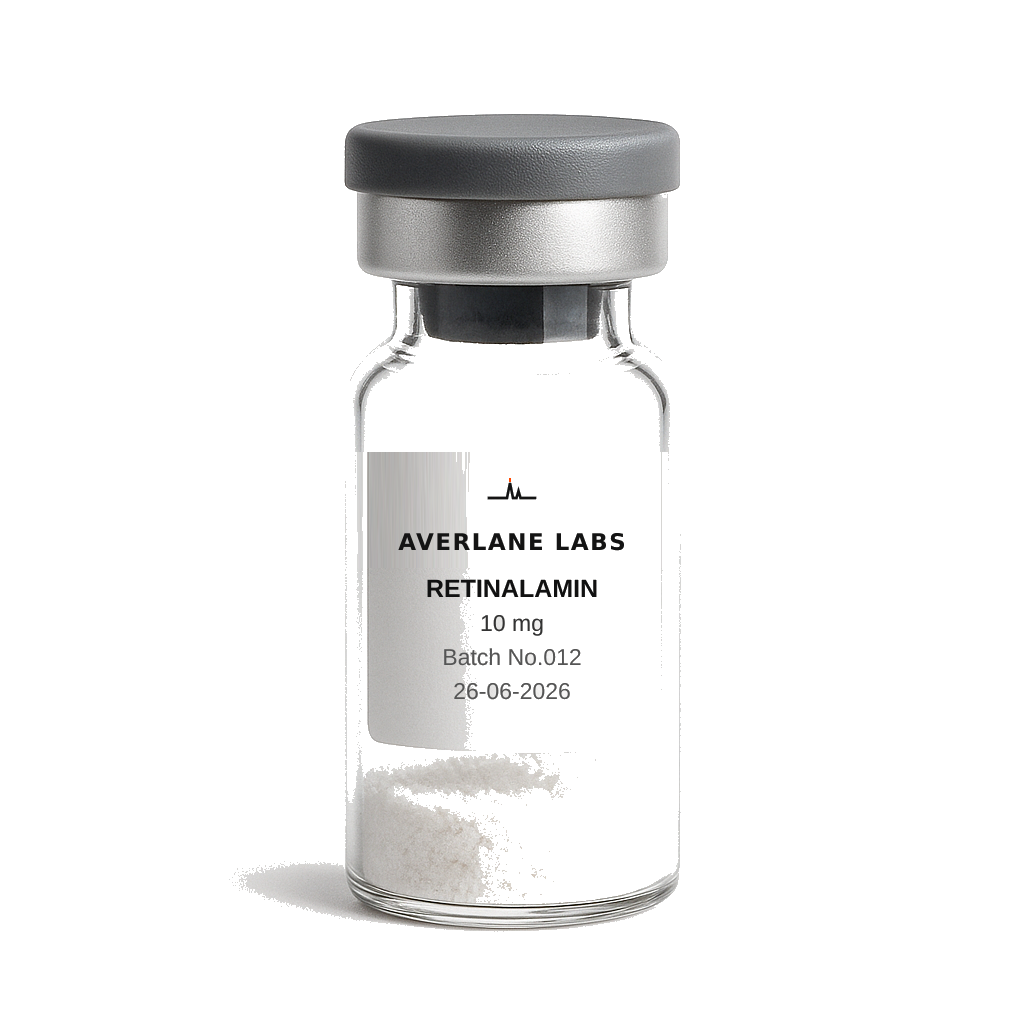
Retinalamin 10mg
Certificate of Analysis available on request for the current lot.
Complete the setup
Reconstitution and bench supplies researchers pair with Retinalamin 10mg
NOT FOR HUMAN CONSUMPTION
Retinalamin is best viewed as an investigational / regionally marketed retina-directed peptide bioregulator, not a globally established ophthalmic therapy. It is described by its manufacturer as a complex of water-soluble polypeptide fractions ≤10 kDa intended to support retinal metabolism and regeneration, and it is used in some markets for conditions such as glaucoma, diabetic retinopathy, retinal dystrophies, and retinal injury. The main limitation is that the evidence base is not built on large modern international randomized trials, so its reputation is stronger in regional / peptide-bioregulator literature than in mainstream global ophthalmology.
Additional benefits of Retinalamin under investigation
| Benefit | Take-away |
|---|---|
| 1. Retinal dystrophy / retinal degeneration support | This is the core use case. Retinalamin is promoted for retinal degenerative conditions and has preclinical and regional clinical literature suggesting retinoprotective effects, but the evidence base is not definitive by modern international standards. |
| 2. Glaucoma / optic-nerve support | It is used in some settings for open-angle glaucoma and optic-nerve pathology, but this is not the same as globally accepted standard-of-care evidence. |
| 3. Diabetic retinopathy interest | The manufacturer and regional sources list diabetic retinopathy among indications, though high-quality global trial evidence remains limited. |
| 4. Retinal injury / photochemical damage | Animal work suggests functional and morphologic retinoprotective effects after retinal injury models. |
| 5. Tissue-repair / regeneration framing | It is officially framed as a tissue-regeneration stimulator / retinoprotector rather than a classic receptor-targeted drug. |
| 6. Ocular metabolism / vascular-permeability support | Product and review materials describe improved retinal metabolism and normalization of vascular permeability, but these claims rely heavily on manufacturer and regional literature. |
| 7. Generally narrow ophthalmic use | This is an eye-focused peptide preparation, not a broad systemic wellness peptide. |
| 8. Not a proven global standard therapy | Outside the specific markets where it is used, it is not a mainstream approved ophthalmology treatment supported by large international trials. This is an inference from the type and location of the available evidence. |
2. Molecular mechanism of action
2.1 Receptor pharmacodynamics
Retinalamin does not have a clean classic receptor pharmacology like a conventional small-molecule drug. It is described as a complex peptide bioregulator extracted from animal retinal tissue, intended to influence retinal cellular metabolism, photoreceptor function, pigment epithelium interaction, and reparative processes. In practice, its claimed action is much more tissue-regulatory / trophic than receptor-selective.
2.2 Downstream biology
| Pathway / theme | Functional outcome | Context |
|---|---|---|
| Retinal-cell metabolic support | Improved retinal cellular function | Retinal disorders |
| Photoreceptor / pigment-epithelium support | Better functional interaction in dystrophic retina | Retinal degeneration |
| Vascular-permeability / local inflammatory modulation | Claimed reduction in local inflammation and normalization of permeability | Retinopathy / injury contexts |
| Reparative / retinoprotective effects | Recovery of light sensitivity and retinal resilience in models | Injury / ischemic retinopathy |
These mechanisms are biologically plausible for a retina-derived peptide mixture, but they still do not by themselves prove strong clinical efficacy.
3. Pharmacokinetics
Retinalamin is typically presented as a lyophilized injectable preparation rather than an oral drug. The practical value is supposed to come from local or systemic peptide-biologic effects on retinal tissue, not from a distinctive modern delivery platform. Published work has also examined its diffusion in human scleral tissue, reflecting interest in ocular tissue penetration.
4. Pre-clinical and clinical evidence
4.1 Retinal degeneration / dystrophy
This is the clearest niche. Product information and review literature present Retinalamin as a retinoprotector for retinal dystrophies and degenerative pathology, and experimental studies report beneficial effects in animal retinal-injury models.
4.2 Ischemic / injury-related retinopathy
A 2021 pharmacology study evaluated Retinalamin in an ischemia/reperfusion-style retinopathy model and suggested beneficial effects, supporting the idea that it may have retinoprotective action under stress conditions.
4.3 Glaucoma / diabetic retinopathy / optic-nerve uses
These are repeatedly listed in manufacturer and regional-use materials, which helps explain the drug’s clinical reputation. But this should be softened because the evidence appears to rely largely on regional publications and product literature rather than large international randomized trials.
4.4 Evidence quality
This is the weak point. There is real literature around Retinalamin, but much of it is regional, older, experimental, or product-linked, and I did not find the sort of large modern international trial program that would justify calling it a globally established retinal therapy. That is why the fairest overall framing is interesting ophthalmic peptide bioregulator with mixed-strength evidence, not proven mainstream therapy.
5. Emerging clinical interests
| Field | Rationale | Status |
|---|---|---|
| Retinal degeneration / dystrophy | Main historical use case | Supportive but not globally definitive |
| Glaucoma / optic neuropathy | Retinoprotective / neurotrophic rationale | Regionally used, limited broader validation |
| Diabetic retinopathy | Vascular and retinal support rationale | Used in some markets, evidence not globally robust |
| Retinal injury / ischemia | Experimental retinoprotection | Preclinical / translational |
6. Safety and tolerability
I did not find a strong modern international safety database for Retinalamin. Product and commercial summaries generally present it as tolerated in ophthalmic use, but that is not the same as a large contemporary safety program. So the best framing is apparently usable in its marketed settings, but not comprehensively characterized by globally standard evidence.
7. Contraindications and cautions
Use extra caution with:
- treating Retinalamin as a globally proven retinal therapy, because the evidence base appears more regional and mixed than mainstream ophthalmology standards usually require.
- replacing established ophthalmic care for glaucoma, diabetic retinopathy, macular disease, or retinal degeneration, because those conditions usually require evidence-based disease-specific management.
- assuming manufacturer-listed indications equal definitive efficacy, because indication lists are broader than the strongest publicly accessible evidence.
- self-sourcing or gray-market use, because formulation quality, route, and supervision matter for injectable peptide products. This is a practical caution based on the product form and evidence limitations.
8. Comparative practical matrix
| Feature | Retinalamin |
|---|---|
| Main strength | Investigational / regionally marketed retinoprotective peptide complex |
| Best-supported use case | Retinal degeneration / retinal-support contexts |
| Clinical evidence depth | Mixed, largely regional |
| Core limitation | Lack of large modern global trial validation |
| Main mechanism | Tissue-regulatory / reparative retinal peptide effects |
| Main safety concern | Limited globally standardized safety/efficacy characterization |
| Best practical framing | Ophthalmic peptide bioregulator, not a proven mainstream global therapy |
9. Regulatory landscape
Retinalamin appears to be a marketed ophthalmic peptide product in some regions, including Russia, where the manufacturer describes it as a retinoprotector for several eye conditions. But it is not a widely recognized mainstream approved ophthalmic therapy in the global evidence-based sense.
10. Future directions
The most useful future work would be:
- larger randomized controlled trials in clearly defined retinal diseases,
- clearer separation of retinal-dystrophy vs glaucoma vs diabetic-retinopathy effects,
- stronger internationally accessible safety and efficacy data,
- and better clarification of whether this peptide mixture offers clinically meaningful benefit beyond standard ophthalmic care. This is an inference from the current evidence gaps.
Best balanced summary
Retinalamin is best viewed as a retina-directed peptide bioregulator with regional clinical use and plausible retinoprotective biology, especially in retinal degeneration, glaucoma-related support, diabetic retinopathy, and retinal-injury contexts. Its main appeal is tissue-repair / retinal-support logic rather than classic receptor pharmacology. But the evidence base is not strong enough to frame it as a globally established ophthalmic therapy, and its claims should be interpreted more cautiously than product or peptide-market language often suggests.
Selected references
- GEROPHARM product information for Retinalamin, best direct source for what the manufacturer claims it is, its peptide composition, and listed ophthalmic indications.
- Dneprovskaya / Kharintseva review chapter, useful higher-level background describing Retinalamin as a peptide complex isolated from animal retina and discussing retinal pathology context.
- Pobeda et al., 2021, experimental pharmacology study evaluating Retinalamin in a retinopathy model induced by transient intraocular pressure increase/reperfusion.
- Suetov et al., 2021, rabbit photochemical retinal-damage study examining retinoprotective effects.
- Genina et al., 2008, diffusion study in human scleral tissue, useful for the ocular-delivery / tissue-penetration angle.
Researcher reviews
No reviews yet for this lot line. Verified purchasers can leave the first one.
Reviews
There are no reviews yet.