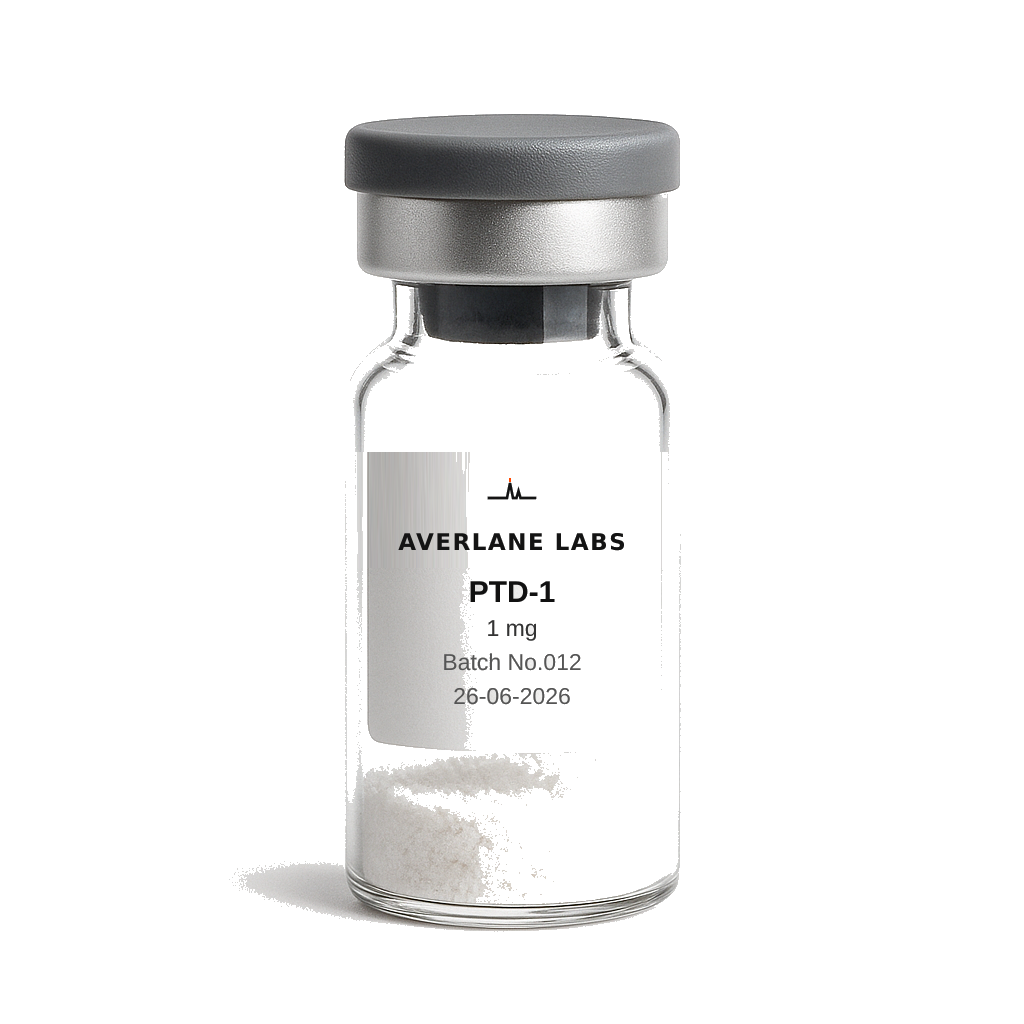
PTD-1 1mg vial
Certificate of Analysis available on request for the current lot.
Complete the setup
Reconstitution and bench supplies researchers pair with PTD-1 1mg vial

NOT FOR HUMAN CONSUMPTION
PTD-1 is best viewed as a protein transduction domain / cell-penetrating peptide, not a standalone therapeutic peptide with a defined disease indication. In the literature, PTD-1 commonly refers to the HIV-1 Tat basic domain used as a delivery motif for intracellular transport of peptides, proteins, or other cargoes. Its main value is therefore drug-delivery and intracellular delivery technology, not direct pharmacologic activity of its own.
Additional roles of PTD-1 under investigation
| Role | Take-away |
|---|---|
| 1. Intracellular cargo delivery | This is the main use case. PTD-1 is used to help transport fused proteins or peptides into cells. |
| 2. Protein transduction research | PTD-1 is part of the broader CPP/PTD field studying how biomolecules cross cell membranes. |
| 3. Therapeutic cargo platform | Its practical relevance is mostly as a carrier for other bioactive molecules, not as the active drug itself. |
| 4. HIV Tat-derived delivery motif | PTD-1 is described in at least one comparative study as corresponding to the HIV-1 Tat basic domain. |
| 5. Cell-penetrating peptide optimization | PTD-1 has been compared with newer PTDs/CPPs to improve uptake efficiency. |
| 6. Experimental rather than clinical identity | PTD-1 is better understood as a laboratory delivery sequence than a marketed medicine. |
| 7. Uptake mechanism controversy/history | Early PTD literature sometimes overestimated direct membrane translocation; later work emphasized endocytosis and experimental artifacts in some systems. |
| 8. Not a proven standalone treatment | PTD-1 itself is not established as a mainstream therapy for hair loss, wound healing, cognition, or other consumer peptide claims. This is an inference from the literature’s focus on delivery rather than direct indication-specific efficacy. |
2. Molecular mechanism of action
2.1 Receptor pharmacodynamics
PTD-1 does not have a classic receptor pharmacology like a typical drug. It is a cell-penetrating / protein-transduction sequence, commonly linked to the Tat basic domain, and is used to facilitate cellular uptake of attached cargo. Its role is therefore more biophysical and delivery-related than receptor-mediated.
2.2 Downstream biology
| Pathway / theme | Functional outcome | Context |
|---|---|---|
| Cell penetration / internalization | Delivers attached biomolecules into cells | Cargo delivery research |
| Endocytosis / uptake processes | Internalization may involve endocytic pathways in many systems | CPP/PTD biology |
| Cargo-dependent downstream effects | Biological effect depends mainly on what PTD-1 is fused to | Therapeutic design platform |
These features explain why PTD-1 is scientifically useful, but they do not make PTD-1 itself a proven therapeutic agent.
3. Pharmacokinetics
PTD-1 is not usually discussed like a conventional drug with its own indication-specific PK profile. Instead, its practical role is as a delivery tag whose behavior depends heavily on the cargo molecule, formulation, and cell type. One comparative study explicitly identified PTD-1 as the HIV-1 Tat basic domain, and broader CPP literature emphasizes that uptake efficiency is highly context-dependent.
4. Preclinical and clinical evidence
4.1 Delivery platform evidence
This is the best-supported niche. PTD-1 belongs to the broader class of protein transduction domains / cell-penetrating peptides used to shuttle proteins and peptides into cells, and that application is well represented in the experimental literature.
4.2 Standalone therapeutic evidence
This is the weak point. I did not find strong evidence that PTD-1 itself is a recognized standalone therapeutic peptide with a defined approved clinical use. The literature is centered on delivery technology, not direct disease treatment.
4.3 Mechanistic limitations
A major theme in the PTD/CPP field is that uptake mechanism and true intracellular delivery efficiency are complex. Some early reports of direct membrane penetration were later challenged, with later work pointing to fixation artifacts and endocytic uptake in many settings.
5. Emerging clinical interests
| Field | Rationale | Status |
|---|---|---|
| Intracellular biologic delivery | PTD-1 can help carry proteins/peptides into cells | Strong research use |
| Drug-delivery engineering | Tat-derived PTDs are widely studied as delivery tools | Active platform research |
| Standalone medicine | No clear established indication found | Unproven |
6. Safety and tolerability
I did not find a mature, indication-specific human safety database for PTD-1 itself as a standalone therapeutic. Safety in practice would depend heavily on the cargo, dose, formulation, and route of administration. So the fairest framing is: useful research delivery motif, but not clinically characterized as its own mainstream drug.
7. Contraindications and cautions
Use extra caution with:
- treating PTD-1 as a standalone therapy, because the literature mainly supports a delivery-function identity, not an approved treatment identity.
- assuming all PTD uptake claims are straightforward, because the mechanism literature is more complicated than early reports suggested.
- extrapolating from one PTD-cargo system to another, because performance is highly cargo- and cell-type-dependent.
8. Comparative practical matrix
| Feature | PTD-1 |
|---|---|
| Main strength | Cell-penetrating / protein-transduction delivery motif |
| Best-supported use case | Intracellular cargo delivery |
| Clinical evidence depth | Limited as a standalone agent |
| Core limitation | Mostly a platform sequence, not an established medicine |
| Main mechanism | Facilitates cellular uptake of attached cargo |
| Main safety concern | Context depends on cargo/formulation; standalone clinical characterization is sparse |
| Best practical framing | Research delivery peptide, not a proven therapeutic |
9. Regulatory landscape
PTD-1 is best understood as a research / delivery sequence, not a mainstream approved therapeutic ingredient. The broader therapeutic-peptide literature discusses cell-penetrating peptides as enabling technologies, but that is different from having a direct approved disease indication.
10. Future directions
The most useful future work is likely to focus on:
- improving delivery efficiency and endosomal escape,
- reducing nonspecific uptake and toxicity,
- optimizing cargo-specific PTD fusion systems,
- and clarifying when PTD-based delivery really outperforms other intracellular delivery approaches.
Best balanced summary
PTD-1 is best viewed as a Tat-related protein transduction / cell-penetrating peptide used to help deliver biomolecular cargo into cells. Its main importance is as a delivery platform rather than as a standalone therapeutic peptide. The science around PTD-1 is real and useful, but it supports a research-tool and drug-delivery role much more than a direct clinical-treatment role.
Selected references
- Vitte AL, et al. comparative PTD study identifying PTD-1 as the HIV-1 Tat basic domain.
- Mai JC, et al. classic work on the Tat protein transduction domain and cell-type-dependent delivery.
- Lundberg M, Johansson M. important review/article on PTD uptake mechanisms and the caution about fixation artifacts.
- Intracellular Traffic and Fate of Protein Transduction Domains for broader PTD/CPP delivery biology.
- Protein transduction domain of translationally controlled tumor protein review for broader PTD/CPP platform context.
Researcher reviews
No reviews yet for this lot line. Verified purchasers can leave the first one.
Reviews
There are no reviews yet.