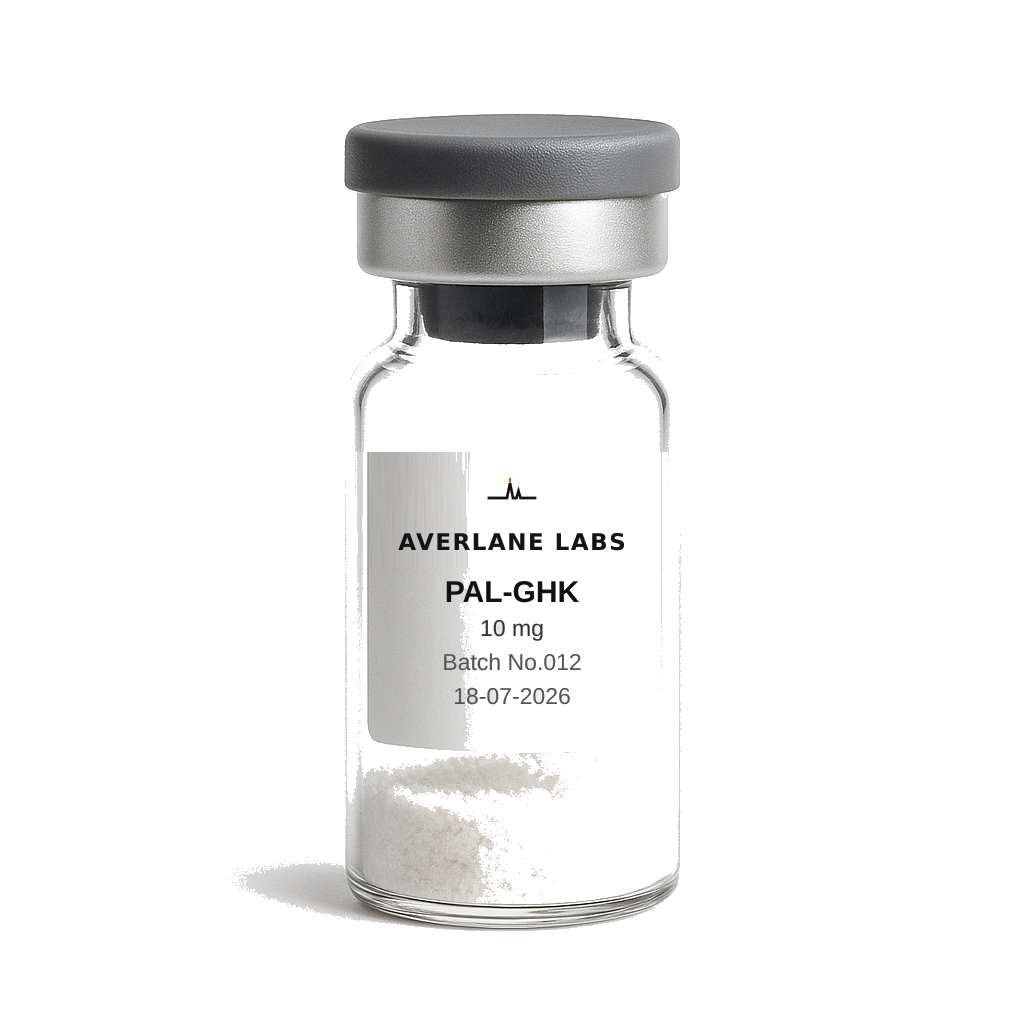
PAL-GHK 10mg vial
Certificate of Analysis available on request for the current lot.
Complete the setup
Reconstitution and bench supplies researchers pair with PAL-GHK 10mg vial
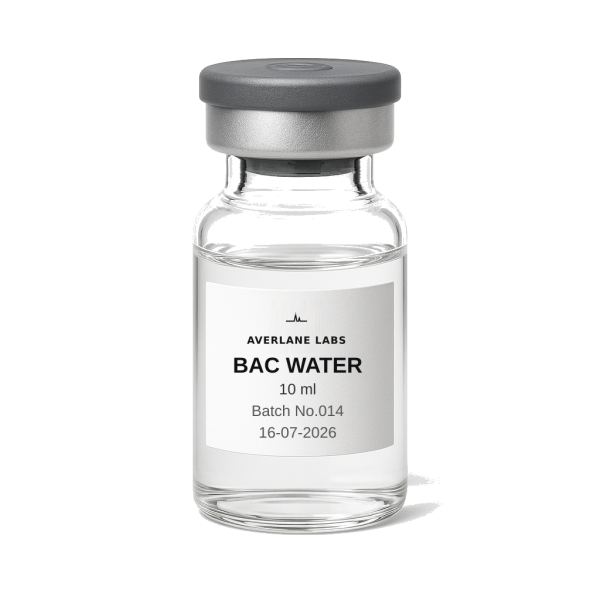
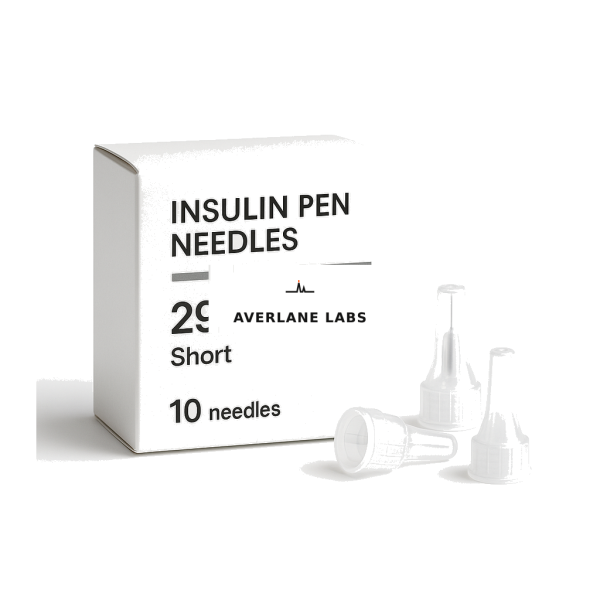
NOT FOR HUMAN CONSUMPTION
PAL-GHK (palmitoyl tripeptide-1, historically also called palmitoyl oligopeptide) is best viewed as a topical cosmetic “signal peptide” for skin aging / skin-quality support, not a proven medical regenerative therapy. Compared with plain GHK, the palmitoyl group is meant to improve skin affinity and penetration, which is why PAL-GHK is used mainly in anti-aging serums and creams. The strongest practical claim is modest topical anti-wrinkle / skin-repair support, while broader claims about wound healing, deep regeneration, or systemic anti-aging are much less established.
Additional benefits of PAL-GHK under investigation
| Benefit | Take-away |
|---|---|
| 1. Wrinkle / photoaging support | This is the clearest use case. Small human cosmetic studies and reviews suggest improvements in wrinkle-related measures and skin texture, but the evidence base is modest rather than definitive. |
| 2. Collagen / ECM signaling | PAL-GHK is generally framed as a “messenger” or signal peptide that may encourage extracellular-matrix repair processes relevant to skin firmness and wrinkle appearance. |
| 3. Skin-thickness / skin-quality support | A small human study cited in the peptide review literature found a small but statistically significant increase in skin thickness versus vehicle. |
| 4. Barrier / texture improvement | Cosmetic use often aims at smoother texture and visible repair of photodamage; this is plausible, but the evidence is mostly cosmetic-scale rather than disease-treatment scale. |
| 5. Better topical suitability than plain GHK | The palmitoyl modification is used to improve lipophilicity and make topical delivery more practical than plain GHK. |
| 6. Combination anti-aging use | PAL-GHK is often used in multi-peptide products, especially alongside palmitoyl tetrapeptide-7, but that makes it harder to isolate its standalone effect in real-world products. |
| 7. Generally favorable cosmetic safety | Cosmetic Ingredient Review concluded tripeptide-1 derivatives including palmitoyl tripeptide-1 are safe in cosmetics under current practices of use and concentration. |
| 8. Not a proven broad regenerative peptide | Marketing often overextends the data; the best-supported framing is still topical cosmetic anti-aging support. |
2. Molecular mechanism of action
2.1 Receptor pharmacodynamics
PAL-GHK does not have a classic single-drug receptor pharmacology. It is generally described as a signal peptidederived from the GHK motif, with the palmitoyl fatty-acid tail added to improve topical delivery characteristics. In practice, its value is not from acting like a conventional receptor agonist, but from influencing skin-repair signaling related to extracellular matrix proteins and visible photoaging.
2.2 Downstream biology
| Pathway / theme | Functional outcome | Context |
|---|---|---|
| Collagen / matrix signaling | May support firmness and wrinkle reduction | Cosmetic anti-aging |
| Increased lipophilicity from palmitoylation | Better skin affinity / topical usability | Formulation / delivery |
| Photoaging repair support | May improve roughness and visible aging signs | Topical skin care |
| Multi-peptide synergy in formulas | Often paired with other peptides, making attribution harder | Commercial products |
These mechanisms are plausible and cosmetically relevant, but they still do not amount to strong proof of major clinical therapeutic benefit.
3. Pharmacokinetics
Route: topical. The main reason PAL-GHK exists is practical: plain GHK is relatively hydrophilic, so adding a palmitoyl group is intended to make the peptide more skin-compatible and more permeable for topical use. That makes PAL-GHK more of a formulation-optimized cosmetic peptide than a fundamentally different biology story. There is still no reason to think of it as a systemically active anti-aging compound based on current evidence.
4. Pre-clinical and clinical evidence
4.1 Wrinkles / photoaging
This is the best-supported niche. A 2017 review of topical anti-aging peptides reported that a cream containing palmitoyl tripeptide-1 produced statistically significant reductions in wrinkle length, depth, and roughness in a small study of women over four weeks, and another small study found a small increase in skin thickness versus vehicle. That is enough to support its reputation as a reasonable anti-aging ingredient, but it is still a small-study cosmetic evidence base, not a large therapeutic literature.
4.2 Standalone anti-wrinkle evidence quality
A 2024 review focusing on topically applied GHK noted that no cellular or clinical anti-wrinkle studies were found specifically for PAL-GHK itself in the literature they reviewed, even though modified GHK peptides are widely discussed. That is an important caution: PAL-GHK is popular in products, but the direct modern standalone literature is thinner than the marketing suggests.
4.3 Wound healing / regeneration
PAL-GHK inherits some conceptual interest from the broader GHK family, but the clearer evidence for wound healing and regenerative biology is associated more with GHK / GHK-Cu literature than with robust PAL-GHK-specific human clinical data. So for PAL-GHK specifically, wound-healing language should be softened.
4.4 Real-world cosmetic use
In practice, PAL-GHK is often used in blend products rather than tested alone, especially in peptide complexes. That means the ingredient may still be useful, but it becomes hard to know how much of a product’s benefit comes from PAL-GHK itself versus the rest of the formula.
5. Emerging clinical interests
| Field | Rationale | Status |
|---|---|---|
| Topical wrinkle reduction | Main commercial use | Supportive but modest |
| Skin repair / photoaging support | Signal-peptide rationale | Plausible, limited direct clinical depth |
| Barrier / texture improvement | Common cosmetic objective | Reasonable cosmetic claim, not a medical indication |
| Broad regenerative / systemic anti-aging use | Marketing extension | Overstated based on current evidence |
6. Safety and tolerability
For topical cosmetic use, the safety picture is fairly reassuring. The Cosmetic Ingredient Review concluded that tripeptide-1 and related derivatives, including palmitoyl tripeptide-1, are safe in cosmetics under present practices of use and concentration. That supports routine topical cosmetic use more than any aggressive medical framing.
Still, “generally safe in cosmetics” should not be stretched into “risk-free under all conditions.” Irritation can still happen depending on formulation, concentration, and the rest of the product. Also, the reassuring safety language is fundamentally about cosmetic topical exposure, not exotic delivery routes.
7. Contraindications and cautions
Use extra caution with:
- Very sensitive or compromised skin, because even well-tolerated cosmetic peptides can irritate depending on the formula they are in.
- Products making drug-like claims, because the evidence supports a cosmetic anti-aging interpretation more than a true therapeutic one.
- Anyone replacing established dermatologic therapy with PAL-GHK alone for significant skin disease or scarring, because the evidence does not justify that substitution.
- Combination peptide products, because positive results may reflect the whole formula rather than PAL-GHK alone.
8. Comparative practical matrix
| Feature | PAL-GHK |
|---|---|
| Main strength | Topical anti-aging / wrinkle-support peptide |
| Best-supported use case | Cosmetic photoaging and wrinkle appearance |
| Clinical evidence depth | Small, supportive, but not robust |
| Core limitation | Direct standalone PAL-GHK evidence is thinner than marketing implies |
| Main formulation advantage | Palmitoylation improves topical suitability |
| Short-term topical tolerability | Generally favorable in cosmetic use |
| Main safety concern | Irritation / overclaiming rather than major known toxicity |
| Best practical framing | Cosmetic signal peptide, not a proven regenerative therapy |
9. Regulatory landscape
PAL-GHK is best understood as a cosmetic ingredient, not an approved anti-aging drug. That matters because product marketing often implies a larger evidence base than actually exists. The strongest defensible claim is modest support for wrinkle/photoaging improvement in topical cosmetic use.
10. Future directions
The most useful future work would be:
- better PAL-GHK-alone randomized topical trials,
- clearer head-to-head comparisons versus GHK and GHK-Cu,
- dose- and vehicle-specific studies,
- and more direct human evidence for whether the palmitoyl modification translates into meaningfully better outcomes rather than just better formulation logic
Selected references
- Mortazavi SM, et al. Topically applied GHK as an anti-wrinkle peptide. 2024. Review discussing GHK, GHK-Cu, and PAL-GHK, including permeability and the relative lack of direct clinical studies for modified forms.
- Schagen SK. Topical Peptide Treatments with Effective Anti-Aging Results. Cosmetics. 2017;4(2):16. Review summarizing small clinical studies of anti-aging peptides, including palmitoyl tripeptide-1 wrinkle and skin-thickness findings.
- Johnson W Jr, et al. Safety Assessment of Tripeptide-1, Hexapeptide-12, Their Metal Salts and Fatty Acyl Derivatives, and Palmitoyl Tetrapeptide-7 as Used in Cosmetics. Cosmetic Ingredient Review. Final safety assessment supporting cosmetic safety under current use conditions.
- Crous C, et al. Overview of popular cosmeceuticals in dermatology. 2024. General review placing cosmetic peptides, including matrix / signal peptides, in the broader dermatology-cosmeceutical context.
Researcher reviews
No reviews yet for this lot line. Verified purchasers can leave the first one.
Reviews
There are no reviews yet.