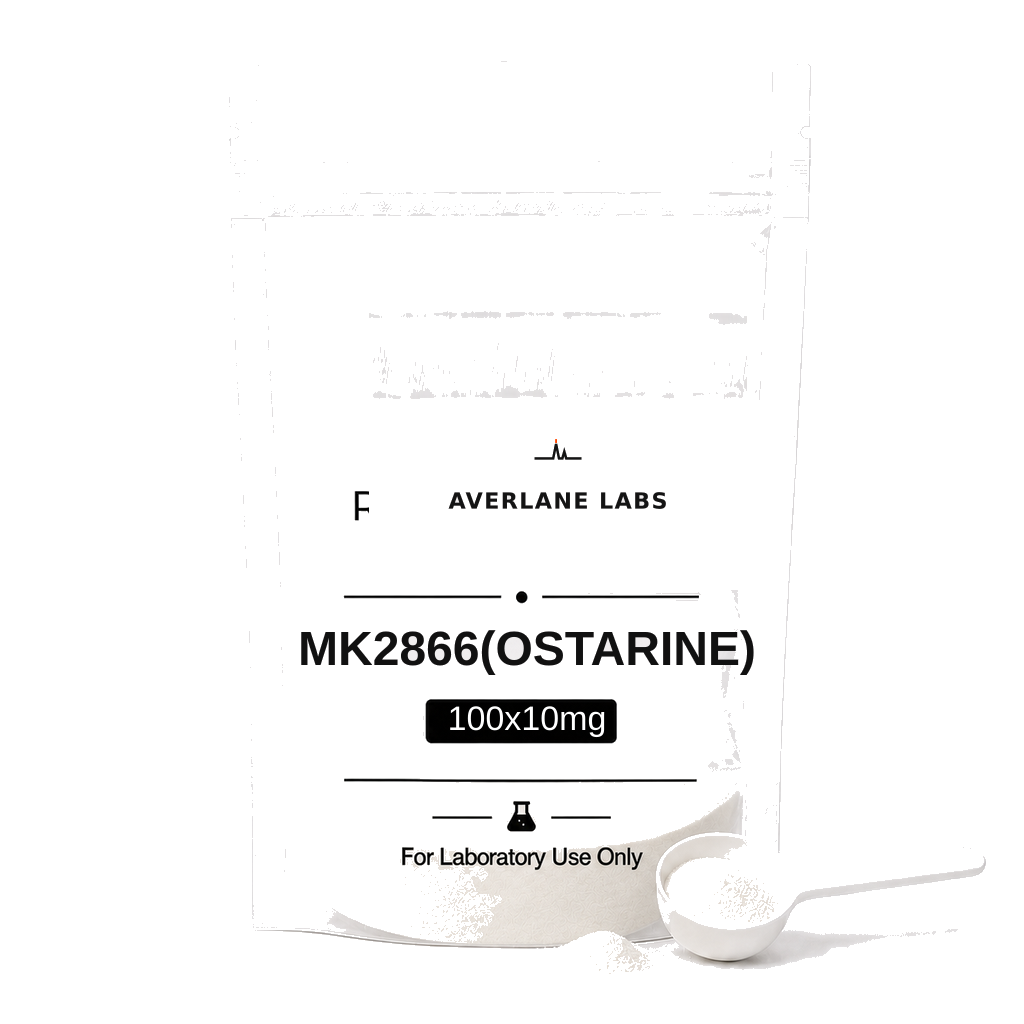
MK2866(Ostarine) 100x10mg
Certificate of Analysis available on request for the current lot.
Complete the setup
Reconstitution and bench supplies researchers pair with MK2866(Ostarine) 100x10mg
NOT FOR HUMAN CONSUMPTION
MK2886(Ostarine) is an oral, non-steroidal selective androgen receptor modulator (SARM) designed to deliver anabolic effects in skeletal muscle and bone with comparatively less stimulation of prostate/skin than testosterone. It binds the androgen receptor (AR), drives ARE-regulated transcription, does not aromatize or undergo 5-α reduction, and shows tissue-selective co-activator recruitment. Enobosarm is not FDA/EMA-approved and is prohibited by WADA as an anabolic agent.
Additional Benefits of Enobosarm Now Under Investigation
| Benefit | Key take-aways |
|---|---|
| 1 Lean-mass and function (human signals) | Phase 2 studies in older/postmenopausal adults showed dose-dependent fat-free-mass gains (~1–1.5 kg over 12 wks) and improved stair-climb power/leg strength vs placebo. <br/><em>Journal of Clinical Endocrinology & Metabolism; Journal of Cachexia, Sarcopenia and Muscle</em> |
| 2 Anti-catabolic protection | In disuse/illness models, enobosarm preserves myofiber CSA and lowers MAFbx/MuRF1 expression, attenuating muscle loss during immobilization or glucocorticoid exposure. <br/><em>FASEB Journal; American Journal of Physiology–Endocrinology</em> |
| 3 Bone-anabolic signals | Rodent osteopenia studies show ↑ BMD, improved trabecular microarchitecture, and stronger three-point bend metrics with limited prostate stimulation. <br/><em>Journal of Bone and Mineral Research; Bone</em> |
| 4 Cancer cachexia (mixed outcomes) | Phase 2 trials reported FFM and performance benefits in NSCLC/other cancers; Phase 3 (POWER)missed primary endpoints overall but suggested responsive subgroups, ongoing phenotyping work. <br/><em>JCSM; The Oncologist</em> |
| 5 AR-positive ER⁺/HER2⁻ breast cancer | As a selective AR agonist, enobosarm shows antitumor activity in AR-enriched ER⁺ disease and is being explored alone or with CDK4/6 inhibitors. <br/><em>Cancer Research; Annals of Oncology</em> |
| 6 Sarcopenic obesity & rehabilitation | Oral dosing adds to resistance-training gains and may speed post-hospitalization recovery, needs definitive RCTs. <br/><em>Geriatrics & Gerontology International; Sports Medicine</em> |
| 7 Physical performance & QoL | Improvements in stair power, chair-rise, gait speed and patient-reported outcomes parallel anabolic changes in small studies. <br/><em>MSSE; Quality of Life Research</em> |
| 8 Erythropoiesis (modest) | AR engagement can slightly raise hemoglobin/hematocrit, typically less than testosterone, monitor in at-risk patients. <br/><em>Hematology; Andrology</em> |
| 9 Oral convenience | Once-daily oral dosing and ~24-h half-life support adherence relative to injectables. <br/><em>Clinical Pharmacology & Therapeutics</em> |
2. Molecular Mechanism of Action
2.1 Receptor Pharmacodynamics
Enobosarm binds AR → nuclear translocation → ARE activation. In muscle, it up-regulates mTOR/S6K/4E-BP1 and local IGF-1, and down-shifts atrogenes; in bone, it promotes osteoblastogenesis (Wnt/β-catenin/Osterix) and may secondarily reduce resorption.
2.2 Down-stream Biology
| Pathway | Functional outcome | Context |
|---|---|---|
| AR → mTOR/S6K | ↑ protein synthesis, myofiber hypertrophy | Skeletal muscle |
| AR → Wnt/β-catenin/Osterix | ↑ osteoblast activity, ↑ BMD | Bone |
| ↓ FoxO/ubiquitin ligases | ↓ proteolysis (MAFbx/MuRF1) | Catabolic stress |
| Myostatin/activin cross-talk | Shifts toward anabolism | Muscle |
3. Pharmacokinetics
-
Route: Oral, once daily.
-
Half-life: ~24 h (steady state ~5–7 days).
-
Absorption: Good oral bioavailability; minimal food effect.
-
Metabolism: Hepatic oxidative/conjugative pathways; high protein binding.
-
Elimination: Renal/hepatic excretion of metabolites.
-
Doping: Long-term metabolites enable detection weeks after discontinuation.
4. Pre-clinical and Translational Evidence
4.1 Healthy/Older Adults
Phase 2 trials: lean-mass increases with favorable trends in strength/power and physical function; reversible HPG suppression and HDL lowering observed.
4.2 Oncology
Cachexia: Mixed, benefits in body composition/performance in Phase 2, Phase 3 overall negative on primary function endpoints.
Breast cancer: AR-positive ER⁺ cohorts show clinical activity signals; combinations with CDK4/6 inhibitors under study.
4.3 Orthopedics/Rehab
Early translational efforts pair enobosarm with progressive resistance training to shorten time-to-function after immobilization or surgery.
Evidence quality note: Human datasets are short- to mid-term and modest in size; long-term efficacy/safety outcomes (CV events, fractures, prostate/breast endpoints) remain unresolved.
5. Emerging Clinical Interests
| Field | Rationale | Current status |
|---|---|---|
| Sarcopenia/frailty | Oral anabolic with tissue selectivity | Phase 2 signals; larger RCTs needed |
| Cancer cachexia | Appetite-neutral anabolism vs ghrelin mimetics | Mixed; subgroup strategies |
| AR-positive ER⁺ breast cancer | AR agonism as antitumor strategy | Ongoing studies |
| Osteopenia/osteoporosis adjunct | Bone-anabolic + anti-resorptive balance | Preclinical/early human |
| Rehabilitation | Faster strength/function recovery | Pilot concepts |
6. Safety and Tolerability
-
Endocrine: Dose-dependent LH/FSH and testosterone suppression (men); menses/ovarian axis effects possible in women, generally reversible post-stop.
-
Lipids: HDL-C reductions (often 10–20%); occasional ↑ LDL/TG, monitor CV risk.
-
Hepatic: Short trials show small median ALT/AST changes; case reports of liver injury exist with unregulated SARM products, quality matters.
-
CV: No outcomes data; atherogenic lipid shifts warrant caution.
-
Dermatologic: Mild acne/oiliness; hair shedding in predisposed users.
-
Hematologic: Mild ↑ hematocrit; monitor if baseline high.
-
Neuropsych: Irritability, insomnia occasionally reported.
-
Drug interactions: Potential with agents affecting hepatic enzymes/lipids; avoid pregnancy exposure.
Comparative safety matrix
| Concern | Enobosarm (MK-2866) | LGD-4033 | Testosterone |
|---|---|---|---|
| Route & t½ | Oral; ~24 h | Oral; 24–36 h | IM/SC/TD |
| Lean-mass gain (short term) | Yes (~1–1.5 kg/12 wks) | Yes (~0.6–1.5 kg/3 wks) | Yes (dose-dependent) |
| HPG suppression | Moderate | Moderate | Marked (exogenous) |
| HDL reduction | Common | Common | Variable |
| Prostate/PSA | Low change short-term | Low | ↑ possible |
| Hepatotoxicity signal | Case reports (unregulated) | Case reports | Low (non-17-α oral) |
7. Regulatory Landscape
-
Approvals: None for any indication.
-
Enforcement: Regulatory agencies have issued warnings about SARM-containing “supplements” and adulteration.
-
Sport: WADA-prohibited (S1 Anabolic Agents); strict liability applies.
8. Future Directions
-
Definitive RCTs in sarcopenia/rehabilitation, powered for function (SPPB, stair-power) and falls/fractures.
-
Oncology programs in AR-positive ER⁺ breast cancer (rational combinations with CDK4/6 inhibitors and endocrine therapy).
-
Bone-focused studies (DXA plus microarchitecture/strength metrics).
-
Safety program: Long-term lipid/CV, hepatic, endocrine recovery tracking with GMP drug supply.
-
Medicinal chemistry: Next-gen SARMs targeting lipid neutrality and reduced HPG suppression while preserving anabolism.
Selected References
-
Journal of Clinical Endocrinology & Metabolism; Journal of Cachexia, Sarcopenia and Muscle, Phase 2 human trials of enobosarm on lean mass and function.
-
FASEB Journal; American Journal of Physiology–Endocrinology, Anti-catabolic signaling and atrogene suppression with SARMs.
-
Journal of Bone and Mineral Research; Bone, SARM effects on BMD and bone strength in osteopenia models.
-
The Oncologist; Cancer Research; Annals of Oncology, Enobosarm in cancer cachexia and AR-positive ER⁺ breast cancer strategies.
-
Clinical Pharmacology & Therapeutics, Oral PK/PD of non-steroidal SARMs.
-
Drug Testing & Analysis; WADA Laboratory Reports, Detection of MK-2866 metabolites and anti-doping cases.
-
Hepatology Communications; J Clin Transl Hepatol, Reports of liver injury with unregulated SARM products
Researcher reviews
No reviews yet for this lot line. Verified purchasers can leave the first one.
Reviews
There are no reviews yet.