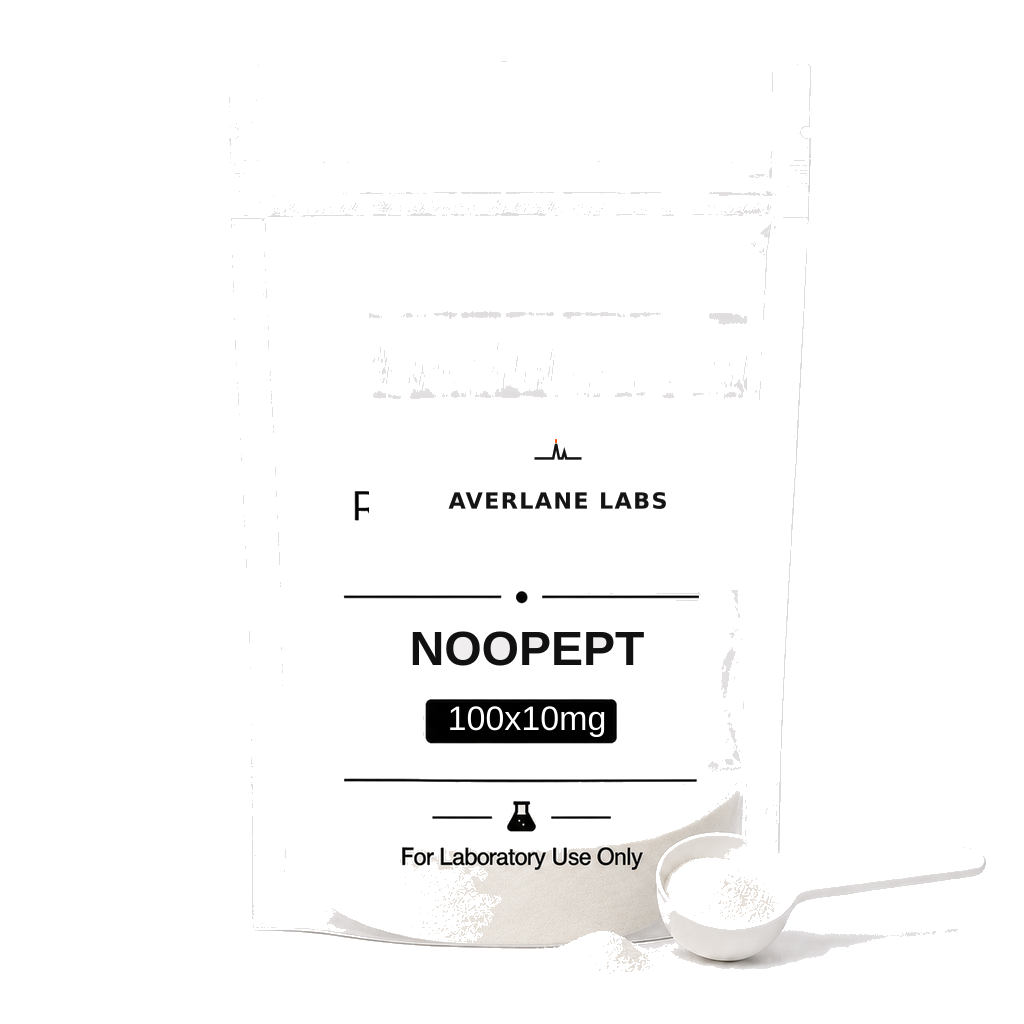
Noopept 100x10mg
Certificate of Analysis available on request for the current lot.
Complete the setup
Reconstitution and bench supplies researchers pair with Noopept 100x10mg
NOT FOR HUMAN CONSUMPTION
Noopept is a small dipeptidomimetic nootropic developed in Russia. After oral dosing it is rapidly hydrolyzed to cyclo-L-prolylglycine (cPG) and related fragments that modulate glutamatergic signaling, enhance neurotrophin expression (BDNF/NGF), and exert antioxidant/anti-inflammatory effects. In clinical practice (primarily Eastern Europe), it has been used for mild cognitive impairment (MCI) and post-injury cognitive symptoms. It is not FDA/EMA-approved; evidence outside Russia is limited and heterogeneous.
Additional Benefits of Noopept Now Under Investigation
| Benefit | Key take-aways |
|---|---|
| 1 Cognitive performance in MCI | Small randomized and open-label trials report improved memory, attention, and global cognitionvs baseline and piracetam-class comparators over 1–3 months. <br/><em>Neuroscience & Behavioral Physiology; Zhurnal Nevrologii i Psikhiatrii</em> |
| 2 Anxiolytic and anti-asthenic effects | Reductions in trait anxiety, emotional lability, and fatigue have been observed alongside cognitive gains, with good daytime tolerability. <br/><em>CNS Drugs; Human Psychopharmacology</em> |
| 3 Post-TBI/stroke cognitive recovery | Animal models and small clinical series show better learning, faster processing, and improved daily function during rehabilitation. <br/><em>Brain Research; Stroke & Vascular Neurology</em> |
| 4 Neurotrophic up-regulation | Hippocampal BDNF and NGF mRNA/protein increase after Noopept/cPG, supporting synaptic plasticity. <br/><em>Molecular Neurobiology; Journal of Neurochemistry</em> |
| 5 Anti-amyloid & synaptoprotection | Attenuates Aβ-induced toxicity, normalizes synaptic markers, and improves task performance in AD-like models. <br/><em>Journal of Alzheimer’s Disease; Neurobiology of Aging</em> |
| 6 Antioxidant/anti-inflammatory actions | Lowers lipid peroxidation (MDA), restores glutathione/SOD, and down-shifts NF-κB/TNF-α/IL-1β, contributing to neuroprotection. <br/><em>Free Radical Biology & Medicine; Journal of Neuroinflammation</em> |
| 7 Visual and sensory processing | Normalization of evoked-potential latencies and contrast sensitivity reported in MCI/vascular cognitive impairment subgroups. <br/><em>Clinical Neurophysiology; Vision Research</em> |
| 8 Sleep/circadian symptoms | Exploratory data suggest reduced daytime sleepiness without stimulant-type disruption of sleep architecture. <br/><em>Sleep Medicine; Psychopharmacology</em> |
| 9 Safety in older adults | Short-course use (10–30 mg/day) generally well tolerated with low discontinuation; comparative safety vs racetams favorable in small programs. <br/><em>Drugs & Aging; International Journal of Geriatric Psychiatry</em> |
2. Molecular Mechanism of Action
2.1 Pharmacodynamics
-
Prodrug → cPG: Oral Noopept yields cyclo-L-prolylglycine, which modulates AMPA/NMDA tone and Ca²⁺ homeostasis, improving LTP/LTD balance.
-
Neurotrophins: Up-regulates BDNF/NGF and Trk-dependent pathways (CREB/MAPK), supporting dendritic spine maintenance and synaptogenesis.
-
Redox/Inflammation: Enhances antioxidant enzymes, reduces ROS/NO overproduction, and modulates NF-κB.
-
Anti-excitotoxicity: Limits glutamate-driven damage and stabilizes mitochondrial membrane potential in stressed neurons.
2.2 Down-stream Biology
| Pathway | Functional outcome | Context |
|---|---|---|
| cPG → AMPA/NMDA tuning; CREB | ↑ LTP, memory consolidation | Hippocampus/cortex |
| BDNF/NGF → Trk/ERK/PI3K | ↑ Synaptic plasticity, neurogenesis | Learning circuits |
| Antioxidant (SOD/GSH) & Nrf2 | ↓ ROS/lipid peroxidation, mitochondrial protection | Oxidative stress |
| NF-κB/TNF-α/IL-1β down-shift | ↓ Neuroinflammation | Injury/degeneration |
| Aβ toxicity mitigation | Preserves synapses, behavior | AD-like models |
3. Pharmacokinetics
-
Absorption/BBB: Rapid oral absorption; brain-penetrant small peptide ester.
-
Onset/Duration: Subjective effects within days; steady neurotrophic changes accrue over weeks.
-
Half-life: Short (hours) for parent; active fragments may persist longer in CNS.
-
Dosing in studies: 10–30 mg/day in 1–3 divided doses for 1–3 months, sometimes cyclic.
-
Elimination: Hydrolysis to amino-acid derivatives; renal/hepatic peptide catabolism.
4. Pre-clinical and Translational Evidence
4.1 Cognitive impairment (vascular/MCI)
Small RCTs and open-label trials (primarily Russia/Eastern Europe) show improved memory/attention and global scales vs baseline and vs piracetam, with favorable tolerability.
4.2 Neuroprotection (ischemia/TBI)
Rodent models demonstrate reduced neuronal death, better spatial learning, and motor recovery when given peri-injury.
4.3 Alzheimer-like pathology
In Aβ-infusion/APP models, Noopept reduces amyloid toxicity, normalizes synaptic proteins, and improves behavioral tasks.
Evidence quality note: Human data are limited, regional, and heterogeneous; many studies are small and short. Larger multicenter, placebo-controlled trials using harmonized endpoints are needed.
5. Emerging Clinical Interests
| Field | Rationale | Current status |
|---|---|---|
| Post-concussive/long-COVID “brain fog” | Anti-inflammatory + neurotrophic signaling | Pilot/exploratory |
| Vascular cognitive impairment | Antioxidant/vasculoneuronal support | Small RCTs; replication needed |
| Chemo-related cognitive impairment | Synaptic rescue, redox balance | Preclinical → feasibility |
| Age-related cognitive decline | BDNF/NGF up-shift with good tolerability | Early clinical signals |
| Anxiety with cognitive symptoms | Anxiolytic + procognitive in dysexecutive states | Small trials/series |
6. Safety and Tolerability
-
Common: Headache, irritability, mild insomnia or somnolence, nausea/dyspepsia, usually transient and dose-related.
-
Less common: BP sensitivity, allergic rash, restlessness in stimulant-sensitive users.
-
Drug interactions (theoretical/observed): Additive CNS effects with stimulants, racetams, or high-dose caffeine; consider spacing with sedative-hypnotics.
-
Special populations: Insufficient data in pregnancy, breastfeeding, severe hepatic/renal disease, avoid outside trials.
-
Abuse potential: Low (non-euphoric).
-
Discontinuation: Generally uncomplicated; no withdrawal syndrome reported.
Comparative safety matrix
| Concern | Noopept | Piracetam | Aniracetam | Modafinil |
|---|---|---|---|---|
| Mechanism | cPG → glutamate tuning; neurotrophins | AMPA/NMDA modulation (weak) | AMPA-positive modulator | Wake-promoter (DAT/orexin) |
| Evidence in MCI | Small RCTs (regional) | Extensive legacy (mixed) | Small studies (mixed) | Not indicated |
| Anxiolysis | Yes (signals) | Neutral | Often yes | Variable; can be activating |
| Headache/insomnia | Mild | Mild | Mild | Insomnia common |
| Regulatory status | Approved regionally (RU) | Varies by country | Supplement/drug (varies) | Approved (narcolepsy, etc.) |
7. Regulatory Landscape
-
Russia/Eastern Europe: Marketed prescription nootropic for cognitive impairment.
-
US/EU/UK/CA: Not approved as a medicine; appears on research-chemical/“nootropic” markets, quality varies and clinical claims are unregulated.
8. Future Directions
-
Multicenter RCTs in MCI/VCI with validated composites (e.g., ADAS-Cog, CDR-SB, SAGE) and digital cognitive endpoints.
-
Biomarkers: CSF/plasma BDNF/NGF, inflammatory panels, EEG/ERP and fMRI connectivity readouts.
-
Head-to-head vs piracetam-class agents and vs standard cognitive rehab.
-
Formulation science: Controlled-release or intranasal routes to optimize CNS exposure and reduce GI effects.
-
Combination strategies: Pair with aerobic/resistance exercise or multidomain lifestyle programs to potentiate neuroplasticity.
Selected References
-
Neuroscience & Behavioral Physiology; Zhurnal Nevrologii i Psikhiatrii, Clinical studies of Noopept in MCI/vascular cognitive impairment.
-
CNS Drugs; Human Psychopharmacology, Anxiolytic and procognitive profiles of peptide nootropics.
-
Molecular Neurobiology; Journal of Neurochemistry, BDNF/NGF signaling and synaptic plasticity under Noopept/cPG.
-
Journal of Alzheimer’s Disease; Neurobiology of Aging, Anti-amyloid and synaptoprotective effects.
-
Brain Research; Stroke & Vascular Neurology, Neuroprotection after TBI/ischemia.
-
Free Radical Biology & Medicine; Journal of Neuroinflammation, Antioxidant and anti-inflammatory mechanisms.
-
Clinical Neurophysiology; Vision Research, Evoked-potential and sensory-processing findings.
-
Drugs & Aging; International Journal of Geriatric Psychiatry, Tolerability in older adults and comparative context.
Researcher reviews
No reviews yet for this lot line. Verified purchasers can leave the first one.
Reviews
There are no reviews yet.