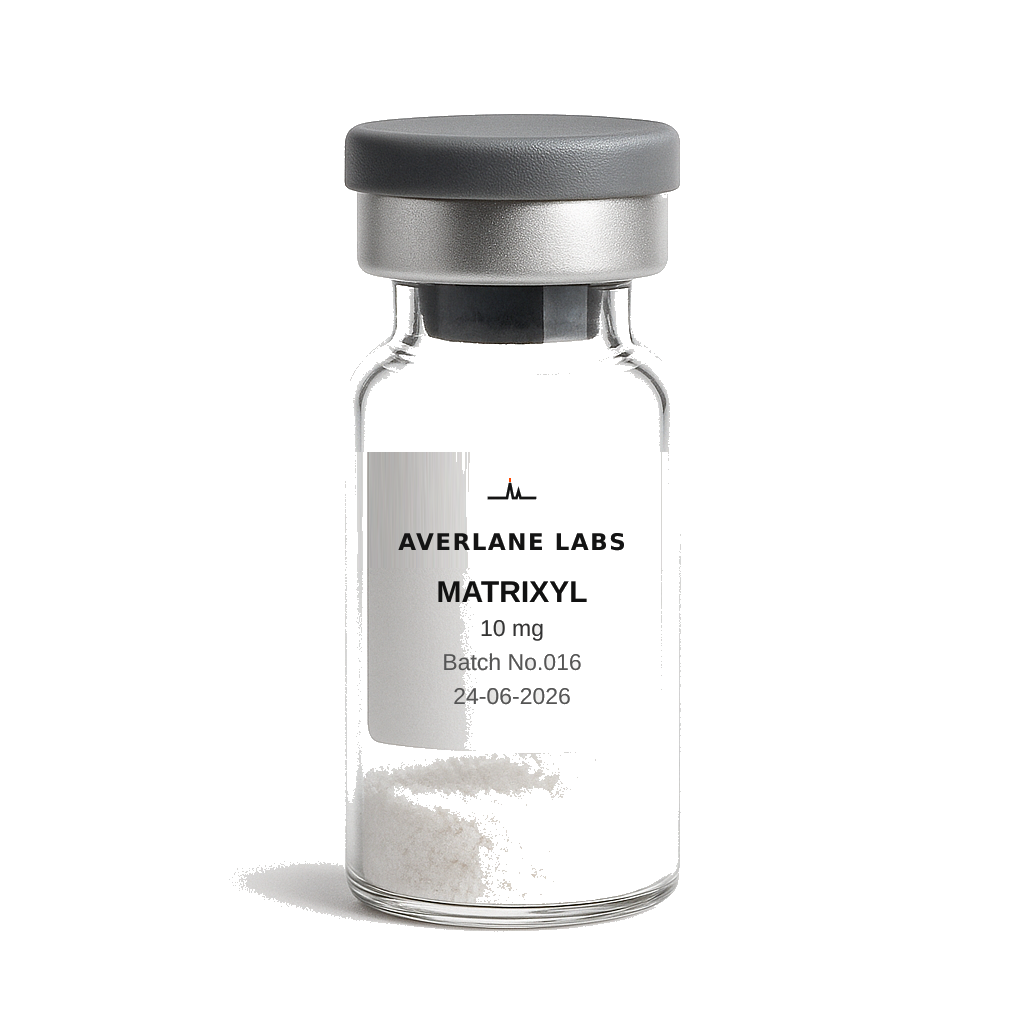
Matrixyl 10mg vial
Certificate of Analysis available on request for the current lot.
Complete the setup
Reconstitution and bench supplies researchers pair with Matrixyl 10mg vial
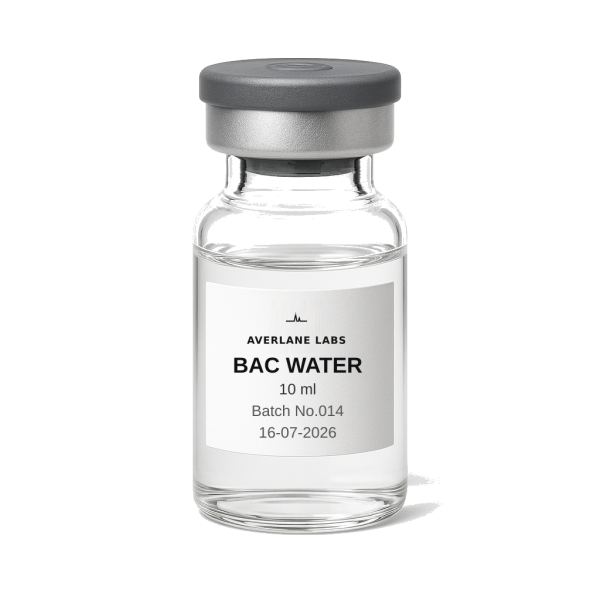

NOT FOR HUMAN CONSUMPTION
Matrixyl® is a trade name most commonly associated with the cosmetic peptide palmitoyl pentapeptide-4 (often written Pal-KTTKS), a palmitoylated “matrikine” designed for topical anti-aging formulations.
Matrixyl 3000® is a peptide blend best known for combining palmitoyl tripeptide-1 (historically “palmitoyl oligopeptide”) with palmitoyl tetrapeptide-7 (often described as an anti-inflammatory / anti-IL-6 signaling peptide in skincare literature).
Regulatory status (practical): Matrixyl peptides are cosmetic ingredients (not FDA/EMA “drug” actives) and are typically used in leave-on products aimed at improving the appearance of aging skin.
2) Chemical and biological design rationale
2.1 Why “palmitoyl-”?
Palmitoylation (attachment of a C16 fatty chain) is a common cosmetic-peptide strategy intended to:
-
increase lipophilicity,
-
improve partitioning into the stratum corneum, and
-
increase residence time vs a non-lipidated peptide (which would be rapidly degraded and poorly permeable).
2.2 Why KTTKS?
The KTTKS sequence is described as a collagen type I fragment (“matrikine” concept), a signal-like peptide meant to “tell” fibroblasts that extracellular matrix (ECM) repair is needed.
3) Molecular mechanism of action
3.1 Palmitoyl pentapeptide-4 (Matrixyl): fibroblast ECM signaling
Mechanistic reviews consistently describe Pal-KTTKS as upregulating dermal ECM components in fibroblast systems, including:
-
procollagen / collagen synthesis,
-
elastin and fibronectin, and
-
hyaluronic-acid–related pathways (e.g., HAS1 in vitro).
3.2 Matrixyl 3000: ECM support + inflammatory tone
Matrixyl 3000’s components are often framed as:
-
palmitoyl tripeptide-1 → ECM “repair signaling,” and
-
palmitoyl tetrapeptide-7 → reduction of inflammatory signaling (commonly via IL-6 modulation in cosmetic science narratives).
Scientific caveat: Most mechanistic claims are based on in vitro or supplier-compiled datasets; the most defensible clinical claim is improvement in appearance metrics (wrinkle depth/roughness/elasticity), not “rebuilding” skin in a medical sense.
4) Pharmacokinetics and delivery constraints (topical reality)
Matrixyl peptides are used topically, and their “PK” is really about:
-
skin penetration/partitioning (helped by palmitoylation),
-
local stability in a cosmetic vehicle, and
-
achieving sufficient local concentration near viable epidermis/upper dermis to influence fibroblast signaling indirectly or via diffusion.
5) Evidence base (clinical and preclinical)
5.1 Human studies (what exists publicly)
-
A 2023 randomized, split-face style clinical study investigated peptide-based topical approaches including palmitoyl pentapeptide-4 for crow’s feet outcomes (wrinkle-related endpoints).
-
A 2020 clinical paper discussing palmitoyl pentapeptide-4 notes prior work (commonly attributed to Robinson et al.) reporting small but significant wrinkle/fine-line improvements over ~12 weeks at commonly used concentrations.
-
Many “Matrixyl 3000” performance statements are frequently repeated in cosmetic education sources; treat these as supporting context unless tied to a peer-reviewed methods/results paper.
5.2 Preclinical / mechanistic evidence (stronger but indirect)
A 2025 review summarizes palmitoyl pentapeptide-4 as increasing procollagen and affecting hyaluronic-acid synthesisin fibroblast systems, consistent with the ECM-support mechanism.
Broader peptide reviews also describe KTTKS-related fragments as supporting collagen, elastin, fibronectin, and glycosaminoglycan biology.
Evidence-quality note: Topical cosmetic peptides often show modest-to-moderate improvements in appearance metrics, with outcomes depending heavily on formulation, concentration, study design, and baseline photodamage.
6) Practical “benefits” (appearance-focused, evidence-weighted)
| Benefit domain | What’s realistic to claim | Notes |
|---|---|---|
| Fine lines / wrinkle appearance | Improvement is plausible | Supported by clinical and mechanistic literature, typically modest effect sizes. |
| Skin texture / smoothness | Plausible improvement | Often tracks with hydration + ECM support and reduced roughness measures. |
| Elasticity / firmness (appearance) | Possible | Usually secondary endpoints; depends on vehicle + duration. |
| Sensitivity/redness modulation (Matrixyl 3000 claims) | Possible but variable | Often attributed to palmitoyl tetrapeptide-7 and IL-6-linked narratives. |
7) Safety and tolerability
For most users, Matrixyl-type peptides are considered well tolerated in leave-on cosmetics, with adverse events primarily being:
-
mild irritation, stinging, or contact dermatitis (usually vehicle/preservative-driven rather than peptide-specific),
-
heightened sensitivity when layered with strong actives (retinoids, acids) depending on formulation.
A 2025 review summarizes palmitoyl pentapeptide-4 as generally safe and non-sensitizing at commonly used levels in cosmetic contexts (as reported in the literature it cites).
8) Formulation and use considerations (what actually determines results)
-
Concentration: Many references discuss ~3% of the supplier blend as a common usage level; actual active peptide content in a “blend” can be much lower (supplier-dependent).
-
Vehicle matters: penetration and stability are driven by emulsion type, solvents/humectants, and pH.
-
Timeline: Expect changes over 8–12+ weeks for appearance metrics in most realistic regimens (consistent with typical topical anti-aging study durations).
9) Bottom line
Matrixyl (palmitoyl pentapeptide-4) and Matrixyl 3000 (palmitoyl tripeptide-1 + palmitoyl tetrapeptide-7) are credible cosmetic peptides with a coherent mechanistic rationale (ECM signaling ± inflammation modulation) and a clinical record that supports modest improvements in the appearance of wrinkles and skin texture when formulated well and used consistently.
If you tell me which product you mean, Matrixyl (PPP-4) vs Matrixyl 3000 vs the newer Matrixyl Synthe’6 line, I can produce a comparative matrix (mechanism, best use-case, evidence strength, typical use level, and compatibility with retinoids/acids/vitamin C).
Researcher reviews
No reviews yet for this lot line. Verified purchasers can leave the first one.
Reviews
There are no reviews yet.