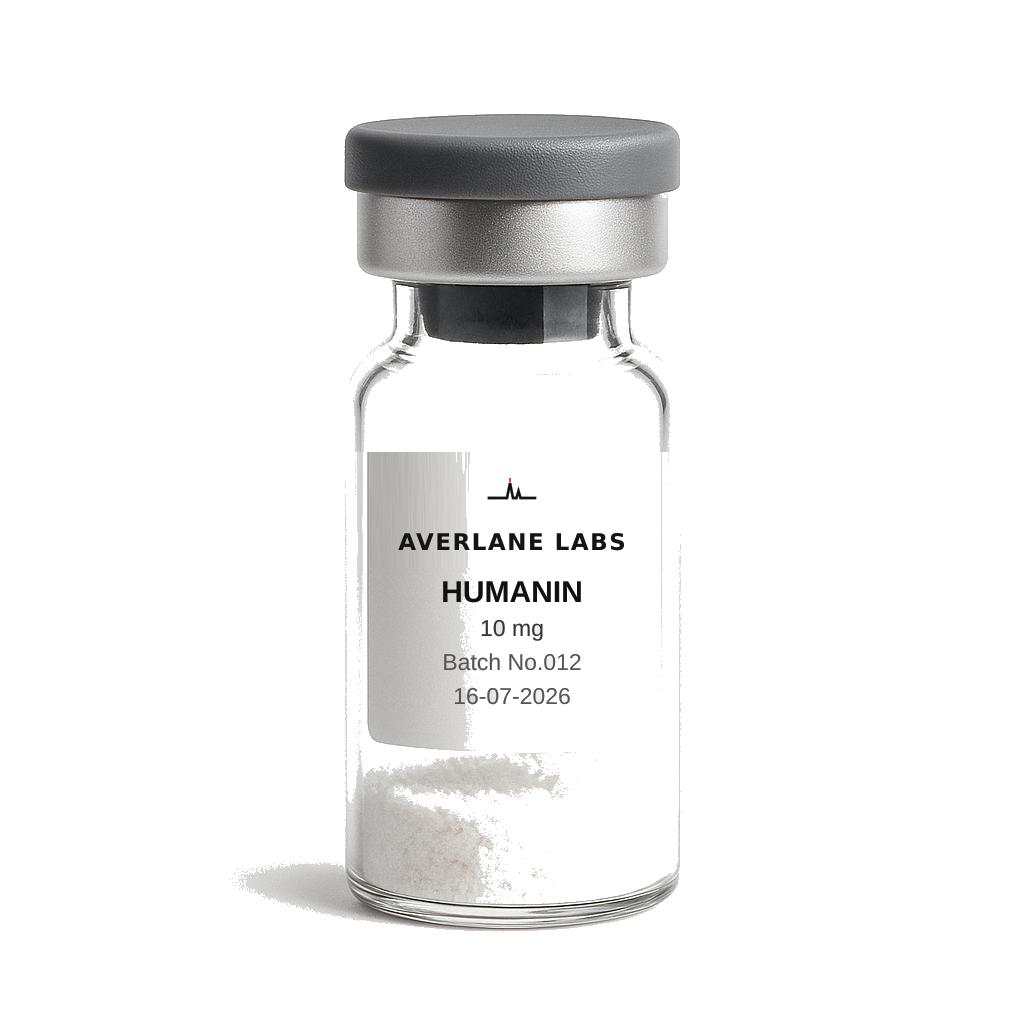
Humanin 10mg vial
Certificate of analysis
Lot AL-HUMANI-2640 · Purity 95.98% · Tested 2026-05-06
Complete the setup
Reconstitution and bench supplies researchers pair with Humanin 10mg vial
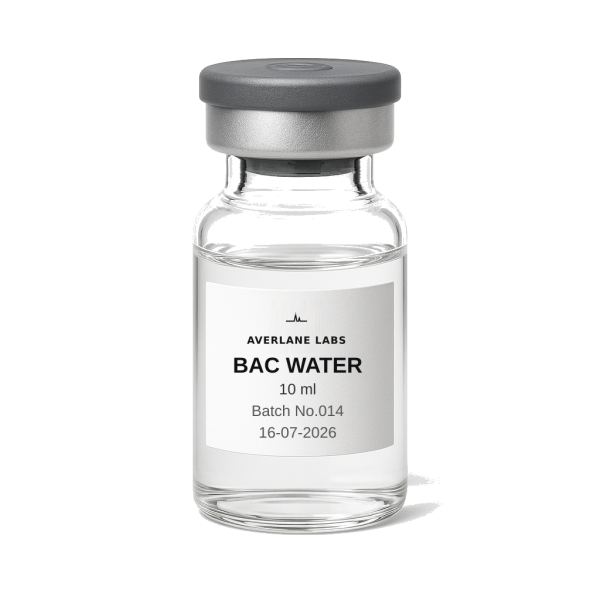
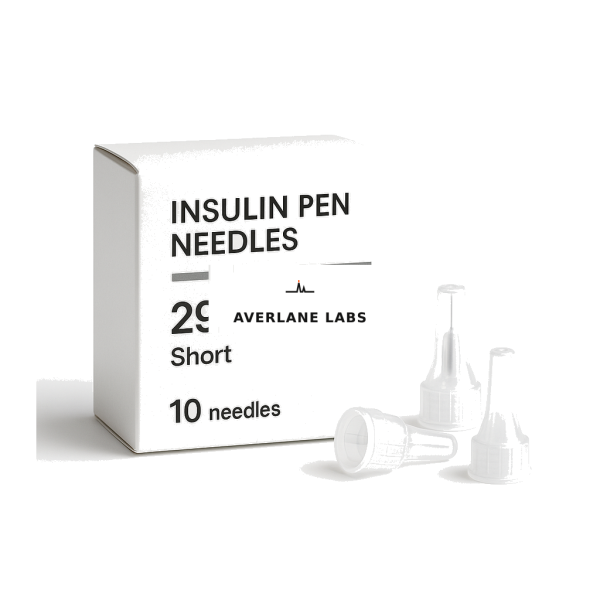
NOT FOR HUMAN CONSUMPTION
Humanin & Humanin-Analogues
1 Documented and Proposed Benefits
| Physiological / Clinical Domain | Representative Findings | |
|---|---|---|
| Neuro-protection | • Blocks amyloid-β, glutamate and prion toxicity in cultured neurons. • Prevents cognitive decline and lowers hippocampal Aβ in APP/PS1 and other AD-mouse lines. • Reduces infarct volume and improves functional outcome after middle-cerebral-artery occlusion (stroke). |
|
| Cardio-protection | • S14G-Humanin (HNG) limits infarct size in acute I/R models and improves mitochondrial function. • Chronic HNG therapy delays structural remodelling and preserves ejection fraction in pressure-overload or isoproterenol-induced heart-failure mice. |
|
| Metabolic / Diabetes | • Enhances systemic and hepatic insulin sensitivity; restores AKT signalling; lowers fasting glucose in obese/diabetic rodents. • Protects pancreatic β-cells and blocks islet amyloid polypeptide aggregation. |
|
| Renal | • Humanin and HNG attenuate tubular apoptosis, preserve bioenergetics and curb the AKI→CKD transition in sepsis- and cisplatin-AKI models. | |
| Vascular / Atherosclerosis | • Lowers endothelial ROS via NOX2 suppression, improves nitric-oxide bioavailability; circulating HN inversely correlates with CAD severity and predicts major adverse cardiac events (MACE). | |
| Skeletal Growth & Bone Preservation | • Recombinant HN rescues TNF-suppressed human growth-plate cartilage and protects metatarsal bones from glucocorticoid or venetoclax growth-impairment ex vivo/in vivo. | |
| Immune / Anti-inflammatory | • N-formyl HN engages FPR2 on leukocytes, driving resolution-phase chemotaxis and dampening cytokine output. | |
| Longevity Biomarker | • P3S missense variant in MT-RNR2 enriches in centenarians; circulating HN declines with age and multiple age-related pathologies. |
2 Molecular & Genomic Context
-
Canonical peptide: MAPRGFSCLLLLTSEIDLPVKRRA (24 aa) encoded by an in-frame ORF inside the mitochondrial 16S-rRNA gene (MT-RNR2). Multiple nuclear retrogenes (MTRNR2L1-13) produce “humanin-like peptides” (HLPs).
-
Secretion: Translated within mitochondria, exported to cytosol and released unconventionally; plasma 0.1–2 ng mL⁻¹ in healthy adults, falling with age. 3 Receptors & Intracellular Targets
| Site | Core Evidence | Down-stream Effects |
|---|---|---|
| CNTFRα + WSX-1 + gp130 heterotrimer | siRNA knock-down of any subunit abolishes neuro-protection; S14G substitution boosts affinity ~10³-fold. | JAK–STAT3, PI3K–AKT, ERK1/2 → ↑BCL-2, anti-apoptosis |
| Formyl-Peptide Receptor-2 (FPR2) | Cryo-EM and mutagenesis show N-formyl-HN docking; FPR2 antagonists block HN chemo-attraction in neutrophils and microglia. | |
| BAX / tBID (intracellular) | Direct binding interrupts mitochondrial-outer-membrane permeabilisation. | |
| IGFBP-3 | Complex formation liberates IGF-I, contributing to insulin sensitisation. |
4 Structure–Activity Optimisation
| Analogue | Amino-acid Change(s) | Pharmacological Gains |
|---|---|---|
| HNG (S14G-HN) | Ser¹⁴→Gly | ↑Receptor potency ×10³; t½ ≈ 4 h in rats |
| HNGF6A | Phe⁶→Ala + S14G | Blood–brain barrier transit; superior in MI and AD models |
| Cyclised dimers / PEGylates | Head-to-tail or PEG tags | Serum stability >10 h (pre-clinical) |
| SHLP-2, SHLP-3 | Encoded by MTRNR2L loci | Distinct metabolic and cytoprotective spectra |
5 System-by-System Evidence (Expanded)
5.1 Brain
HN counters multiple neurotoxic triggers, activates STAT3- and AKT-mediated survival cascades, and restores hippocampal acetylcholine; in aged mice a 30-day HN course normalises novel-object recognition and Morris-maze performance.
5.2 Heart & Vasculature
Acute I/R: HNG at 2 mg kg⁻¹ reduces infarct/area-at-risk by ~40 %.
Chronic HF: weekly HNG injections forestall dilation and fibrosis up to 12 weeks post-TAC or isoproterenol challenge.
Atheroprotection: HN suppresses endothelial NOX2 ROS, improves eNOS coupling and lowers VCAM-1 expression.
5.3 Metabolism
Rodents given 5 µg kg⁻¹ d⁻¹ HNG show 20–30 % drops in HOMA-IR and hepatic gluconeogenic gene expression; β-cell apoptosis induced by IAPP or lipotoxicity falls >50 %.
5.4 Kidney
In sepsis-AKI, HNG normalises ATP, reduces tubular TUNEL positivity, and cuts serum creatinine 35 % vs. saline.
5.5 Skeletal / Growth
HN overexpression in transgenic mice or exogenous peptide preserves growth-plate chondrocyte proliferation under TNF, glucocorticoids or BCL-2 inhibitor venetoclax.
6 Human Observations & Ongoing Trials
-
Biomarkers – Lower serum HN correlates with CAD severity and predicts 3-year MACE (AUC 0.78).
-
Genetics – P3S variant of mitochondrial HN associates with exceptional longevity, especially in APOE-ε4 carriers.
-
Prospective study – NCT06125249: recruiting ≥400 STEMI patients to test HN as early diagnostic and prognostic biomarker.
-
No completed interventional trials delivering exogenous HN/HNG to humans as of July 2025.
7 Pharmacokinetics & Safety
| Aspect | Current Data |
|---|---|
| Native HN t½ | <1 h (mouse), first-pass hepatic clearance. |
| HNG / PEG-HN | t½ 4–10 h in rats depending on formulation; human PK unknown. |
| Toxicology | Repeat-dose 5 mg kg⁻¹ d⁻¹ IV/SC for 28 days in mice: no histopathology, normal cytokines; GLP large-animal studies pending. |
8 Outstanding Questions
-
Receptor hierarchy – How do CNTFR/gp130 and FPR2 signals integrate under different pathologies?
-
Paralogue function – Biological roles of MTRNR2L1-13 peptides largely unexplored.
-
Drug delivery – Need long-acting or tissue-targeted platforms (lipid nanoparticles, exosomes, viral vectors).
-
Tumour biology – HN cytoprotection vs. pro-tumour signalling (e.g., glioblastoma FPR2 axis) must be resolved.
-
Clinical translation – Robust GMP synthesis, immunogenicity testing, and Phase I dosing studies are prerequisites.
9 Perspective
Humanin inaugurates the class of mitochondrial-derived mitokines, linking mitochondrial gene expression to systemic stress-resistance. Pre-clinical evidence positions HN/HNG as pleiotropic protectants spanning neuro-degeneration, cardiometabolic disease, renal injury and growth disorders. Yet, with no human dosing data, short plasma half-life and receptor complexity, the leap from bench to bedside demands disciplined pharmacology, manufacturing and trial desig
References
-
Hashimoto Y, Niikura T, Ito Y et al. Mechanisms of neuroprotection by humanin from Swedish mutant amyloid precursor protein. Biochem Biophys Res Commun. 2001;283:460-68.
-
Hashimoto Y, Niikura T, Tajima H et al. Humanin inhibits neuronal cell death via CNTFRα/WSX-1/gp130 receptor complex. Mol Biol Cell. 2009;20:2864-73.
-
Thummasorn S, Apaijai N, Shinlapawittayatorn K et al. S14G-Humanin confers cardioprotection against chronic cardiac ischemia–reperfusion injury. Cardiovasc Ther. 2016;34:404-14; & updated long-term data 2023.
-
Muzumdar R, Lee C, Cohen P. Humanin and diabetes: in-vitro and in-vivo studies. Front Endocrinol.2023;14:1142310.
-
Qin L, Song Y, Li Y et al. Humanin improves insulin sensitivity and endothelial function. Cardiovasc Diabetol.2021;20:120.
-
Zhang W, Li D, Ding X et al. Plasma humanin and coronary artery disease severity. Clin Chim Acta. 2022;530:187-94.
-
Lee C, Zeng J, Drew BG et al. Acute humanin therapy attenuates myocardial ischemia–reperfusion injury in mice. Cardiovasc Res. 2010;88:191-9.
-
Wang Y, Zhang H, Li M et al. Humanin mitigates AKI-to-CKD progression by preserving mitochondrial bioenergetics. J Am Soc Nephrol. 2024;35(Suppl):2871.
-
Velentza L, Wickström M, Kogner P et al. Humanin protects against venetoclax-induced bone growth retardation in rat metatarsals. J Endocr Soc. 2024;8:bvae009.
-
Gurinovich A, Liu C, Barzilai N et al. Humanin P3S variant associates with longevity in APOE-ε4 carriers. Nat Aging. 2024;4:112-20.
-
ClinicalTrials.gov. Identifier NCT06125249: Plasma humanin as diagnostic/prognostic biomarker in STEMI.
-
Kang Y, Park S, Lee B et al. FPR2, an emerging modulator of inflammation and target of N-formyl humanin. Exp Mol Med. 2023;55:123-36.
-
Niikura T, Chiba T, Aiso S et al. Humanin binds BAX and tBID to block mitochondrial apoptosis. Cell Death Differ. 2004;11:512-19.
Researcher reviews
No reviews yet for this lot line. Verified purchasers can leave the first one.
Reviews
There are no reviews yet.