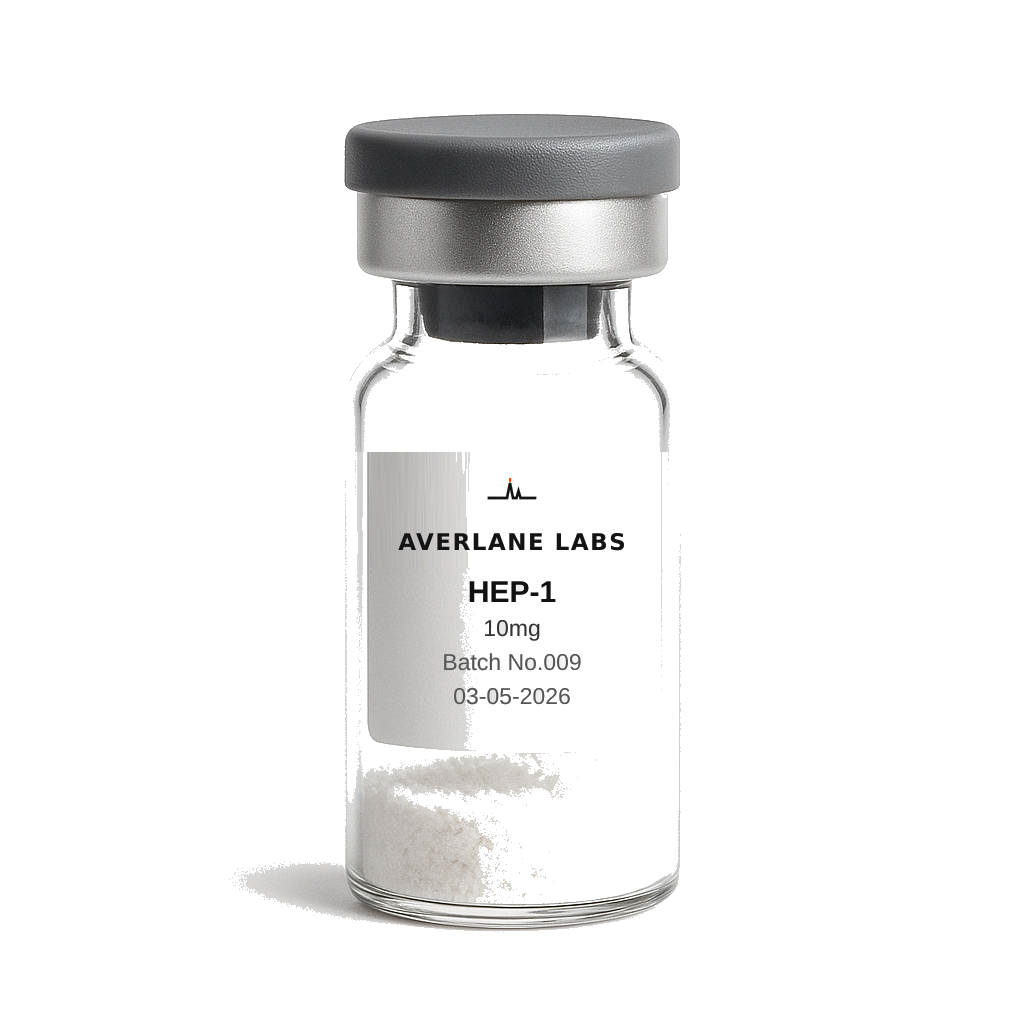
HEP-1 10mg vial
Certificate of analysis
Lot AL-HEP110-2626 · Purity 98.18% · Tested 2026-06-30
Complete the setup
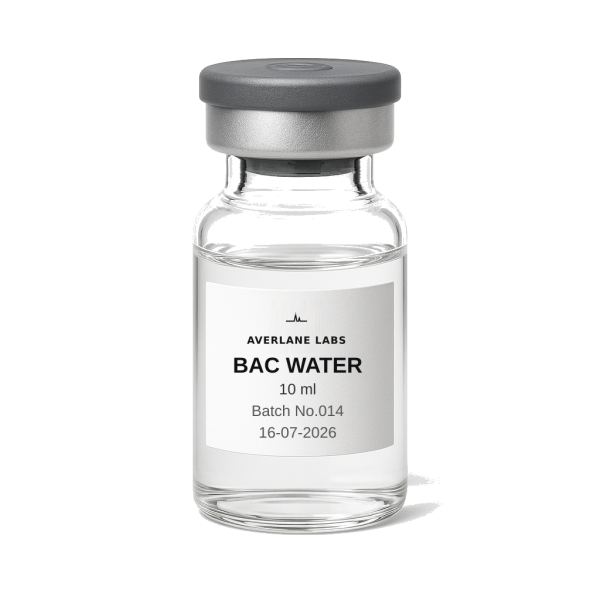
Reconstitution and bench supplies researchers pair with HEP-1 10mg vial

NOT FOR HUMAN CONSUMPTION
HEP-1 is best viewed as an investigational human ezrin–derived peptide with antiviral, anti-inflammatory, and immunomodulatory claims, not a proven mainstream therapy. It is a 14-amino-acid synthetic peptide derived from the 324–337 region of human ezrin and has been studied mainly in the context of mucosal immunity, viral infections, and inflammation. The strongest publicly accessible evidence is a mix of review literature, older regional clinical-use claims, and trial registrations, rather than large, modern, internationally replicated efficacy trials.
Additional benefits of HEP-1 under investigation
| Benefit | Take-away |
|---|---|
| 1. Antiviral / infection-related use | This is the main use case. Reviews describe HEP-1 as having been developed for HIV-related settings and later explored against other viral infections, but the evidence base is not robust by modern global standards. |
| 2. Immunomodulatory effects | HEP-1 is described as amplifying adaptive antiviral immunity and modulating inflammation, which is central to its proposed mechanism. |
| 3. Anti-inflammatory activity | Review literature emphasizes anti-inflammatory effects as one of the peptide’s core proposed properties, especially in mucosal and infection-related settings. |
| 4. Mucosal infection support | Older review-level descriptions claim benefit in recurrent mucosal infections and opportunistic infections, but these claims rely heavily on non-mainstream or region-specific literature. |
| 5. Vaccine-adjuvant / antibody-response interest | Product/research catalog summaries describe increased antibody titers with hepatitis B vaccination, but this is not the same as established clinical adoption. |
| 6. COVID-19 interest | HEP-1 was formally studied in a COVID-19 trial setting, which shows translational interest, but a trial registration is not proof of efficacy. |
| 7. Generally framed as well tolerated | Public-facing sources and reviews describe an encouraging safety profile, but the accessible evidence is not equivalent to a large international safety database. |
| 8. Not a proven broad-spectrum anti-infective | Marketing-style descriptions often go broader than the evidence supports; the most defensible framing is still investigational immunomodulatory peptide, not established broad anti-infective therapy. |
2. Molecular mechanism of action
2.1 Receptor pharmacodynamics
HEP-1 does not have the profile of a classic receptor-targeted drug. It is a synthetic mimic of part of the α-domain of human ezrin, specifically the so-called Hep receptor region spanning residues 324–337. The mechanistic literature frames it more as a signaling / immunomodulatory peptide than as a conventional agonist or antagonist at a single defined drug receptor.
2.2 Downstream biology
| Pathway / theme | Functional outcome | Context |
|---|---|---|
| Ezrin-domain mimicry | Modulation of immune and inflammatory signaling | Infection / mucosal biology |
| Adaptive immune amplification | Enhanced antiviral immune response proposed | Viral infection context |
| Anti-inflammatory signaling | Reduced inflammatory activity proposed | Infection / mucosal inflammation |
| Mucosal immune support | Proposed benefit in local infection control | Opportunistic / mucosal infections |
These mechanisms are biologically interesting, but they still do not establish strong clinical efficacy by themselves.
3. Pharmacokinetics
Routes described: oral, mucosal/topical, and injectable in public-facing summaries, though the most detailed accessible sources are not modern pharmacokinetic trials. The practical appeal of HEP-1 is that it has been presented as orally activeand usable on mucous membranes, but those claims come mainly from review and product-style sources rather than a large international PK literature.
4. Pre-clinical and clinical evidence
4.1 Viral / opportunistic infection use
This is the best-known niche. Review articles state that HEP-1 was originally developed in HIV-related contexts and later reported benefits in opportunistic infections and recurrent mucosal infections. However, much of this narrative comes from a relatively narrow literature base rather than broad modern replication.
4.2 Immunomodulatory and anti-inflammatory effects
The literature repeatedly emphasizes inhibition of inflammation and amplification of adaptive antiviral immunity as the central rationale for HEP-1. That explains why it has been proposed not just for viral infection control but also for chronic inflammatory and immune-vulnerable settings. Still, this remains more of a biologic and translational rationalethan definitive clinical proof.
4.3 COVID-19
A registered clinical trial evaluated HEP-1 for COVID-19, which shows that the peptide reached formal interventional testing. But trial registration alone does not establish benefit, and I did not find a strong, definitive published efficacy result from a major randomized international trial in the sources reviewed.
4.4 Evidence quality
This is the main limitation. There is real scientific and clinical-development interest around HEP-1, but the publicly accessible evidence appears to rely heavily on reviews, regional development history, commercial summaries, patents, and trial registrations, not on a large body of modern, high-confidence efficacy trials. That means the fairest framing is investigational peptide with interesting immunologic claims, not established therapy.
5. Emerging clinical interests
| Field | Rationale | Status |
|---|---|---|
| Viral infections | Antiviral + immune-amplifying rationale | Investigational, evidence mixed/limited |
| HIV-related and opportunistic infections | Historical development path | Regionally described, not globally definitive |
| COVID-19 | Anti-inflammatory and antiviral rationale | Trial-stage interest, efficacy not established here |
| Vaccine-response support | Antibody-amplification claims | Exploratory / limited |
| Chronic inflammatory / mucosal disease | Immune-modulating rationale | Speculative / early translational framing |
6. Safety and tolerability
The accessible literature generally presents HEP-1 as having a favorable safety profile, but this claim should be interpreted cautiously because I did not find a large, modern, globally recognized safety database comparable to an approved mainstream medicine. The best safety framing is therefore apparently encouraging but not comprehensively characterized by current international standards.
7. Contraindications and cautions
Use extra caution with:
- treating HEP-1 as a proven broad antiviral therapy, because that overstates the evidence.
- assuming COVID-19 trial registration means clinical success, because registration is not efficacy proof.
- replacing established anti-infective or immunologic care with HEP-1, because the evidence base is not strong enough for that.
- relying on gray-market or commercial peptide descriptions as if they were equivalent to regulatory-grade evidence.
8. Comparative practical matrix
| Feature | HEP-1 |
|---|---|
| Main strength | Investigational ezrin-derived immunomodulatory peptide |
| Best-supported use case | Viral / mucosal infection and immune-modulation interest |
| Clinical evidence depth | Limited and uneven |
| Core limitation | Sparse modern international efficacy validation |
| Main mechanism | Ezrin-domain mimicry with immune and anti-inflammatory signaling claims |
| Main safety concern | Human safety/efficacy not characterized to mainstream standards |
| Best practical framing | Research / regionally developed immunomodulatory peptide, not a proven standard therapy |
9. Regulatory landscape
HEP-1 is best understood as an investigational or regionally developed peptide product, not a globally established approved therapy. The most important regulatory reality is that, despite long-standing interest and formal trial activity, it has not emerged as a mainstream internationally recognized antiviral or immunomodulatory medicine.
10. Future directions
The most useful future work would be:
- larger randomized controlled trials in clearly defined viral or inflammatory settings,
- clearer separation of immunomodulatory vs direct antiviral effects,
- stronger modern pharmacokinetic and safety characterization,
- and independent replication outside the narrower development ecosystem currently associated with HEP-1. This is an inference from the current evidence gaps.
Best balanced summary
HEP-1 is best viewed as a human ezrin–derived investigational peptide with plausible antiviral, anti-inflammatory, and immunomodulatory properties. Its strongest appeal lies in biologic rationale and long-running translational interest, including formal COVID-19 trial activity, but the publicly accessible evidence remains too limited and uneven to support framing it as a proven mainstream therapy.
Selected references
- Holms RD, et al. Ezrin Peptide Therapy from HIV to COVID: Inhibition of Inflammation and Amplification of Adaptive Anti-Viral Immunity. Best higher-level source for HEP-1 identity, mechanism, and claimed antiviral/immunomodulatory scope.
- ClinicalTrials.gov / EU CTR COVID-19 trial registrations. Best sources showing formal clinical-testing interest in HEP-1 for COVID-19.
- MedChemExpress / GLPBio HEP-1 entries. Useful for identity, peptide sequence framing, and commonly repeated research-use claims, though these are not the same as regulatory proof.
Researcher reviews
No reviews yet for this lot line. Verified purchasers can leave the first one.
Reviews
There are no reviews yet.