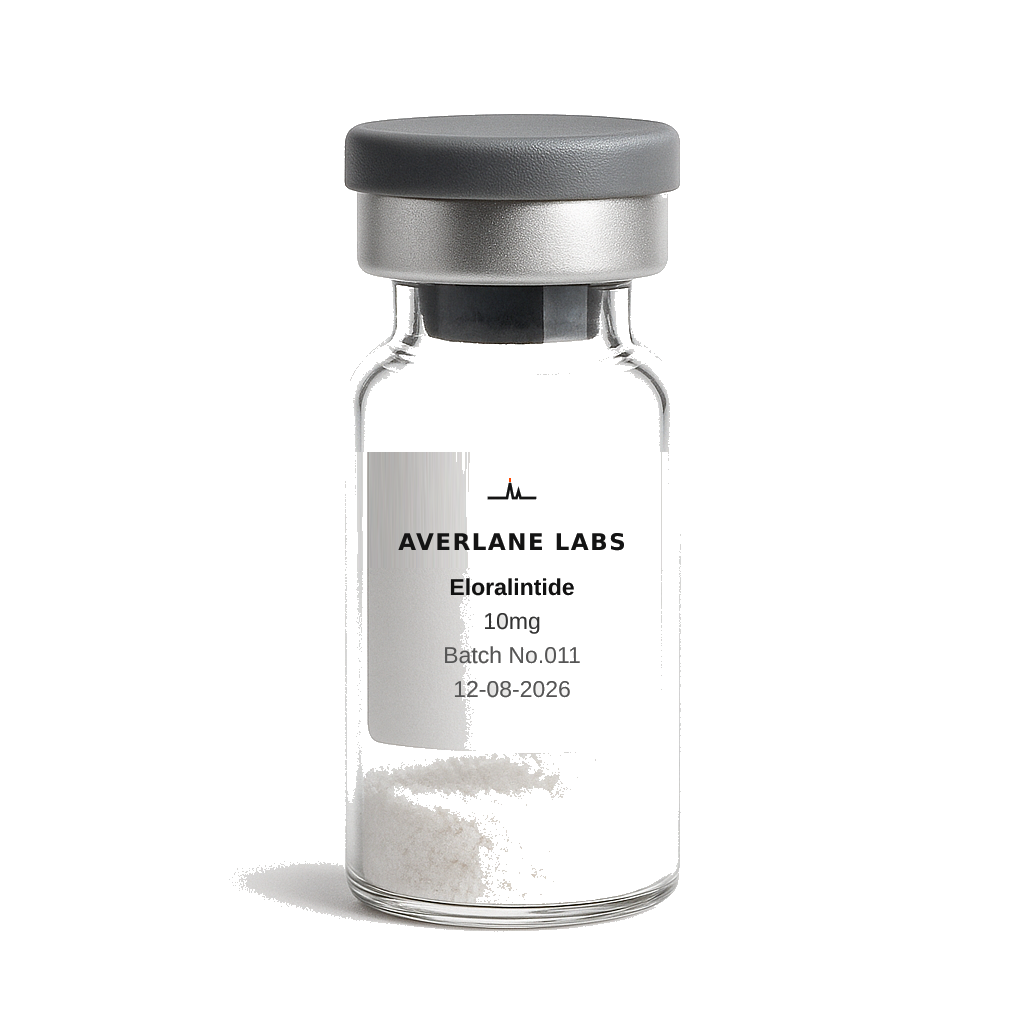
Eloralintide 10mg
Certificate of analysis
Lot AL-ELORAL-2622 · Purity 99.52% · Tested 2026-08-19
Complete the setup
Reconstitution and bench supplies researchers pair with Eloralintide 10mg

NOT FOR HUMAN CONSUMPTION
Eloralintide, Comprehensive Scientific Review
Eloralintide (LY3841136) is an investigational, long-acting, once-weekly selective amylin receptor agonist being developed by Eli Lilly for obesity and related metabolic complications. Unlike semaglutide, tirzepatide, and retatrutide, eloralintide does not primarily act through GLP-1, GIP, or glucagon receptors. Instead, it mimics selected actions of the pancreatic hormone amylin, particularly central satiety signaling and reduction of food intake.
This mechanistic separation from the incretin pathway is one of eloralintide’s most important features. It creates the possibility of substantial weight loss as a stand-alone therapy while also providing a biologically complementary pathway that could potentially be combined with GLP-1/GIP-based drugs.
In a 48-week Phase 2 obesity trial, once-weekly eloralintide produced mean body-weight reductions ranging from approximately 9.5% to 20.1%, compared with approximately 0.4% with placebo. The highest-dose arms remained associated with substantial ongoing weight reduction at the end of treatment.
Eloralintide remains investigational and does not currently have marketing authorization for obesity treatment.
1. Additional Benefits of Eloralintide Now Under Investigation
Benefit | Key take-aways |
|---|---|
1. High-magnitude weight loss | Phase 2 participants receiving higher doses achieved approximately 17.6–20.1% mean weight reduction at 48 weeks, establishing amylin receptor agonism as a potentially high-efficacy obesity mechanism independent of GLP-1 receptor activation. |
2. Strong appetite and satiety control | Amylin signaling acts prominently within hindbrain and hypothalamic appetite networks, increasing satiation and reducing meal size and caloric intake. |
3. Alternative to incretin therapy | Because eloralintide uses an amylin-based mechanism rather than GLP-1/GIP signaling, it could eventually offer an alternative for individuals who respond inadequately to or cannot tolerate incretin-based therapy. This remains a clinical-development hypothesis rather than an established indication. |
4. Potentially favorable GI tolerability | Phase 1 and Phase 2 data suggest gastrointestinal adverse events may be comparatively manageable, particularly at lower doses and with gradual escalation. Nausea and fatigue remain important adverse events, especially at higher exposures. |
5. Cardiometabolic improvements | Phase 2 treatment was associated with improvements in waist circumference, blood pressure, lipid parameters, glycaemic measures and inflammatory biomarkers. Whether these translate into cardiovascular-event reduction remains unknown. |
6. Potential improvement in quality of weight loss | Preclinical head-to-head work suggests eloralintide may preferentially reduce fat mass and potentially preserve more lean mass than less-selective amylin agonism. This has not yet established clinically meaningful muscle preservation in humans. |
7. Combination potential with tirzepatide | Amylin and GLP-1/GIP signaling are mechanistically complementary. Early studies have investigated co-administration with tirzepatide, but larger controlled trials are needed to establish efficacy and safety advantages. |
8. Obstructive sleep apnea | Eloralintide is being evaluated in Phase 3 development in people with moderate-to-severe OSA and obesity/overweight. |
9. Obesity-associated knee osteoarthritis | Phase 3 development is evaluating whether eloralintide-mediated weight reduction improves symptoms and clinical outcomes in people with obesity/overweight and knee osteoarthritis. |
2. Molecular Mechanism of Action
2.1 Amylin Physiology
Native amylin is a pancreatic peptide hormone co-secreted with insulin from β-cells following nutrient intake. Physiologically, amylin contributes to energy and glucose homeostasis by integrating signals between the gastrointestinal tract, pancreas and central nervous system.
Its principal actions include:
Central satiety:
↑ satiation and meal termination
↓ meal size
↓ food motivation and caloric intake
Gastric regulation:
Slowing of gastric emptying can moderate nutrient delivery into the intestine, particularly in the post-prandial state.
Pancreatic regulation:
Amylin physiology can suppress inappropriate post-prandial glucagon secretion, complementing insulin-mediated glucose control.
Body-weight regulation:
Chronic activation of amylin-sensitive neural circuits decreases energy intake and supports sustained negative energy balance.
Eloralintide is therefore principally an energy-intake modulator rather than a drug whose primary mechanism depends on increasing systemic energy expenditure.
2.2 Receptor Pharmacodynamics
Classical amylin receptors are heterodimeric receptor complexes composed of the calcitonin receptor (CTR) combined with receptor-activity-modifying proteins (RAMPs).
These complexes form:
AMY1R: CTR + RAMP1
AMY2R: CTR + RAMP2
AMY3R: CTR + RAMP3
Eloralintide was engineered as a selective amylin receptor agonist, with particular pharmacological emphasis on AMY1R activity rather than broad activation of calcitonin-family receptors.
This selectivity may be important because broader calcitonin-family receptor activation has been hypothesized to contribute to nausea or aversive responses observed with some earlier amylin analogues.
In animal models, eloralintide produced strong reductions in food intake and body weight with comparatively limited conditioned taste avoidance.
Whether receptor selectivity itself explains differences in human tolerability remains under investigation.
2.3 Down-stream Biology
Pathway | Functional outcome | Context |
|---|---|---|
Area postrema / NTS | Satiation ↑, meal size ↓ | Hindbrain appetite regulation |
Hypothalamic integration | Hunger drive ↓, satiety signaling ↑ | CNS energy balance |
Gastric motility | Gastric emptying ↓ | Post-prandial nutrient delivery |
Pancreatic glucagon signaling | Post-prandial glucagon suppression | Glycaemic regulation |
Adipose-energy balance | Fat mass ↓ secondary to sustained energy deficit | Body composition |
Incretin-complementary pathway | Potential additive appetite/weight effects | Combination therapy |
3. Pharmacokinetics
Route:
Once-weekly subcutaneous injection in clinical development.
Absorption:
Eloralintide demonstrates relatively slow absorption following subcutaneous administration.
Half-life:
Published Phase 1 pharmacokinetic work reports a mean terminal half-life of approximately 13.9–15.8 days, supporting once-weekly administration.
Exposure characteristics:
Long systemic persistence may reduce peak-to-trough fluctuations and could contribute to tolerability, although the clinical significance of this property has not yet been fully established.
Distribution/clearance:
Eloralintide is a long-acting peptide analogue designed to resist rapid degradation and clearance. Detailed human metabolism and elimination data remain less extensively characterized publicly than those of approved incretin therapies.
Food interactions:
Direct food-dependent absorption interactions are not relevant because administration is subcutaneous.
4. Pre-clinical and Clinical Evidence
4.1 Pre-clinical Pharmacology
In experimental models, eloralintide reduced food intake and body weight while demonstrating pharmacological differentiation from less-selective amylin agonists.
Rodent studies demonstrated:
substantial reductions in food intake;
substantial body-weight reduction;
preferential reduction of fat mass;
comparatively less lean-mass loss in certain head-to-head experiments;
reduced conditioned taste avoidance versus cagrilintide;
prolonged pharmacokinetic exposure.
These findings generated the hypothesis that selective amylin receptor agonism might preserve anti-obesity efficacy while reducing some unwanted aversive or gastrointestinal signaling associated with broader calcitonin-family receptor activation.
These results should not be interpreted as proof of superior lean-mass preservation or gastrointestinal tolerability in humans.
4.2 Phase 1 Proof-of-Concept
Early clinical studies demonstrated pharmacokinetic exposure compatible with weekly dosing and clinically meaningful reductions in body weight.
Published Phase 1 work concluded that once-weekly eloralintide was generally well tolerated and produced meaningful early weight loss.
The approximately 14–16 day terminal half-life observed in these studies subsequently supported development of once-weekly regimens.
4.3 Phase 2 Obesity Trial
The Phase 2 dose-ranging trial enrolled 263 adults with obesity, or overweight plus at least one weight-related comorbidity, without type 2 diabetes.
Participants received once-weekly eloralintide or placebo for 48 weeks.
Mean Body-Weight Change at Week 48
Treatment arm | Mean change |
|---|---|
Eloralintide 1 mg | −9.5% |
Eloralintide 3 mg | −12.4% |
Eloralintide 6 mg | −17.6% |
Eloralintide 9 mg | −20.1% |
6 → 9 mg escalation | −19.9% |
3 → 6 → 9 mg escalation | −16.4% |
Placebo | −0.4% |
Average baseline body weight was approximately 109.1 kg.
At the highest 9-mg dose, estimated mean absolute weight reduction was approximately 21.3 kg at 48 weeks.
The dose-response relationship was substantial, while slower escalation appeared to improve tolerability.
These are clinical-trial dose arms, not approved or recommended dosing instructions.
4.4 Cardiometabolic Effects
Phase 2 participants demonstrated improvements across several obesity-associated metabolic variables, including:
waist circumference ↓
blood pressure ↓
lipid profile improvement
glycaemic parameters improvement
inflammatory markers ↓
However, existing trials have not established reductions in myocardial infarction, stroke, cardiovascular mortality or progression of kidney disease.
4.5 Type 2 Diabetes
The clinical development program is expanding into people with obesity or overweight and type 2 diabetes.
Dedicated Phase 3 research is evaluating weight reduction, metabolic outcomes and safety in this population.
Claims that eloralintide has already demonstrated GLP-1-like HbA1c reductions should therefore currently be avoided. Robust diabetes-specific efficacy data remain under development.
4.6 Combination With Tirzepatide
The mechanistic rationale for combining eloralintide with tirzepatide is strong:
Tirzepatide: GIPR + GLP-1R
Eloralintide: amylin receptor pathway
The combination therefore targets appetite and metabolic regulation through distinct but potentially complementary pathways.
Early clinical development has assessed eloralintide alone and alongside tirzepatide in adults with obesity or overweight.
The major clinical question is whether combination therapy can produce greater weight loss without disproportionate nausea, vomiting, lean-mass loss or treatment discontinuation.
5. Phase 3 Development Program
Eloralintide entered Phase 3 development following positive Phase 2 findings.
ENLIGHTEN-1, Obesity Without Type 2 Diabetes
Phase 3 evaluation in adults with obesity or overweight without type 2 diabetes.
Important outcomes include:
long-term weight reduction
safety and tolerability
metabolic outcomes
progression from prediabetes toward type 2 diabetes
ENLIGHTEN-2, Obesity/Overweight + Type 2 Diabetes
Phase 3 evaluation in people with overweight or obesity and type 2 diabetes.
This program should provide substantially stronger evidence regarding:
body-weight reduction
HbA1c
fasting glucose
metabolic outcomes
safety in diabetes
ENLIGHTEN-3, Obstructive Sleep Apnea
Phase 3 evaluation in adults with moderate-to-severe OSA plus obesity/overweight.
Relevant outcomes include:
apnea-hypopnea index
oxygenation
OSA symptoms
body-weight reduction
PAP-related outcomes
ENLIGHTEN-4, Knee Osteoarthritis
Phase 3 evaluation in people with obesity/overweight and symptomatic knee osteoarthritis.
This program should determine whether substantial pharmacological weight reduction translates into improvements in:
pain
mobility
physical function
quality of life
6. Emerging Clinical Interests
Field | Rationale | Current status |
|---|---|---|
Obesity | Strong dose-dependent weight reduction | Phase 3 |
Obesity + T2D | Weight loss plus potential glycaemic benefit | Phase 3 |
Prediabetes prevention | Sustained weight reduction may lower progression risk | Long-term evaluation |
OSA | Weight reduction may decrease upper-airway obstruction | Phase 3 |
Knee osteoarthritis | Weight reduction may decrease mechanical load and improve function | Phase 3 |
Combination with tirzepatide | Complementary amylin + GIP/GLP-1 pathways | Early clinical development |
Lean-mass preservation | Favorable preclinical body-composition signal | Exploratory |
Cardiovascular risk reduction | Weight loss + BP/lipid/metabolic improvement | Not established |
MASLD/MASH | Potential secondary benefit through fat loss and improved metabolic health | Hypothesis; dedicated evidence limited |
Weight-loss maintenance | Long half-life and distinct satiety pathway | Future research question |
7. Safety and Tolerability
Most Common Adverse Events
The most frequently reported adverse events include:
Nausea
Fatigue
Gastrointestinal symptoms
Most events reported during Phase 2 were mild to moderate.
Adverse events occurred more frequently at higher exposures, while gradual dose escalation appeared to improve tolerability.
Gastrointestinal Tolerability
GI tolerability represents an important aspect of eloralintide development.
Amylin signaling can influence gastric emptying and central nausea pathways, meaning absence of GLP-1 activity does not imply absence of gastrointestinal adverse effects.
Early clinical and translational data nevertheless suggest selective receptor pharmacology may produce a potentially favorable tolerability profile.
Confirmation requires much larger Phase 3 populations.
Fatigue
Fatigue has appeared as a clinically relevant adverse event.
Whether this reflects:
reduced caloric intake
central amylin signaling
drug exposure
or another mechanism
remains uncertain.
Hypoglycaemia
Eloralintide is not primarily a direct insulin secretagogue.
Clinically meaningful hypoglycaemia would therefore not be expected solely from its principal mechanism in non-diabetic individuals.
Risk in people with diabetes will depend substantially on concomitant glucose-lowering therapy and requires further characterization.
Pancreatitis
Eloralintide does not currently have an approved product label establishing the pancreatitis warnings used for commercial GLP-1 receptor agonists.
Its long-term pancreatic safety profile remains to be established.
Gallbladder Disease
Rapid and substantial weight reduction itself can increase gallstone risk regardless of the pharmacological mechanism.
Gallbladder events therefore remain an important safety outcome in long-duration studies.
Gastric Motility / Procedures
Because amylin signaling can slow gastric emptying, gastric motility and potential peri-procedural implications warrant further study.
Recommendations developed for approved GLP-1 therapies should not automatically be assumed to apply identically to eloralintide.
Thyroid C-Cell Tumours
The boxed thyroid C-cell tumor warnings associated with several GLP-1-based therapies should not simply be transferred to eloralintide.
Eloralintide has different receptor pharmacology, and no approved product labeling currently establishes such a warning for this molecule.
8. Comparative Pharmacology Matrix
Feature | Eloralintide | Cagrilintide | Tirzepatide | Retatrutide |
|---|---|---|---|---|
Principal target | Selective amylin receptor | Amylin/calcitonin-family receptors | GIP + GLP-1 | GIP + GLP-1 + glucagon |
Incretin activity | None | None | Yes | Yes |
Primary appetite pathway | Amylin satiety | Amylin satiety | Incretin/CNS | Incretin/CNS |
Direct energy-expenditure mechanism | Not established | Not established | Limited | ↑ via GCGR |
Weight-loss efficacy | Up to ~20% at 48 wk Phase 2 | High; under development | Very high | Very high |
Glycaemic potency | Under investigation | Secondary | Very high | Very high |
GI adverse effects | Present | Present | GLP-1-class | Present |
Lean-mass preservation | Interesting preclinical signal | Under study | Under study | Under study |
Weekly dosing | Yes | Yes | Yes | Yes |
Combination rationale | Strong with incretins | Strong with incretins | Can pair with non-incretin pathway | Already multi-pathway |
Development status | Phase 3 | Late-stage | Approved | Investigational |
Cross-trial comparisons should be interpreted cautiously because populations, treatment duration, statistical estimands and trial designs differ.
9. Body Composition
Body composition is one of the more scientifically interesting aspects of eloralintide development.
Any large weight-loss intervention reduces both:
fat mass
and
fat-free/lean mass
The clinically meaningful objective is therefore not zero lean-mass loss but a favorable fat-to-lean tissue loss ratio, combined with preservation of strength and physical function.
Preclinical experiments suggested that eloralintide produced substantial fat-mass reductions with comparatively favorable lean-mass preservation relative to cagrilintide in certain experimental models.
This has generated interest in eloralintide as a potential “quality of weight loss” therapy.
However:
Human evidence proving clinically superior muscle preservation is not yet sufficient.
Future DXA/MRI, strength and functional-performance data will therefore be considerably more informative than changes in scale weight alone.
10. Potential Role in Combination Therapy
Eloralintide’s greatest long-term value could potentially come from combination therapy rather than monotherapy alone.
Potential architecture:
GIPR/GLP-1R agonism
→ appetite reduction
→ insulin-dependent metabolic control
●
Amylin receptor agonism
→ additional satiation
→ reduced meal size
→ complementary CNS signaling
This potentially allows multiple physiological satiety pathways to be recruited without simply increasing GLP-1 receptor stimulation.
Conceptually, lower or moderate exposure across complementary mechanisms could eventually provide a different efficacy/tolerability balance than maximizing one pathway.
That hypothesis remains to be established in controlled clinical trials.
11. Regulatory Landscape
Development code: LY3841136
Developer: Eli Lilly and Company
Administration: Investigational once-weekly subcutaneous injection
Current development: Phase 3 obesity program
Approval status: Investigational; no established marketing authorization.
The development program extends beyond uncomplicated obesity into:
type 2 diabetes
obstructive sleep apnea
knee osteoarthritis
prediabetes/metabolic-risk evaluation
This positions eloralintide as a potential broad chronic weight-management platform rather than solely a weight-reduction intervention.
12. Major Unknowns
Despite strong early efficacy, several important questions remain unresolved.
Long-term efficacy
Will weight loss plateau around the levels observed at 48 weeks, or will longer treatment produce additional reductions?
Long-term tolerability
A Phase 2 study cannot fully predict adverse-event patterns across several years and thousands of patients.
Weight regain after withdrawal
As with other chronic obesity therapies, the degree of weight regain following discontinuation remains an important question.
Lean mass
Will favorable preclinical body-composition findings translate into meaningful preservation of skeletal muscle, strength and physical function?
Cardiovascular outcomes
Improvements in blood pressure, weight and lipids do not automatically establish reductions in myocardial infarction, stroke or cardiovascular mortality.
Diabetes outcomes
Large controlled studies are required to establish HbA1c efficacy and interactions with antidiabetic therapies.
MASH/MASLD
Substantial weight reduction could plausibly improve hepatic steatosis, but dedicated liver-imaging and histological evidence for eloralintide remains limited.
Combination therapy
The optimal efficacy/tolerability balance of eloralintide plus tirzepatide or other incretin therapies remains under investigation.
Chronic receptor pharmacology
The consequences of sustained selective amylin receptor stimulation over many years remain incompletely characterized.
13. Future Directions
Phase 3 obesity confirmation
Determine whether approximately 20% weight reduction can be reproduced in larger and more diverse populations.
Type 2 diabetes studies
Characterize HbA1c, fasting glucose, medication requirements and hypoglycaemia risk.
Prediabetes prevention
Determine whether chronic treatment reduces progression toward type 2 diabetes.
OSA studies
Assess apnea-hypopnea index, oxygenation, symptoms and PAP requirements.
Osteoarthritis studies
Determine whether pharmacological weight reduction meaningfully improves pain, mobility and physical function.
Body-composition research
DXA/MRI assessment of total fat, visceral fat, skeletal muscle and ectopic fat.
Physical-function studies
Strength, gait, mobility, VO₂ and frailty-related metrics.
Combination therapy
Particularly amylin + GIP/GLP-1 approaches.
Cardiovascular outcomes
Determine whether improvements in risk factors eventually translate into reductions in clinical cardiovascular events.
Treatment personalization
Eloralintide may eventually provide an alternative mechanism for individuals whose efficacy or tolerability profile is poorly matched to incretin-dominant therapy.
14. Overall Assessment
Eloralintide represents one of the most important emerging non-incretin obesity therapies.
Its early clinical profile combines:
up to ~20% mean weight loss at 48 weeks
once-weekly administration
mechanistic independence from GLP-1 signaling
potentially favorable GI tolerability
promising cardiometabolic improvements
an interesting body-composition signal
strong biological compatibility with incretin combination therapy
Its key scientific characteristic is the introduction of an orthogonal appetite-control pathway through selective amylin receptor agonism.
This could eventually allow eloralintide to function either as an independent high-efficacy obesity therapy or as a complementary component of multi-pathway pharmacotherapy.
Phase 3 will need to establish whether selective amylin receptor agonism can reliably produce very large and durable weight reductions while maintaining acceptable gastrointestinal tolerability, safety, body composition and physical function.
For now, the evidence base remains substantially smaller than that of established incretin therapies. Long-term cardiovascular, metabolic and safety outcomes remain unknown, and eloralintide remains an investigational drug rather than an approved treatment.
Selected References
Billings LK, Hsia S, Bays H, et al., The Lancet (2025).
48-week Phase 2 randomized trial of eloralintide in adults with obesity or overweight: efficacy, cardiometabolic outcomes and safety.
Briere DA, Long A, Bullock DM, et al. (2025).
Translational characterization of LY3841136/eloralintide, including receptor pharmacology, body-weight effects, body composition and comparison with cagrilintide.
Bhattachar SN, et al., Diabetes, Obesity and Metabolism (2026).
Phase 1 proof-of-concept and pharmacokinetic characterization of long-acting once-weekly eloralintide.
Eli Lilly and Company.
Clinical development updates for eloralintide and the ENLIGHTEN Phase 3 program.
ENLIGHTEN Phase 3 clinical program.
Obesity, type 2 diabetes, obstructive sleep apnea and knee osteoarthritis studies.
Researcher reviews
No reviews yet for this lot line. Verified purchasers can leave the first one.
Reviews
There are no reviews yet.