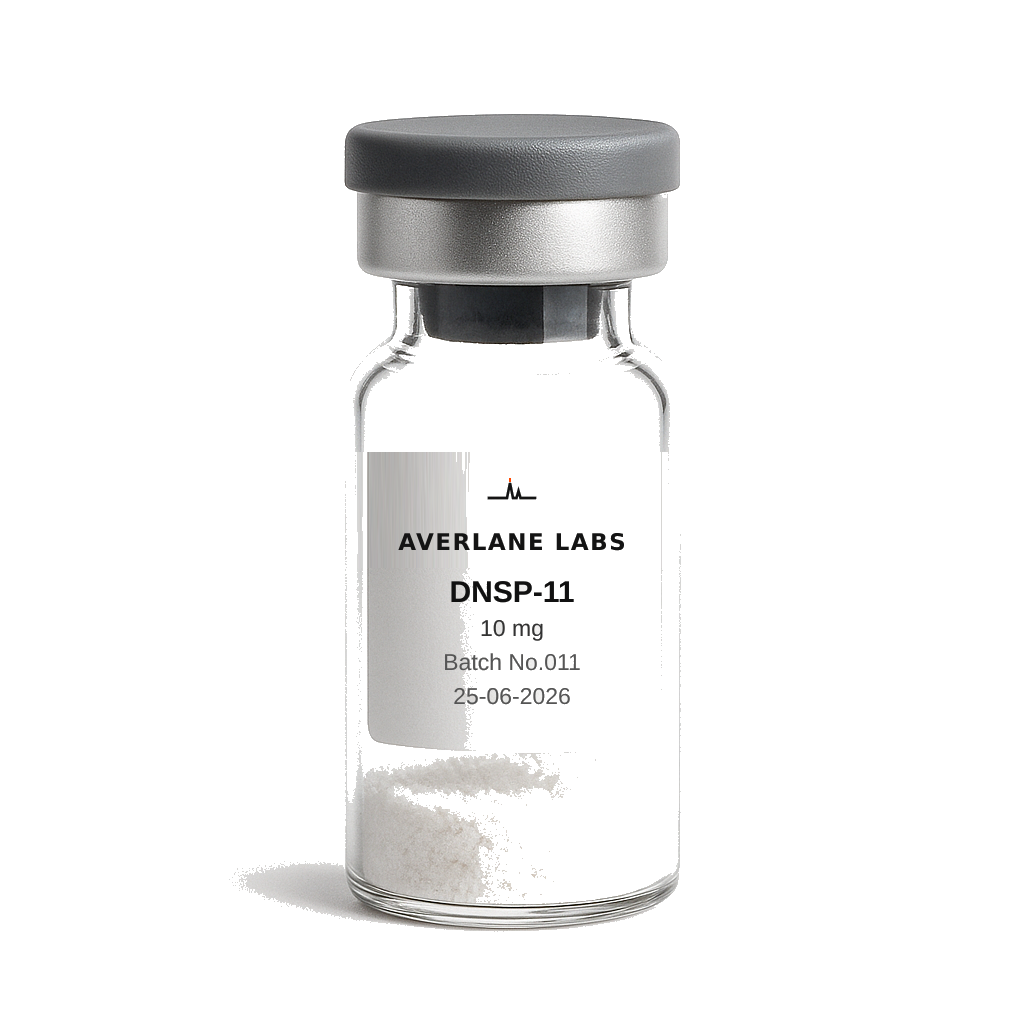
DNSP-11 10mg vial
Certificate of Analysis available on request for the current lot.
Complete the setup
Reconstitution and bench supplies researchers pair with DNSP-11 10mg vial
NOT FOR HUMAN CONSUMPTION
DNSP-11 is best viewed as an investigational neuroactive peptide derived from the proregion of GDNF (glial cell line-derived neurotrophic factor), not a proven therapeutic or consumer neuroregenerative peptide. Its strongest evidence is in preclinical Parkinson’s-disease-related models, where it has shown dopaminergic trophic-like activity, neurochemical effects, and some behavioral benefit, plus the ability to be delivered intranasally in animals. Human evidence is very limited and centers mainly on an early phase I intranasal safety/pharmacokinetic study, not efficacy.
Additional benefits of DNSP-11 under investigation
| Benefit | Take-away |
|---|---|
| 1. Dopaminergic neurotrophic-like support | This is the main reason DNSP-11 is studied. Cell and animal studies suggest support for dopaminergic neuron growth, differentiation, and function. |
| 2. Parkinson’s disease model relevance | DNSP-11 has shown encouraging effects in rodent PD models, including changes in dopamine turnover, protection of TH-positive neurons, and reduced rotational asymmetry in some studies. |
| 3. ERK1/2 signaling activation | A recurring mechanistic theme is ERK1/2 phosphorylation, which fits with trophic and neurite-support biology. |
| 4. Neuroprotection interest | In vitro work suggests protection against apoptosis and toxic injury, but in vivo neuroprotection is less clear-cut than marketing language implies. |
| 5. Intranasal delivery feasibility | DNSP-11 is notable because repeated intranasal delivery has been shown to reach the CNS and retain neuroactivity in rats, which is a practical advantage over many peptides. |
| 6. Better distribution logic than full GDNF | Reviews note that DNSP-11 lacks some of the large-molecule delivery limitations of GDNF and does not rely on direct GFRα1 binding in the same way. |
| 7. Stable peptide-development candidate | The peptide has been described as structurally stable and attractive for storage and formulation in preclinical work, but that does not prove clinical success. |
| 8. Not a proven human PD therapy | The evidence remains mostly preclinical, with no established human efficacy. |
2. Molecular mechanism of action
2.1 Receptor pharmacodynamics
DNSP-11 does not appear to work as a simple miniature GDNF replacement through the standard GFRα1/RET receptor pathway. Preclinical work suggests it has trophic-like effects on dopaminergic neurons through mechanisms that are at least partly independent of direct GFRα1 binding, which is one of the reasons it attracted interest as a distinct peptide rather than just a truncated GDNF fragment.
2.2 Downstream biology
| Pathway / theme | Functional outcome | Context |
|---|---|---|
| ERK1/2 activation | Supports trophic/neuroplasticity signaling | Dopaminergic cell studies |
| Dopaminergic neurite/growth effects | Growth and differentiation support | In vitro dopaminergic models |
| Neurochemical modulation | Increased dopamine metabolism/release in some settings | Nigrostriatal function studies |
| Anti-apoptotic/cell-protective effects | Protection from toxic injury in vitro | Preclinical neuroprotection |
These mechanisms are biologically plausible and fit the peptide’s reputation, but they still do not amount to strong proof of meaningful clinical benefit in humans.
3. Pharmacokinetics
Routes studied: direct brain infusion in animal work and intranasal delivery in both animals and early human testing. The practical point is that DNSP-11 was developed partly to overcome the delivery and biodistribution problems of larger trophic factors like GDNF. Repeated intranasal rat studies found CNS distribution and maintained neuroactivity, while review literature still notes uncertainty about whether it can adequately penetrate and reach targets under clinically relevant conditions.
4. Pre-clinical and clinical evidence
4.1 Parkinson’s / dopaminergic function
This is the best-supported niche. In cell systems and rodent studies, DNSP-11 has been associated with neuronal growth, differentiation, ERK1/2 activation, altered dopamine turnover, and some preservation of dopaminergic markers. In rat PD-related models, repeated intranasal administration reduced rotational behavior and showed evidence of sparing of tyrosine hydroxylase-positive neurons in the substantia nigra.
4.2 Neurochemical and behavioral effects
The picture is encouraging but mixed. One in vivo study found region-specific increases in potassium-evoked dopamine release after a single treatment, but no change in spontaneous locomotor activity. That supports neuroactivity, but it also shows that the leap from neurochemical effects to broad functional improvement is not automatic.
4.3 Neuroprotection
DNSP-11 has shown protective effects in vitro against toxic injury and apoptosis-related insults, but review literature has cautioned that in vivo results look more neuroactive than robustly neuroprotective. That is an important distinction, because a lot of peptide marketing blurs those categories.
4.4 Human evidence
Human evidence is very limited. The main published clinical signal is an early phase I intranasal FGLL/DNSP-11 safety and PK study in healthy volunteers, which is useful for tolerability framing but not evidence of efficacy in Parkinson’s disease or any other neurologic disorder. The absence of established later-stage clinical benefit is a major limitation.
5. Emerging clinical interests
| Field | Rationale | Status |
|---|---|---|
| Parkinson’s disease | Main development target via dopaminergic support | Preclinical-heavy; human efficacy unproven |
| Intranasal CNS peptide delivery | Practical route for bypassing BBB issues | Technically promising in animals |
| Neuroprotection / neurorestoration | Trophic-like and anti-apoptotic findings | Exploratory, especially in vivo |
| General neurodegeneration | Extension of dopaminergic repair logic | Speculative beyond PD-focused models |
6. Safety and tolerability
The most reassuring safety information is early and limited. Preclinical work supports reasonable experimental tolerability, and the human development literature provides some early intranasal safety/PK experience, but this is far from the kind of safety database expected for an established drug. So the correct framing is preliminarily encouraging but sparse, not well characterized.
7. Contraindications and cautions
Use extra caution with:
- Any claim that DNSP-11 is a proven PD treatment or neurorestorative therapy, because the evidence base remains mostly animal/preclinical.
- Self-experimentation or gray-market peptide sourcing, because formal human efficacy and longer-term safety data are lacking.
- Assuming intranasal delivery solves the translation problem, because promising animal delivery does not automatically equal clinical success.
- Replacing standard neurologic care, because DNSP-11 remains investigational rather than validated treatment.
8. Comparative practical matrix
| Feature | DNSP-11 |
|---|---|
| Main strength | Investigational dopaminergic neuroactive peptide |
| Best-supported use case | Preclinical Parkinson’s-related dopaminergic support |
| Clinical evidence depth | Very limited |
| Core limitation | Mostly animal data; no established human efficacy |
| Main mechanism | GDNF-proregion-derived trophic-like signaling with ERK1/2 activation |
| Delivery interest | Intranasal CNS delivery feasibility |
| Main safety concern | Sparse human data |
| Best practical framing | Research peptide, not a proven therapeutic |
9. Regulatory landscape
DNSP-11 is best understood as an investigational research peptide, not an approved mainstream therapy or validated supplement. Reviews of GDNF-targeting strategies still discuss it as an interesting attempt to capture trophic benefits with a smaller peptide, but they also emphasize that clinically meaningful translation has not yet been established.
10. Future directions
The most useful future work would be:
- larger and clearer human efficacy trials,
- better demonstration of disease modification rather than just neurochemical changes,
- further optimization of intranasal delivery,
- and more direct mechanistic clarification of how DNSP-11 differs from classic GDNF/RET signaling.
Best balanced summary
DNSP-11 is best viewed as a GDNF-proregion-derived investigational peptide with promising preclinical effects on dopaminergic neuron function, Parkinson’s-related animal models, and intranasal CNS delivery. Its biology is credible and more practically attractive than full GDNF in some respects, but the evidence remains mostly preclinical and does not establish DNSP-11 as a proven human neuroregenerative or Parkinson’s therapy.
Selected references
- Kelps KA, et al. Evaluation of the Physical and In Vitro Protective Activity of a Dopamine Neuron Stimulating Peptide. Good source for peptide characterization and in-vitro protective activity.
- Fuqua JL, et al. Dynamic Changes in Dopamine Neuron Function after DNSP-11 Treatment. Best source for in vivo dopamine-function and ERK1/2 findings.
- Stenslik MJ, et al. Methodology and effects of repeated intranasal delivery of DNSP-11 in normal and 6-OHDA rats. Best source for intranasal delivery and PD-model relevance.
- Sidorova YA, et al. Small Molecules and Peptides Targeting Glial Cell Line-Derived Neurotrophic Factor Receptors for the Treatment of Neurodegeneration. Best review-level source placing DNSP-11 in the broader translational landscape.
- Conway JA, et al. Is activation of GDNF/RET signaling the answer for successful treatment of Parkinson’s disease? Useful cautionary review noting that DNSP-11 appears neuroactive in vivo but not clearly neuroprotective.
Researcher reviews
No reviews yet for this lot line. Verified purchasers can leave the first one.
Reviews
There are no reviews yet.