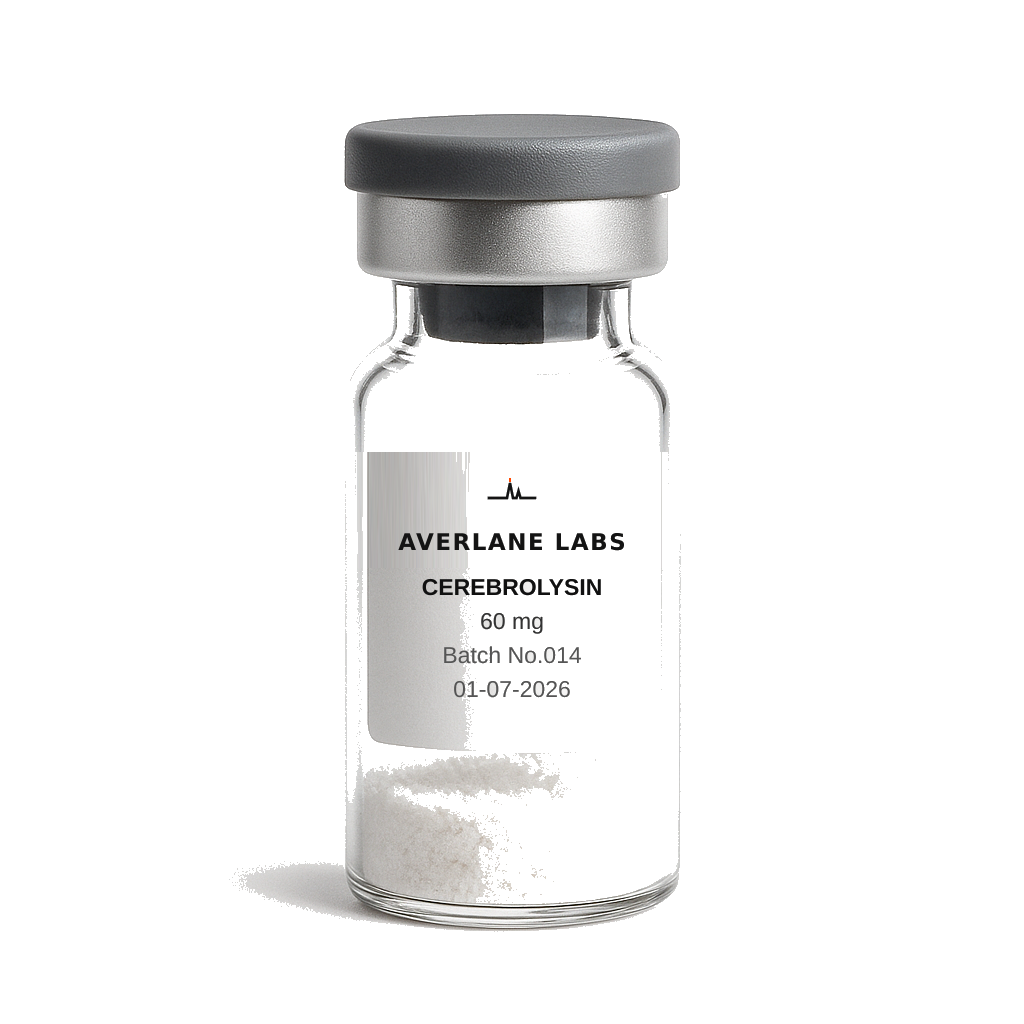
Cerebrolysin 60mg vial
Certificate of Analysis available on request for the current lot.
Complete the setup
Reconstitution and bench supplies researchers pair with Cerebrolysin 60mg vial
NOT FOR HUMAN CONSUMPTION
Cerebrolysin is a standardized porcine brain–derived peptide and amino-acid preparation (low–molecular-weight neuropeptides <10 kDa) formulated for parenteral use. It exerts neurotrophic-like activity, functionally mimicking BDNF/NGFsignaling, promoting neuronal survival, synaptogenesis, neurogenesis, and plasticity while dampening excitotoxicity, oxidative stress, and neuroinflammation. It is not FDA-approved; it is marketed in several countries (ex-US/UK) for stroke recovery, traumatic brain injury (TBI), and cognitive impairment based on regional evidence and guidelines.
Additional Benefits of Cerebrolysin Now Under Investigation
| Benefit | Key take-aways |
|---|---|
| 1 Post-ischemic stroke functional recovery | Meta-analyses and RCTs report improved global disability and NIHSS with early IV courses (e.g., 30 mL/day × 10–20 days), particularly when paired with structured rehab; heterogeneity and risk of bias remain. <br/><em>Stroke; Journal of Stroke & Cerebrovascular Diseases; European Stroke Journal</em> |
| 2 Traumatic brain injury (moderate–severe) | Signals for better Glasgow Outcome Scale-Extended, faster cognitive/motor gains, and lower mortality trends in some cohorts using 10–50 mL/day cycles; larger contemporary trials are needed. <br/><em>Neurorehabilitation & Neural Repair; Journal of Neurotrauma</em> |
| 3 Vascular/mixed cognitive impairment | Modest attention/executive and memory improvements across small RCTs; effects strengthen when combined with multidomain cognitive rehab. <br/><em>CNS Drugs; International Journal of Geriatric Psychiatry</em> |
| 4 Alzheimer’s disease (symptomatic) | Add-on to standard care shows short-term cognitive and global-function benefits in mild–moderate AD; durability and disease-modification are unproven. <br/><em>Alzheimer’s Research & Therapy; Journal of Alzheimer’s Disease</em> |
| 5 Aphasia & post-stroke language | Pilot trials indicate greater gains on aphasia batteries when Cerebrolysin is given concurrently with intensive speech therapy. <br/><em>Aphasiology; Neuropsychological Rehabilitation</em> |
| 6 Motor plasticity & gait | Enhanced Fugl-Meyer, Barthel Index, gait speed and DTI/fMRI plasticity markers when paired with task-specific physiotherapy. <br/><em>Neurorehabilitation & Neural Repair; Restorative Neurology & Neuroscience</em> |
| 7 Post-ICU/encephalopathy recovery | Observational programs suggest faster cognitive/functional rebound after toxic-metabolic encephalopathy; controlled evidence is preliminary. <br/><em>Critical Care Medicine; Frontiers in Neurology</em> |
| 8 Neuroprotection biomarkers | In models and small human studies: ↑BDNF, ↓NfL, ↓MDA/oxidative stress, and ↓pro-inflammatory cytokines, paralleling clinical improvements. <br/><em>Molecular Neurobiology; Frontiers in Aging Neuroscience</em> |
| 9 Combination neurorehab strategies | Additive effects with robot-assisted therapy, NMES, rTMS/tDCS, and early mobilization, supporting a “drug-plus-dose-dense-rehab” paradigm. <br/><em>Clinical Neurophysiology; Archives of Physical Medicine & Rehabilitation</em> |
2. Molecular Mechanism of Action
2.1 Pharmacodynamics
Cerebrolysin’s peptide fractions activate Trk receptors (TrkB/TrkA-like) and downstream PI3K–Akt and MAPK–ERK cascades, enhancing CREB signaling → synaptic protein expression (synapsin, PSD-95), neurite outgrowth, and anti-apoptosis (Bcl-2↑/caspase↓). Additional actions include NMDA/GABA balance (anti-excitotoxic), microglial modulation (NF-κB down-tuning), mitochondrial support, and amyloid/tau pathway normalization in models.
2.2 Down-stream Biology
| Pathway | Functional outcome | Context |
|---|---|---|
| BDNF/TrkB → PI3K–Akt–CREB | Neuronal survival, LTP, synaptogenesis | Hippocampus/cortex |
| MAPK–ERK | Plasticity, learning, neurogenesis | Neurorehab windows |
| NMDA/GABA re-balancing | Anti-excitotoxicity, network stability | Acute/subacute injury |
| NF-κB / NLRP3 restraint | ↓ Microglial cytokines, ↓ inflammation | Stroke/TBI, AD |
| Oxidative stress control | ↓ ROS/lipid peroxidation; mitochondrial support | Ischemia–reperfusion |
| Aβ/tau modulation | ↓ Amyloid toxicity, ↓ tau hyper-phosphorylation (models) | AD-like settings |
3. Pharmacokinetics
-
Composition: Low-MW neuropeptides and free amino acids; parenteral only.
-
BBB access: Peptides <10 kDa and fragments cross the BBB; pharmacodynamic effects outlast plasma exposure.
-
Half-life: Short (minutes–hours) for peptide components; signaling changes persist for days–weeks.
-
Dosing in studies: IV infusion 5–50 mL/day (often 30 mL/day) for 10–20 days, repeated every 1–3 months in subacute/chronic phases; IM 5 mL used in some protocols.
4. Pre-clinical and Translational Evidence
4.1 Stroke
Rodent and primate stroke models show smaller infarcts, better neurologic scores, and enhanced peri-infarct plasticity. Human RCTs/meta-analyses suggest functional benefits with early use + rehab, but trial heterogeneity(timing, dose, endpoints) tempers certainty.
4.2 Traumatic Brain Injury
Improved consciousness metrics, cognition, and activities of daily living reported in several trials/series; multi-center, modern-design RCTs are warranted.
4.3 Cognitive Disorders
In vascular/mixed impairment and mild–moderate AD, repeated courses yield modest cognitive and global-function gains; disease-modifying effects remain unproven.
Evidence quality note: The totality of evidence is supportive but heterogeneous (regional RCTs, varying quality). Benefits appear greatest when combined with early, intensive rehabilitation and standardized dosing.
5. Emerging Clinical Interests
| Field | Rationale | Current status |
|---|---|---|
| Aphasia/upper-limb recovery | Trophic plasticity + task-specific training | Phase 2–style signals |
| Post-ICU cognitive dysfunction | Anti-inflammatory/mitochondrial support | Observational/pilot |
| Long-COVID cognitive issues | Neuroinflammatory modulation | Exploratory |
| Perioperative neurocognitive disorder | Synaptic resilience | Concept/feasibility |
| Parkinson’s-related cognitive decline | Synaptic/mitochondrial support | Early studies |
6. Safety and Tolerability
-
Common: Injection-site reactions, transient agitation/anxiety, dizziness, headache, flushing, sweating, insomnia; generally mild.
-
Less common/rare: Allergic reactions, blood-pressure lability; avoid in known hypersensitivity.
-
Seizure risk: Use caution in uncontrolled epilepsy (excitability symptoms possible).
-
Drug interactions: No major CYP interactions expected; monitor with CNS-active regimens (sedatives/stimulants) and antihypertensives.
-
Geriatrics/polymedication: Good short-course tolerability in studies; continue routine BP and neurostatuschecks.
Comparative safety matrix
| Concern | Cerebrolysin | Citicoline (CDP-choline) | Edaravone |
|---|---|---|---|
| Route | IV/IM cycles | Oral/IV | IV |
| Evidence focus | Stroke/TBI, VCI/AD (symptomatic) | Stroke recovery, cognition | ALS (JP), stroke (select regions) |
| AEs | Mild CNS/vasomotor | GI, headache (mild) | Infusion reactions, renal risk |
| Role | Neurotrophic + rehab adjunct | Membrane/choline donor | Free-radical scavenger |
7. Regulatory Landscape
-
Status: Not FDA/EMA-approved; marketed in several countries as an injectable neuropeptide preparation for stroke/TBI/cognitive impairment.
-
Guidance: Best supported as an adjunct to structured neurorehabilitation with early initiation and repeat cycles where locally permitted.
8. Future Directions
-
Modern, adequately powered RCTs with standardized dosing (e.g., 30 mL/day × 10–20 days) and core outcome sets (mRS/NIHSS, Fugl-Meyer, language batteries, PROMs).
-
Precision timing: Initiation within days of stroke/TBI; evaluate dose–response and cycle frequency.
-
Biomarkers & imaging: Serum/CSF BDNF, NfL, inflammatory panels; DTI/fMRI for network plasticity; digital mobility/cognition endpoints.
-
Combination therapy: Pair with high-intensity rehab, speech therapy, robotics, rTMS/tDCS; examine synergyand sequencing.
-
Real-world registries: Safety, adherence, and comparative effectiveness vs citicoline, memantine, donepezil, and standard rehab.
Selected References
-
Stroke; European Stroke Journal; Journal of Stroke & Cerebrovascular Diseases, Acute/subacute stroke trials and meta-analyses of Cerebrolysin.
-
Neurorehabilitation & Neural Repair; Archives of Physical Medicine & Rehabilitation, Functional recovery, motor outcomes, and rehab synergy.
-
Journal of Neurotrauma; Brain Injury, TBI cohorts and functional/cognitive endpoints.
-
CNS Drugs; International Journal of Geriatric Psychiatry, Vascular/mixed cognitive impairment and safety in older adults.
-
Alzheimer’s Research & Therapy; Journal of Alzheimer’s Disease, Add-on symptomatic effects in mild–moderate AD.
-
Molecular Neurobiology; Frontiers in Aging Neuroscience, Mechanistic work: neurotrophic signaling, inflammation, oxidative stress, biomarkers.
-
Restorative Neurology & Neuroscience; Clinical Neurophysiology, Plasticity measures (DTI, fMRI) and combination neuromodulation.
Researcher reviews
No reviews yet for this lot line. Verified purchasers can leave the first one.
Reviews
There are no reviews yet.