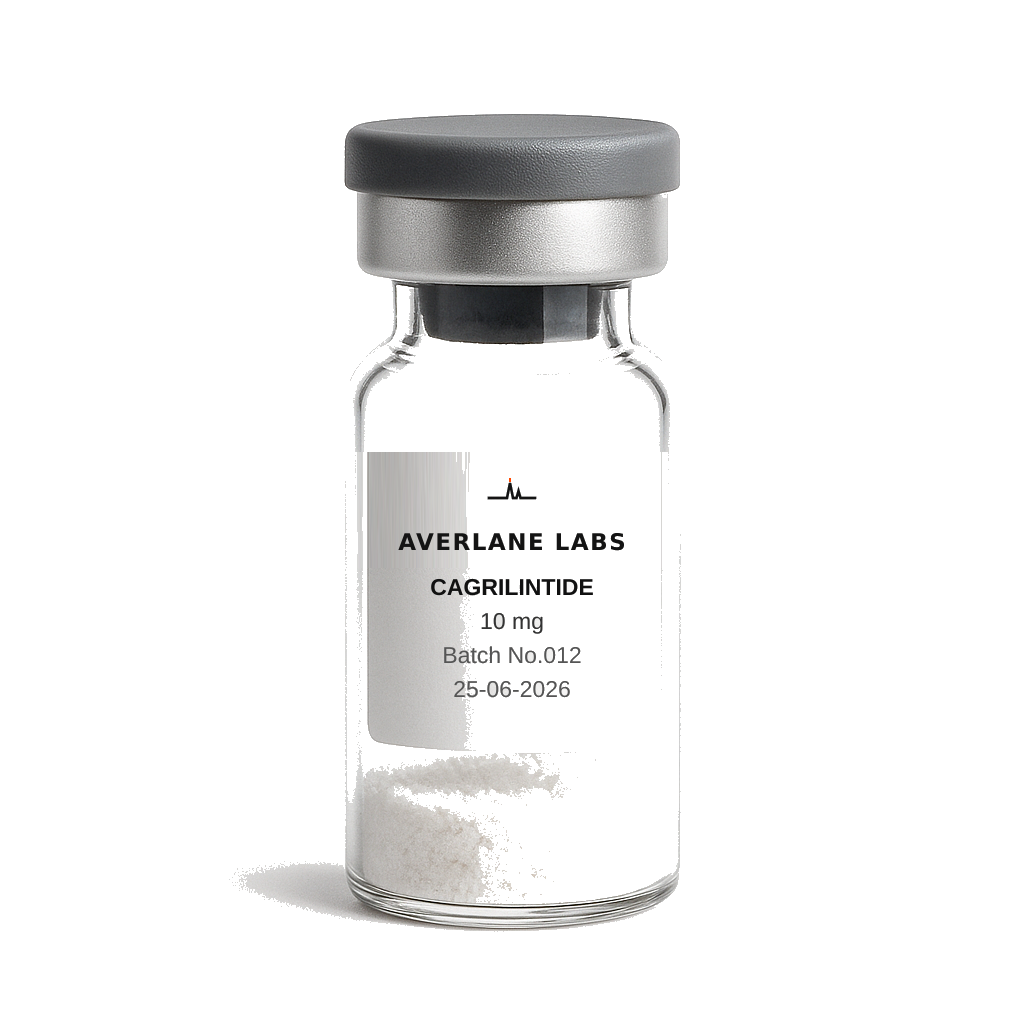
Cagrilintide 10mg vial
Certificate of analysis
Lot AL-CAGRIL-2610 · Purity 99.26% · Tested 2026-08-21
Complete the setup
Reconstitution and bench supplies researchers pair with Cagrilintide 10mg vial
NOT FOR HUMAN CONSUMPTION
Cagrilintide is a novel, long-acting amylin analogue under development primarily for obesity management and type 2 diabetes mellitus (T2DM). It mimics and extends the physiological effects of endogenous amylin, a pancreatic hormone co-secreted with insulin, by regulating gastric emptying, satiety, and food intake. Cagrilintide is administered once weekly via subcutaneous injection and is being investigated both as monotherapy and in combination with semaglutide, a GLP-1 receptor agonist, in a dual-agonist formulation referred to as CagriSema.
2. Mechanism of Action
Cagrilintide exerts its pharmacologic effects through dual receptor activation:
-
Amylin Receptor Agonism: Enhances satiety, delays gastric emptying, and reduces postprandial glucagon secretion.
-
Calcitonin Receptor Agonism (minor activity): Contributes to appetite regulation and weight modulation.
This dual activity distinguishes cagrilintide from endogenous amylin and its predecessor, pramlintide, by offering prolonged receptor engagement and greater weight-reduction potential.
3. Clinical Efficacy
3.1. Monotherapy Trials
In a Phase 2 randomized, placebo-controlled trial (Marre et al., The Lancet, 2021), over 300 adults with obesity received varying doses of cagrilintide (0.3–4.5 mg) or liraglutide 3.0 mg daily for 26 weeks. Results included:
-
Mean weight reduction of up to 8.1% at the highest cagrilintide dose.
-
Superior weight loss versus liraglutide (6.8%) and placebo (1.6%).
-
Improvements in waist circumference, systolic blood pressure, and patient-reported appetite scores.
3.2. Combination Therapy (CagriSema)
Cagrilintide has shown remarkable synergy when combined with semaglutide:
Phase 2 Trial (CagriSema vs. Semaglutide vs. Cagrilintide Alone):
-
Population: Adults with T2DM and overweight or obesity.
-
Duration: 32 weeks.
-
Findings:
-
CagriSema: ~15.6% weight loss.
-
Semaglutide 2.4 mg alone: ~5.1%.
-
Cagrilintide 2.4 mg alone: ~8.1%.
-
This indicates an additive or possibly synergistic effect when both agents are used concurrently.
REDEFINE 2 Phase 3 Trial (2024, Novo Nordisk):
-
Population: Adults with T2DM and BMI ≥27 kg/m².
-
Duration: 68 weeks.
-
Results:
-
CagriSema group: 15.7% mean weight loss.
-
Placebo group: 3.1%.
-
Also noted improvements in HbA1c, fasting glucose, and lipid profiles.
-
4. Safety and Tolerability
Across studies, cagrilintide has demonstrated a favorable safety profile:
-
Most common adverse events: Gastrointestinal symptoms (nausea, vomiting, constipation), dose-dependent and transient.
-
Hypoglycemia risk: Minimal when used without insulin or insulin secretagogues.
-
Cardiac safety: No significant QT prolongation; no increase in major adverse cardiovascular events (MACE).
-
Immunogenicity: Low incidence of anti-drug antibodies; no impact on efficacy observed.
5. Pharmacokinetics
-
Half-life: Approximately 150 hours, supporting once-weekly dosing.
-
Absorption: Delayed Tmax (~72 hours), with stable weekly plasma concentrations.
-
Elimination: Renal excretion is minor; no dose adjustment required for mild/moderate renal impairment.
6. Clinical Development and Future Outlook
Cagrilintide is part of Novo Nordisk’s REDEFINE clinical trial program, targeting both monotherapy and dual-therapy use:
-
REDEFINE 1–6 Trials: Ongoing Phase 3 studies in various patient subgroups (obesity, T2DM, prediabetes).
-
Combination Focus: CagriSema is expected to be a first-in-class dual peptide for chronic weight and glucose management.
-
Potential indications: Obesity, T2DM, metabolic syndrome, possibly for cardiovascular risk reduction pending outcomes.
If regulatory approval is granted, CagriSema could redefine obesity pharmacotherapy, offering superior efficacy with manageable tolerability.
7. Conclusion
Cagrilintide represents a significant advancement in metabolic therapeutics. Its ability to induce meaningful weight loss, especially in combination with GLP-1 agonists like semaglutide, places it at the forefront of next-generation obesity and diabetes management. Pending long-term safety and cardiovascular outcome data, it holds promise for widespread clinical adoption.
Key References
-
Marre M, et al. The Lancet, 2021. DOI: 10.1016/S2213-8587(21)00203-0
-
Davies M, et al. Lancet Diabetes Endocrinol., 2023. PMID: 37364590
-
Rosenstock J, et al. Diabetes Obes Metab., 2023. DOI: 10.1111/dom.15951
-
Novo Nordisk press release: REDEFINE 2 Trial Results, 2024
-
Wadden TA, et al. Obesity, 2024. Clinical implications of CagriSema dual therapy.
Researcher reviews
No reviews yet for this lot line. Verified purchasers can leave the first one.
Reviews
There are no reviews yet.