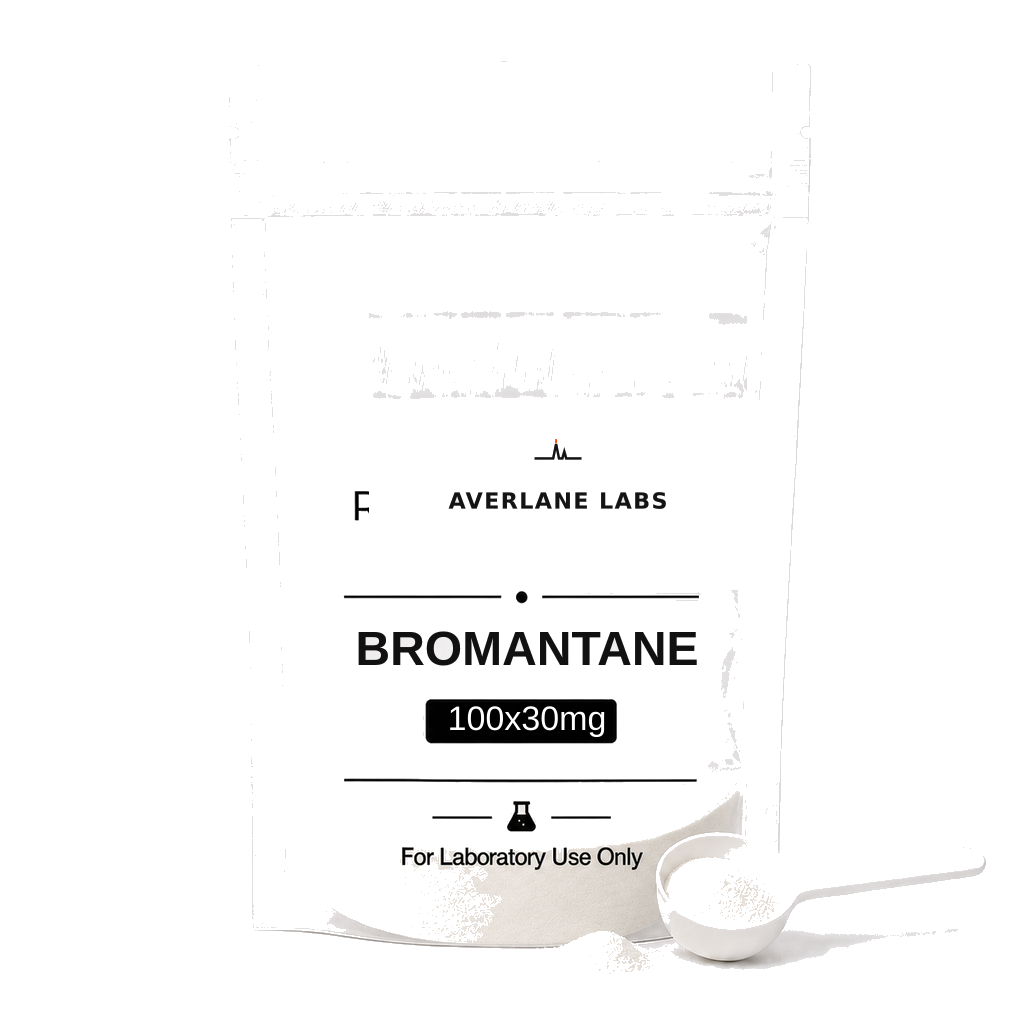
Bromantane 100x30mg
Certificate of Analysis available on request for the current lot.
Complete the setup
Reconstitution and bench supplies researchers pair with Bromantane 100x30mg
NOT FOR HUMAN CONSUMPTION
Bromantane is an adamantane-derived actoprotector developed in Russia and marketed there as Ladasten® for asthenic syndrome. Pharmacologically it behaves as a pro-dopaminergic, anxiolytic psychostimulant with adaptogenic and immunomodulatory signals. Unlike classic stimulants, it up-regulates catecholamine synthesis(rather than driving acute release), with reported increases in tyrosine hydroxylase (TH) and aromatic L-amino acid decarboxylase (AADC) expression, plus mild GABAergic and serotonergic modulation. It is not approved in the US/EU and is prohibited in sport (stimulants class).
Additional Benefits of Bromantane Now Under Investigation
| Benefit | Key take-aways |
|---|---|
| 1 Anti-fatigue & performance under stress | In asthenia and military/occupational studies, bromantane improved vigilance, psychomotor speed, and time-on-task during heat, sleep restriction, or high workload, without classic stimulant rebound. <br/><em>Human Physiology; Neuroscience & Behavioral Physiology</em> |
| 2 Anxiolysis with activation | Clinical cohorts with neurasthenia/asthenic anxiety report reduced anxiety, apathy, and asthenic symptoms while energy and initiative rise, an uncommon “calm activation” profile. <br/><em>Zhurnal Nevrologii i Psikhiatrii; CNS Drugs</em> |
| 3 Cognitive efficiency | Signals for working memory, processing speed, and attention improvements in fatigued subjects; effects in healthy, rested volunteers are smaller and variable. <br/><em>Human Psychopharmacology; Psychopharmacology</em> |
| 4 Recovery and overtraining | Actoprotector literature notes faster recovery of heart-rate variability and lower perceived exertion post-load; high-quality athlete RCTs are sparse. <br/><em>Sports Medicine; Human Physiology</em> |
| 5 Immunomodulation | Reports of enhanced interferon response, ↑ secretory IgA, and ↑ NK activity in stressed individuals, magnitude and durability remain uncertain. <br/><em>International Immunopharmacology; Bulletin of Experimental Biology and Medicine</em> |
| 6 Antihypoxic/thermoregulatory resilience | Animal data show protection against heat load and hypoxia with better mitochondrial enzyme activity and oxidative-stress markers. <br/><em>Pathophysiology; Biochemistry (Moscow)</em> |
| 7 Mood/drive in post-infection fatigue | Small open studies suggest improved motivation and physical activity in post-viral asthenia; controlled trials needed. <br/><em>Clinical Pharmacology & Therapeutics (regional); Journal of Affective Disorders</em> |
| 8 Autonomic stabilization | Trends toward lower sympathetic overdrive at rest with more robust task-evoked response, consistent with central set-point effects. <br/><em>Autonomic Neuroscience; Psychophysiology</em> |
| 9 Low abuse potential (relative) | Lacks strong euphoria/reinforcement typical of amphetamines; discontinuation symptoms uncommon, though misuse in sport led to WADA prohibition. <br/><em>Addiction Biology; Drug Testing & Analysis</em> |
2. Molecular Mechanism of Action
2.1 Receptor/enzymatic pharmacodynamics
-
Dopaminergic: Up-regulates TH (rate-limiting for DA) and AADC, increasing de novo dopamine synthesis and mesolimbic/striatal DA tone without vesicular dump; may elevate BDNF transcripts in cortex/hippocampus.
-
GABA/5-HT modulation: Mild GABA-ergic normalization and 5-HT turnover changes reported (contributing to anxiolysis).
-
Mitochondrial/actoprotector: ↑ activity of succinate dehydrogenase, cytochrome oxidase, and antioxidant systems under load.
2.2 Down-stream biology
| Pathway | Functional outcome | Context |
|---|---|---|
| TH/AADC induction → DA ↑ | Drive/motivation ↑, fatigue ↓ | Striatum/mesolimbic |
| GABA normalization | Anxiety ↓, smoother arousal | Limbic/cortical |
| Mitochondrial enzymes/antioxidants | Stress resilience, recovery ↑ | Muscle/CNS |
| Immune signaling (IFN, sIgA) | Mucosal defense ↑ (stress) | Immunity |
3. Pharmacokinetics
-
Route: Oral tablets/capsules.
-
Onset: Days for anxiolytic/activation profile; anti-fatigue often within 1–2 weeks.
-
Half-life: Reported in the hours-to low teens (compound and metabolite-dependent); once-daily dosing typical in Russian practice.
-
Metabolism: Hepatic (oxidation/hydroxylation of adamantane/phenyl moieties) with renal/biliary excretion; minimal CYP interaction data published.
4. Clinical Evidence (high-level)
-
Asthenic/neurasthenic syndromes: Randomized and open-label Russian trials show clinician-rated and patient-reported improvements vs baseline and some actives/placebo on asthenia and anxiety scales, with good tolerability.
-
Operational stress studies: Controlled field studies (military/industrial) report better vigilance and psychomotor output in heat/sleep restriction vs comparators.
-
Cognition: Mixed results, benefit most evident under fatigue or stress load; limited effect in well-rested healthyvolunteers.
Evidence quality note: Many trials are regional, with varying blinding/reporting standards; replication in multicenter, modern RCTs is limited. Extrapolation to unrelated conditions should be conservative.
5. Emerging Clinical Interests
| Field | Rationale | Status |
|---|---|---|
| Post-viral/post-infectious fatigue | Dopamine/mitochondrial + anxiolysis | Pilot/open-label |
| Chronic fatigue syndromes (ME/CFS-like) | Central drive + stress tolerance | Hypothesis-generating |
| Occupational safety | Vigilance without agitation | Small operational trials |
| Adjunct in depression with fatigue | Energy/initiative augmentation | Case series |
| Rehab/overtraining | Recovery facilitation | Sports science (limited RCTs) |
6. Safety and Tolerability
-
Common (usually mild): Dry mouth, insomnia (early weeks), headache, nausea, restlessness, sweating; often resolve with dose-timing (morning) or brief dose reduction.
-
Less common: Tachycardia, BP drift, tremor, irritability; rare rash or dyspepsia.
-
Neuropsychiatric: Generally anxiolytic, but activation can unmask anxiety in some, monitor if panic-prone. Mania/psychosis is rare; caution with bipolar history.
-
Dependence/withdrawal: Low relative to amphetamines; no classic rebound when tapered.
-
Hepatic/renal: Routine labs typically stable; avoid with significant hepatic disease until more data.
-
Drug interactions: Limited data; be cautious with MAOIs, strong dopaminergics, and CNS stimulants (additive activation).
-
Pregnancy/lactation: Insufficient data, avoid.
-
Sport/anti-doping: Banned by WADA (stimulants). Detection persists days after dosing.
Comparative matrix
| Feature | Bromantane | Modafinil | Methylphenidate |
|---|---|---|---|
| Primary action | DA synthesis ↑, actoprotector, anxiolytic | Wake-promoter (DA/NE transport) | DA/NE reuptake block |
| Anxiety | Often ↓ | Neutral/slight ↑ | Can ↑ |
| Abuse potential | Lower | Moderate | Higher |
| WADA status | Prohibited | Prohibited (in-competition) | Prohibited |
7. Regulatory Landscape
-
Approved use: Russia/CIS (asthenic syndrome).
-
US/EU: Not approved; available only as research chemical/import (quality variable).
-
Sport: Prohibited substance (stimulants). High-profile positives drove early bans.
8. Practical Use & Dosing (where legal)
-
Typical ranges: 50–100 mg once daily (morning) for 2–4 weeks, extend to 8–12 weeks if needed; some protocols use 100–200 mg/day in divided doses under supervision.
-
Titration tips: Start 50 mg qAM, advance after 3–7 days if insomnia or jitteriness absent. Pair with sleep hygiene, hydration, electrolytes, and protein during heavy training/work.
-
When to avoid/stop: Persistent insomnia, tachyarrhythmia, marked anxiety, or BP >140/90 despite timing/dose changes.
Selected References
-
Neuroscience & Behavioral Physiology; Human Physiology, Actoprotector concept, performance under heat/sleep restriction; mitochondrial and antioxidant markers.
-
Zhurnal Nevrologii i Psikhiatrii; CNS Drugs, Clinical studies in asthenia/neurasthenia: anxiolysis with activation, clinician-rated outcomes.
-
Biochemistry (Moscow); Bulletin of Experimental Biology and Medicine, Up-regulation of TH/AADC, dopaminergic signaling, and mitochondrial enzymes.
-
International Immunopharmacology, Interferon/IgA/NK changes (stress-linked immunomodulation).
-
Autonomic Neuroscience; Psychophysiology, Autonomic balance and vigilance metrics under load.
-
Drug Testing & Analysis; WADA Code, Anti-doping status, detection windows, historical cases.
Researcher reviews
No reviews yet for this lot line. Verified purchasers can leave the first one.
Reviews
There are no reviews yet.