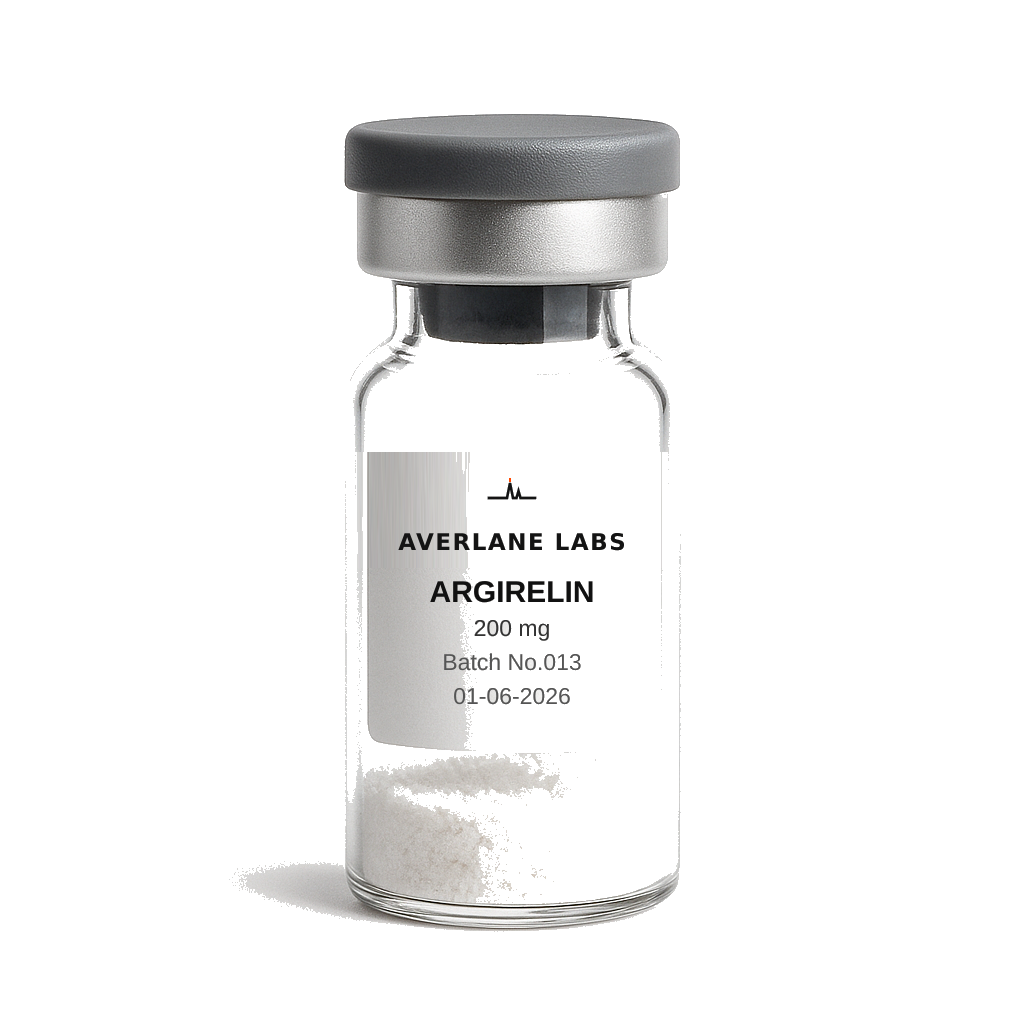
Argirelin 200mg vial
Certificate of analysis
Lot AL-ARGIRE-2624 · Purity 97.10% · Tested 2026-07-10
Complete the setup
Reconstitution and bench supplies researchers pair with Argirelin 200mg vial
NOT FOR HUMAN CONSUMPTION
Argireline usually refers to acetyl hexapeptide-8 (AH-8), a topical cosmetic “neurotransmitter peptide” best viewed as a cosmeceutical anti-wrinkle ingredient, not a proven medical alternative to botulinum toxin. Its main appeal is that it was designed from part of SNAP-25 and is marketed to reduce expression-line formation by interfering with vesicle-release signaling. The strongest defensible claim is modest topical wrinkle-improvement support, while broader claims about “Botox in a bottle” are clearly overstated. The evidence is supportive but limited, with small clinical studies, formulation-dependent results, and ongoing uncertainty about how much peptide reaches relevant skin targets.
Additional benefits of Argireline under investigation
| Benefit | Take-away |
|---|---|
| 1. Expression-wrinkle support | This is the clearest use case. Small human studies suggest improvement in peri-orbital or facial wrinkle measures, but the effect size is modest and not equivalent to injected botulinum toxin. |
| 2. Dynamic-wrinkle interest | Because the proposed mechanism is neuromuscular-signaling interference, it is often framed as more relevant to dynamic/expression lines than to deep static rhytids. |
| 3. Skin-texture / elasticity support | Reviews and newer cosmetic studies report possible improvement in elasticity, hydration, and overall texture, but these outcomes are formulation-dependent and not uniquely specific to Argireline alone. |
| 4. Blepharospasm interest | A small pilot study explored topical AH-8 for blepharospasm, which is interesting mechanistically, but this is far from an established indication. |
| 5. “Botox-like” positioning | This is common marketing language, but the best scientific framing is only that Argireline is inspired by SNAP-25-related neurotransmitter biology; it is not a proven clinical substitute for botulinum toxin. |
| 6. Formulation-dependent performance | Delivery matters a lot. Reviews emphasize that skin penetration is a major limitation and that emulsions, patches, and other systems may affect outcomes. |
| 7. Generally favorable cosmetic safety | Cosmetic safety reviews have concluded acetyl hexapeptide-8 is safe in cosmetics under present practices of use, including reported use up to 0.005%. |
| 8. Not a proven broad anti-aging treatment | The evidence supports a narrow cosmetic anti-wrinkle interpretation, not broad regenerative or systemic anti-aging claims. |
2. Molecular mechanism of action
2.1 Receptor pharmacodynamics
Argireline does not have a classic single-receptor drug pharmacology. It is a synthetic peptide modeled on the N-terminus of SNAP-25, and the proposed mechanism is interference with SNARE-complex-related vesicle docking and acetylcholine release. In practice, this is why it is called a “neurotransmitter peptide” in cosmetic science. However, the mechanistic analogy to botulinum toxin is much stronger than the clinical equivalence.
2.2 Downstream biology
| Pathway / theme | Functional outcome | Context |
|---|---|---|
| SNAP-25 mimicry / SNARE interference | Reduced neurotransmitter release proposed | Cosmetic anti-wrinkle rationale |
| Reduced acetylcholine signaling | Less contraction-related wrinkling proposed | Expression lines |
| Formulation-mediated skin delivery | Determines whether enough peptide reaches relevant targets | Topical product performance |
These mechanisms are biologically plausible, but the key uncertainty is still delivery: whether topically applied AH-8 reaches the right depth and targets in meaningful amounts remains debated.
3. Pharmacokinetics
Route: topical.
The practical value of Argireline is entirely tied to topical formulation, not systemic pharmacology. A 2025 review and earlier penetration work both emphasize that skin penetration is a major constraint, especially if one is claiming effects analogous to neuromuscular signaling modulation. That means “Argireline works” is too simplistic; performance likely depends heavily on vehicle, concentration, exposure time, and product design.
4. Pre-clinical and clinical evidence
4.1 Facial wrinkles / photoaging
This is the best-supported niche. A 2013 clinical study in Chinese subjects reported safety and efficacy signals for peri-orbital wrinkles, and newer cosmetic studies continue to report small improvements in wrinkle scores and skin-aging parameters after several weeks of use. Still, these are mostly small cosmetic studies, not large therapeutic trials.
4.2 Standalone evidence quality
The overall evidence is supportive but not robust. Reviews describe wrinkle-depth and elasticity improvements, but they also note mechanistic uncertainty and formulation dependence. This is enough to justify its reputation as a plausible anti-wrinkle ingredient, but not enough to justify strong drug-like claims.
4.3 Delivery-enhanced systems
Some clinical work has used microneedle patches or specially designed serum systems containing AH-8, which suggests that delivery enhancement may improve visible outcomes. That also means results from one product should not be casually generalized to all Argireline products.
4.4 Medical / neuromuscular uses
A pilot study explored topical AH-8 for blepharospasm, showing interest beyond cosmetics, but this remains preliminary and very far from an established medical indication.
5. Emerging clinical interests
| Field | Rationale | Status |
|---|---|---|
| Topical anti-wrinkle skincare | Main commercial use | Supportive but modest |
| Dynamic expression lines | “Neurotransmitter peptide” rationale | Plausible, formulation-dependent |
| Delivery-enhanced wrinkle treatment | Patches / advanced serums may improve local effect | Early cosmetic translational use |
| Blepharospasm / neuromuscular cosmetic-medical overlap | SNAP-25-related rationale | Exploratory only |
6. Safety and tolerability
For cosmetic topical use, the safety picture is fairly reassuring. The Cosmetic Ingredient Review panel concluded that acetyl hexapeptide-8 / acetyl hexapeptide-8 amide is safe in cosmetics under present practices of use, with reported use concentrations up to 0.005% in the safety assessment. That supports routine cosmetic use much more than any aggressive medical framing.
Still, “safe in cosmetics” should not be stretched into “proven under every use condition.” Irritation, formulation-specific reactions, and unrealistic expectations remain the bigger practical concerns.
7. Contraindications and cautions
Use extra caution with:
- “Botox in a bottle” claims, because the evidence does not support equivalence to botulinum toxin.
- Assuming all Argireline products are interchangeable, because formulation and delivery seem to matter a lot.
- Replacing established dermatologic procedures with Argireline alone when someone wants strong wrinkle reduction, because the effect profile is much milder.
- Extrapolating cosmetic results to medical neuromuscular treatment, because the blepharospasm literature is only preliminary.
8. Comparative practical matrix
| Feature | Argireline |
|---|---|
| Main strength | Topical cosmetic anti-wrinkle peptide |
| Best-supported use case | Mild-to-moderate wrinkle appearance support |
| Clinical evidence depth | Small, supportive, but not robust |
| Core limitation | Delivery uncertainty and modest effect size |
| Main mechanism | SNAP-25-derived “neurotransmitter peptide” rationale |
| Short-term topical tolerability | Generally favorable |
| Main safety concern | More about overclaiming than major known toxicity |
| Best practical framing | Cosmeceutical wrinkle-support ingredient, not a Botox replacement |
9. Regulatory landscape
Argireline is best understood as a cosmetic ingredient, not an approved anti-wrinkle drug. Its strongest defensible positioning is as a topical cosmeceutical peptide with modest wrinkle-support evidence and a favorable cosmetic safety profile.
10. Future directions
The most useful future work would be:
- better Argireline-alone randomized trials,
- clearer dose- and vehicle-specific comparisons,
- stronger data on skin penetration and target engagement,
- and head-to-head comparisons versus other topical wrinkle peptides and standard cosmetic approaches.
Best balanced summary
Argireline is best viewed as a topical cosmetic peptide with plausible and modest anti-wrinkle benefits, especially for expression-line appearance. Its mechanism, based on SNAP-25-related neurotransmitter signaling, is biologically interesting, but clinical effects are much smaller and less certain than marketing phrases like “Botox-like” suggest. The ingredient is better framed as a reasonable cosmeceutical wrinkle-support peptide than as a proven medical anti-aging therapy.
Selected references
- Zdrada-Nowak J, et al. Acetyl Hexapeptide-8 in Cosmeceuticals, A Review of Skin Permeability and Efficacy.2025 review on mechanism, penetration limits, and efficacy framing.
- Wang Y, et al. The anti-wrinkle efficacy of argireline, a synthetic hexapeptide, in Chinese subjects. Key clinical wrinkle study.
- Henseler H, et al. Investigating the effects of Argireline in a skin serum. Recent small clinical/cosmetic study.
- Kraeling ME, et al. In vitro skin penetration of acetyl hexapeptide-8 from a cosmetic formulation. Important source on the delivery limitation question.
- Cosmetic Ingredient Review Expert Panel. Safety Assessment of Acetyl Hexapeptide-8 Amide as Used in Cosmetics. Best source for cosmetic safety framing.
Researcher reviews
No reviews yet for this lot line. Verified purchasers can leave the first one.
Reviews
There are no reviews yet.