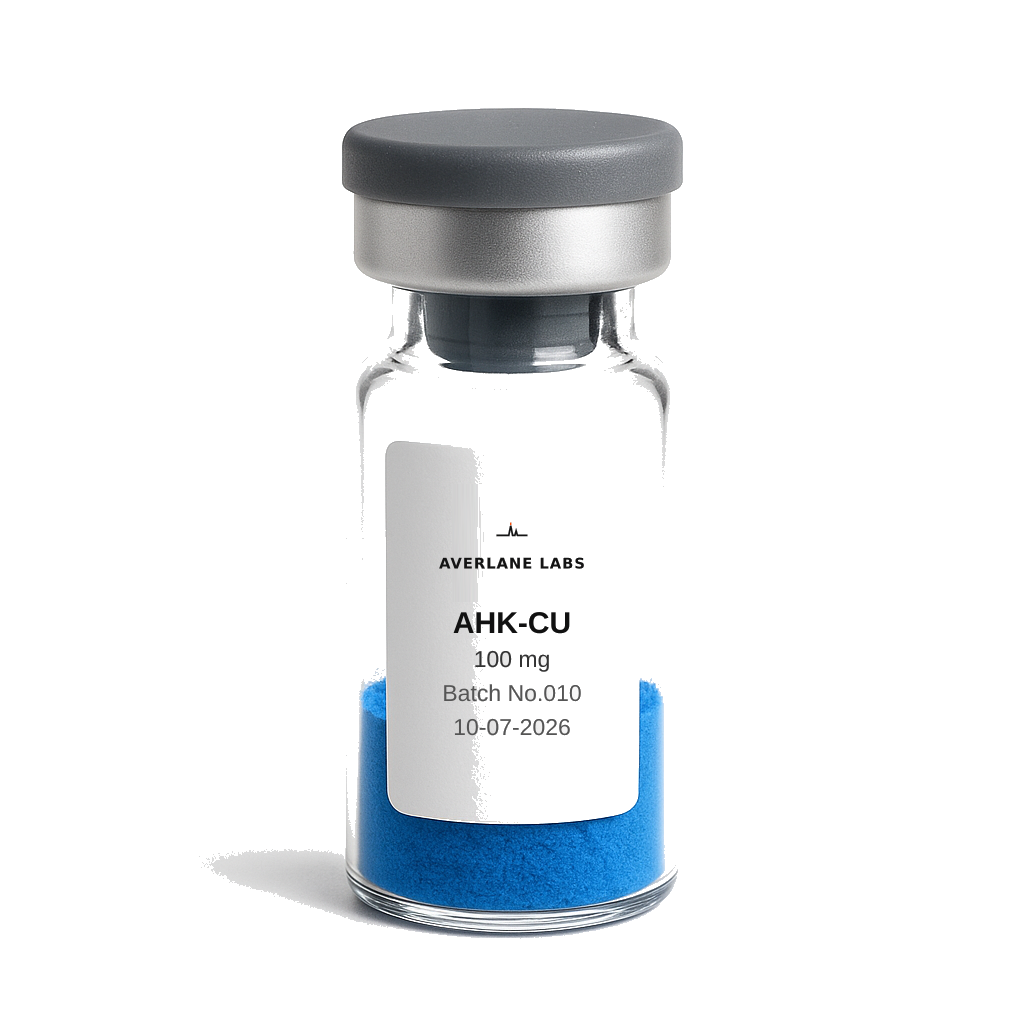
AHK-CU 100mg vial
Certificate of Analysis available on request for the current lot.
Complete the setup
Reconstitution and bench supplies researchers pair with AHK-CU 100mg vial
NOT FOR HUMAN CONSUMPTION
NOT FOR HUMAN CONSUMPTION
AHK-Cu, also known as Copper Tripeptide-1, is a naturally occurring copper-binding tripeptide with the amino-acid sequence Gly-His-Lys (GHK) complexed with Cu²⁺. In human physiology, GHK-Cu is released during tissue injury and remodeling and functions as a signal peptide that coordinates repair, regeneration, and inflammation control.
Regulatory context:
AHK-Cu is widely used in cosmetic, dermatologic, and research applications. It is not FDA-approved as a drug, but it is one of the most extensively studied bioactive peptides in skin biology.
2) Biological rationale
Copper is an essential trace element for:
-
collagen and elastin cross-linking (lysyl oxidase),
-
angiogenesis,
-
antioxidant defense (superoxide dismutase),
-
cellular energy metabolism.
The GHK peptide acts as a targeted copper delivery system, ensuring copper reaches sites of tissue repair while avoiding free-copper toxicity. Together, the complex functions as a master regulator of tissue homeostasis.
3) Molecular mechanism of action
3.1 Gene-expression modulation
AHK-Cu is notable for its ability to influence hundreds to thousands of genes involved in:
-
extracellular matrix (ECM) synthesis,
-
inflammation suppression,
-
antioxidant pathways,
-
cell growth and differentiation.
Transcriptomic analyses suggest GHK-Cu upregulates regenerative genes while downregulating pro-inflammatory and fibrotic genes, a rare profile among cosmetic peptides.
3.2 Skin and connective-tissue effects
| Pathway | Functional outcome |
|---|---|
| Fibroblast activation | ↑ collagen (I, III), elastin, proteoglycans |
| Matrix remodeling | ↑ MMP regulation → healthier ECM turnover |
| Angiogenesis | ↑ VEGF, improved microcirculation |
| Inflammation | ↓ IL-6, TNF-α, NF-κB signaling |
| Oxidative stress | ↑ antioxidant enzymes, ↓ ROS damage |
3.3 Hair follicle biology
AHK-Cu supports hair follicle health by:
-
promoting dermal papilla cell survival,
-
improving follicular angiogenesis,
-
counteracting inflammation-driven miniaturization.
This has led to its inclusion in hair-growth and scalp-repair formulations.
4) Pharmacokinetics and delivery considerations
-
Topical delivery: primary and best-studied route (serums, creams, foams).
-
Skin penetration: enhanced by copper chelation and appropriate vehicle formulation.
-
Stability: copper-bound form is significantly more biologically active than free GHK.
Injectable and systemic use remains research-only and is not supported by approved clinical pharmacology data.
5) Evidence base
5.1 Preclinical and mechanistic evidence (strong)
-
Robust in-vitro fibroblast and keratinocyte studies show increased ECM production and improved wound-healing kinetics.
-
Gene-expression studies demonstrate broad regenerative signaling unmatched by most cosmetic actives.
5.2 Human clinical and applied evidence (moderate)
Human studies and long-term cosmetic use support improvements in:
-
skin firmness and elasticity,
-
fine lines and wrinkles,
-
wound healing and scar appearance,
-
post-procedure recovery (laser, microneedling, chemical peels).
While many studies are small or formulation-dependent, the totality of evidence across decades is unusually strong for a non-drug peptide.
6) Practical benefits (evidence-weighted)
| Benefit | Strength of support | Notes |
|---|---|---|
| Skin repair & regeneration | High | Consistent across models and real-world use |
| Anti-aging (wrinkles, elasticity) | Moderate–high | Best with long-term use |
| Wound healing | High | Historical and modern support |
| Inflammation reduction | High | Particularly post-procedure |
| Hair/scalp support | Moderate | Adjunctive, not monotherapy |
7) Safety and tolerability
AHK-Cu is generally well tolerated, especially topically.
Potential issues:
-
Transient blue coloration on skin if over-concentrated
-
Mild irritation in sensitive individuals
-
Copper sensitivity is rare but possible
Not recommended:
-
For use on active infections
-
In formulations exceeding physiologically reasonable copper concentrations
8) Formulation considerations
-
Typical cosmetic concentrations: 0.01–0.05% active peptide
-
pH-sensitive; stability depends on formulation chemistry
-
Often synergistic with:
-
hyaluronic acid,
-
niacinamide,
-
growth-factor-supporting actives
-
-
Should not be layered immediately with strong acids or chelators that disrupt copper binding
9) Comparative positioning
| Feature | AHK-Cu | Matrixyl peptides | Growth factors |
|---|---|---|---|
| Regenerative signaling | Broad, multi-gene | ECM-focused | Strong but unstable |
| Anti-inflammatory | Strong | Mild | Variable |
| Stability | High | High | Low |
| Safety profile | Excellent | Excellent | Variable |
| Longevity of use | Decades | Decades | Limited |
Researcher reviews
No reviews yet for this lot line. Verified purchasers can leave the first one.
Reviews
There are no reviews yet.