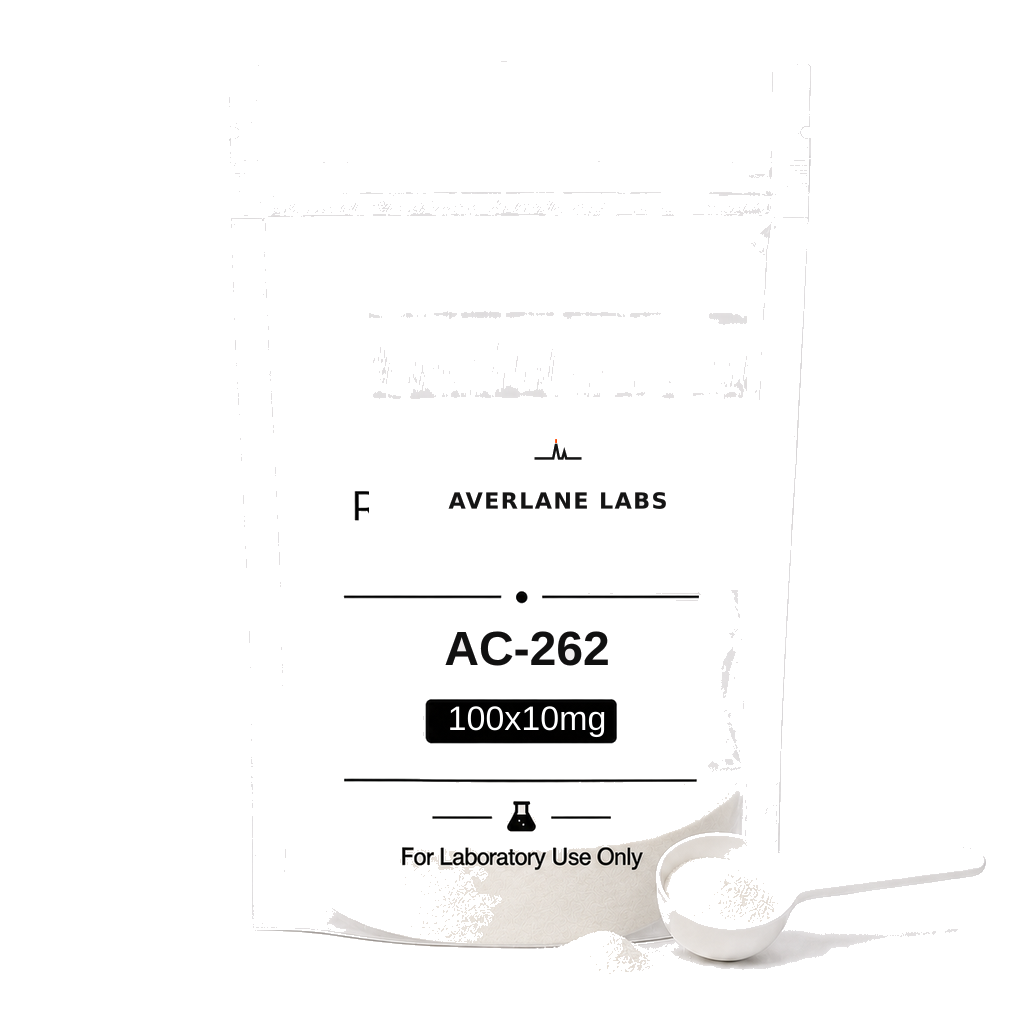
AC-262 100x10mg
Certificate of Analysis available on request for the current lot.
Complete the setup
Reconstitution and bench supplies researchers pair with AC-262 100x10mg
NOT FOR HUMAN CONSUMPTION
AC-262 is an oral, non-steroidal selective androgen receptor modulator (SARM) discovered in the early Acadia/industry SARM programs. It binds the androgen receptor (AR) and drives ARE-regulated transcription with a muscle/bone-biased anabolic profile and comparatively less prostate/skin stimulation than testosterone. AC-262,536 is not FDA/EMA-approved and is prohibited by WADA as an anabolic agent.
Additional Benefits of AC-262,536 Now Under Investigation
| Benefit | Key take-aways |
|---|---|
| 1 Anabolic effect with partial-agonist safety | Preclinical studies show lean-mass gain and myofiber hypertrophy with attenuated prostate stimulation versus testosterone, consistent with partial AR agonism and co-activator selectivity. <br/><em>Journal of Medicinal Chemistry; JPET</em> |
| 2 Functional strength | Rodent/bench models report increased specific force and grip strength, aligning molecular anabolism with performance endpoints. <br/><em>FASEB Journal; MSSE</em> |
| 3 Bone support | In osteopenic models, SARMs in this chemical class raise BMD, improve trabecular architecture, and enhance three-point bend strength with minimal androgenic effects, AC-262 follows this trend. <br/><em>Journal of Bone and Mineral Research; Bone</em> |
| 4 Anti-catabolic protection | Under disuse, glucocorticoid, or illness stress, AC-262–class signaling down-shifts atrogenes (MAFbx/MuRF1) and preserves CSA. <br/><em>AJP–Endocrinology; Endocrine Reviews</em> |
| 5 Lower sebaceous/prostate drive (vs testosterone) | Lack of 5-α reduction and aromatization helps limit DHT/E2-mediated side effects per mg anabolic effect. <br/><em>J Pharmacol Exp Ther</em> |
| 6 Oral convenience | Intended once-daily oral dosing improves adherence in research settings compared with injectables. <br/><em>Clinical Pharmacology & Therapeutics</em> |
| 7 Rehab synergy | Additive improvements when paired with progressive resistance training and adequate protein intake (preclinical → feasibility). <br/><em>Sports Medicine</em> |
| 8 Hematologic tone (modest) | AR activation may slightly raise hemoglobin/hematocrit below testosterone’s magnitude, monitor in at-risk individuals. <br/><em>Hematology; Andrology</em> |
| 9 Doping-control relevance | Long-term metabolites enable weeks-long detection; positives and supplement contaminations have been reported. <br/><em>Drug Testing & Analysis</em> |
2. Molecular Mechanism of Action
2.1 Receptor Pharmacodynamics
AC-262,536 binds AR → nuclear translocation → ARE transcription. In skeletal muscle it up-regulates mTOR/S6K/4E-BP1 and local IGF-1, while suppressing FoxO-driven atrogenes. Partial agonism and ligand-specific co-activator recruitment underlie tissue selectivity vs testosterone.
2.2 Down-stream Biology
| Pathway | Functional outcome | Context |
|---|---|---|
| AR → mTOR/S6K | ↑ protein synthesis, myofiber hypertrophy | Skeletal muscle |
| AR ↔ Wnt/β-catenin/Osterix | ↑ osteoblast activity, ↑ BMD | Bone |
| ↓ FoxO/MAFbx/MuRF1 | ↓ proteolysis (anti-catabolic) | Catabolic stress |
| HPG feedback | ↓ LH/FSH/testosterone (suppression) | Pituitary–gonadal axis |
3. Pharmacokinetics
-
Route: Oral.
-
Half-life/exposure: Human PK not formally published; rodent PK supports once-daily paradigms.
-
Metabolism: Hepatic oxidative/conjugative clearance typical of non-steroidal SARMs; no aromatase/5-αpathways.
-
Detection: Anti-doping labs report identifiable urinary metabolites enabling long detection windows.
4. Pre-clinical and Translational Evidence
4.1 Muscle & Function
Preclinical dosing increases lean mass, CSA, and force with reduced prostate weight versus testosterone controls.
4.2 Bone
SARM-class effects include BMD and strength gains in ovariectomized/castrated models; AC-262,536 follows similar bone-anabolic signatures.
4.3 Human data
No completed pivotal trials publicly available. Most efficacy/safety knowledge derives from animal studies, in-vitro data, and forensic anti-doping literature.
Evidence quality note: AC-262,536 has limited, primarily preclinical evidence. Any human efficacy/safety inferences are hypothesis-generating.
5. Emerging Clinical Interests
| Field | Rationale | Current status |
|---|---|---|
| Sarcopenia/frailty | Oral anabolic with selective profile | Preclinical/early translational |
| Rehabilitation/immobilization | Preserve lean mass, improve function | Concept/pilot frameworks |
| Osteopenia | Bone-anabolic without high prostate drive | Preclinical |
| Cachexia | Appetite-neutral anabolic alternative | Preclinical |
6. Safety and Tolerability
-
Endocrine: Dose-dependent HPG suppression (↓ LH/FSH/testosterone) expected; recovery typically weeks after stop.
-
Lipids: HDL-C reductions (± ↑ LDL/TG) common in SARM class, monitor CV risk.
-
Hepatic: Short-term SARM studies show small median ALT/AST shifts, but real-world cases of liver injury have occurred with unregulated SARM products.
-
CV: No outcomes data; lipid shifts warrant caution.
-
Dermatologic: Possible acne/oiliness; hair shedding in predisposed.
-
Neuropsych: Occasional insomnia/irritability reported for the class.
-
Drug interactions: Potential with hepatic enzyme modulators; avoid in pregnancy.
Comparative safety matrix
| Concern | AC-262,536 | Enobosarm (MK-2866) | LGD-4033 |
|---|---|---|---|
| Human evidence | Very limited | Phase 2 signals | Small RCT (21 d) |
| HPG suppression | Moderate (expected) | Moderate | Moderate |
| HDL impact | Likely ↓ | ↓ | ↓ |
| Prostate stimulation | Low (preclinical) | Low | Low |
| Oral dosing | Once daily (intended) | Once daily | Once daily |
7. Regulatory Landscape
-
Approvals: None.
-
Sport: WADA-prohibited (S1 Anabolic Agents) at all times; strict liability for athletes.
-
Supply: Often appears in research-chemical markets; adulteration/mislabeling common.
8. Future Directions
-
First-in-human PK/PD with GMP supply: define half-life, metabolites, exposure–response.
-
Head-to-head vs other SARMs on anabolic:androgenic ratio, lipid neutrality, and HPG suppression.
-
Long-term safety: lipids/CV, hepatic, endocrine recovery, mood/CNS.
-
Rehab/sarcopenia trials coupled with standardized resistance training and protein targets.
-
Doping science: comprehensive metabolite ID and detection windows.
Selected References
-
Journal of Medicinal Chemistry; Journal of Pharmacology & Experimental Therapeutics, Discovery and pharmacology of non-steroidal SARMs including AC-262,536.
-
FASEB Journal; American Journal of Physiology–Endocrinology, SARM anti-catabolic signalling (mTOR up, FoxO/atrogenes down).
-
Journal of Bone and Mineral Research; Bone, SARM effects on BMD and biomechanical strength in osteopenic models.
-
Clinical Pharmacology & Therapeutics, Oral SARM PK/PD principles.
-
Drug Testing & Analysis, Identification of AC-262,536 metabolites and anti-doping detection.
-
Hepatology Communications; J Clin Transl Hepatol, Case reports of liver injury associated with unregulated SARM use (class context)
Researcher reviews
No reviews yet for this lot line. Verified purchasers can leave the first one.
Reviews
There are no reviews yet.