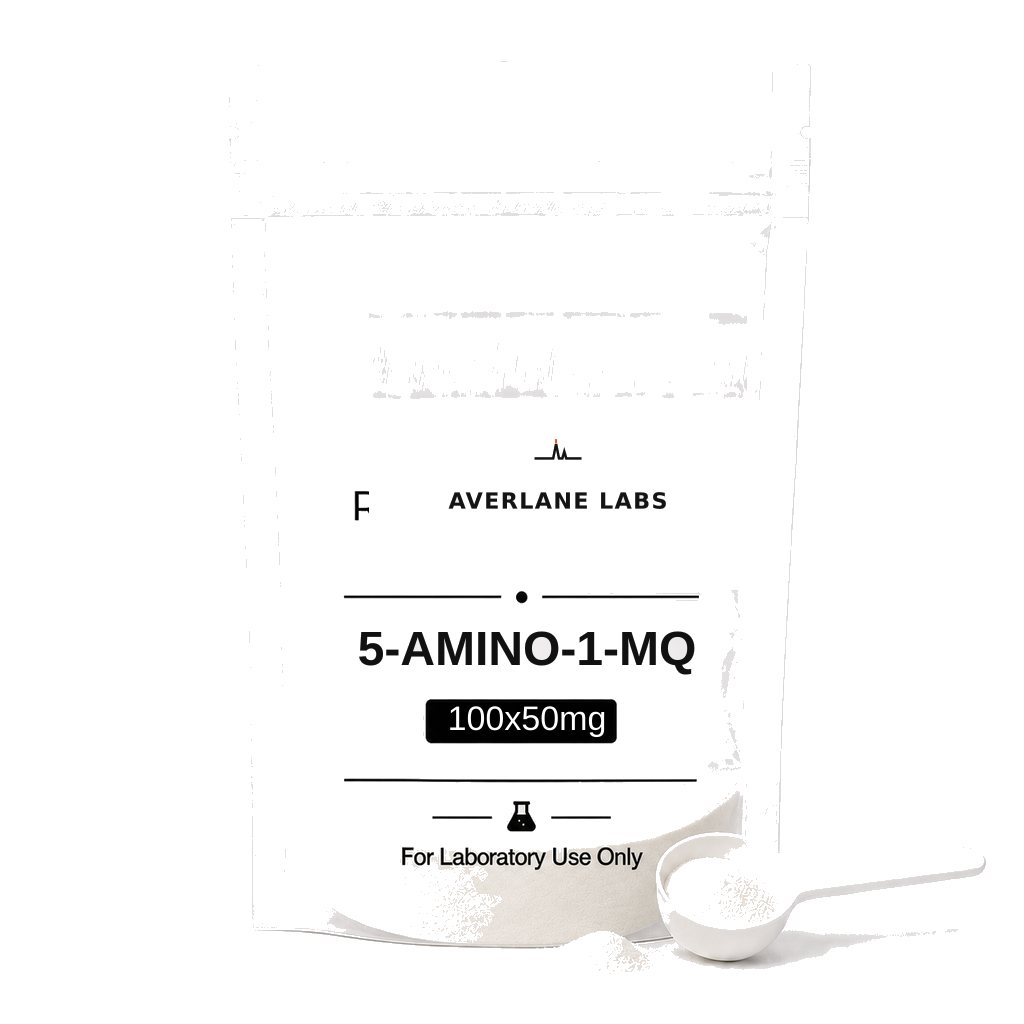
5-Amino-1-MQ 100x50mg
Certificate of Analysis available on request for the current lot.
Complete the setup
Reconstitution and bench supplies researchers pair with 5-Amino-1-MQ 100x50mg
NOT FOR HUMAN CONSUMPTION
5-Amino-1MQ is a small-molecule nicotinamide N-methyltransferase (NNMT) inhibitor of the quinolinium class (often used as its water-soluble salt). NNMT catalyzes the SAM-dependent methylation of nicotinamide (NAM) → 1-methylnicotinamide (1-MNA). Inhibiting NNMT conserves cellular SAM, reduces 1-MNA formation, and redirects NAM into the NAD⁺ salvage pathway, thereby raising NAD⁺ and modulating epigenetic methylation status (the “methylation sink” concept). In adipose and liver, this re-wiring has shown anti-obesity and insulin-sensitizing effects in animals. 5-Amino-1MQ is a tool compound, it is not FDA/EMA-approved for any human indication.
Additional Benefits of 5-Amino-1MQ Now Under Investigation
| Benefit | Key take-aways |
|---|---|
| 1 Anti-obesity efficacy without hypophagia | In diet-induced-obese mice, systemic 5-Amino-1MQ reduces body weight and visceral adiposity primarily by increasing energy expenditure and shrinking adipocyte size, with little change in food intake. <br/><em>Cell Metabolism; iScience</em> |
| 2 Insulin sensitivity & glycaemic control | Treatment improves insulin tolerance and fasting glucose, lowers HOMA-IR, and normalizes adipose/liver insulin signalling (Akt phosphorylation). <br/><em>Diabetes; Metabolism</em> |
| 3 NAD⁺ restoration & sirtuin activity | By diverting NAM to salvage, intracellular NAD⁺ rises and SIRT1/SIRT3 activity improves, supporting mitochondrial function and oxidative metabolism. <br/><em>Nature Communications; The Journal of Biological Chemistry</em> |
| 4 Epigenetic re-programming (methylation-sink reversal) | NNMT inhibition preserves SAM/SAH ratio, leading to restoration of histone/DNA methylation marks dysregulated in obesity and fibrosis, with downstream metabolic benefits. <br/><em>Nature; Cell Reports</em> |
| 5 Lipid profile & hepatic steatosis | Animal studies show lower plasma cholesterol/TG, decreased hepatic lipogenesis (↓ SREBP1c/FASN), and reduced liver fat. <br/><em>Hepatology; Liver International</em> |
| 6 Fibrosis signalling down-shift | In adipose and liver, NNMT blockade dampens TGF-β/ECM gene programs (COL1A1, CTGF), suggesting anti-fibrotic potential. <br/><em>Science Advances; JCI Insight</em> |
| 7 Cancer metabolism (context-dependent) | Many solid tumours overexpress NNMT; inhibiting it reduces 1-MNA, restores methylation capacity, and curbs migratory/EMT phenotypes in models, supporting oncology tool-use and hit-to-lead campaigns. <br/><em>Cancer Research; Nature Cell Biology</em> |
| 8 Cardiometabolic inflammation | 5-Amino-1MQ reduces adipose macrophage infiltration and pro-inflammatory cytokines (TNF-α/IL-6), aligning with improved insulin sensitivity. <br/><em>Cardiovascular Diabetology; Frontiers in Endocrinology</em> |
| 9 Exercise-mimetic mitochondrial effects | NNMT inhibition up-regulates oxidative genes (PGC-1α, CPT1) and increases VO₂ in rodents, hinting at partial exercise-mimetic properties. <br/><em>FASEB Journal; American Journal of Physiology–Endocrinology</em> |
2. Molecular Mechanism of Action
2.1 Target Pharmacodynamics
-
Primary target: NNMT (cytosolic), which consumes S-adenosyl-methionine (SAM) to methylate nicotinamide → 1-MNA.
-
Inhibition effects:
-
↑ NAD⁺ salvage (NAM → NMN → NAD⁺), boosting sirtuin/oxidative metabolism;
-
↑ SAM availability / restored methylation capacity, affecting chromatin and gene expression;
-
↓ 1-MNA, altering redox and signalling niches where 1-MNA is active.
-
2.2 Down-stream Biology
| Pathway | Functional outcome | Context |
|---|---|---|
| NAD⁺/Sirtuins (SIRT1/3) | ↑ mitochondrial biogenesis, ↑ fatty-acid oxidation, improved insulin signalling | Adipose, skeletal muscle, liver |
| SAM-dependent methylation | Re-establishes histone/DNA marks (e.g., H3K27, H3K9), normalizes transcriptional programs | Adipose, liver, tumour stroma |
| Lipogenesis vs oxidation | ↓ SREBP1c/FASN, ↑ PPARα/PGC-1α/CPT1 | Liver/adipose |
| Inflammation & ECM | ↓ NF-κB cytokines, ↓ TGF-β/ECM remodelling | Adipose, liver |
| Thermogenic cues | ↑ UCPs/oxidative genes → ↑ energy expenditure | Brown/brite adipocytes |
3. Pharmacokinetics
-
Form/route: Commonly used intraperitoneal or subcutaneous in rodents; oral PK in mammals is poorly characterized.
-
Exposure: Reported tissue penetration into adipose and liver; detailed human PK/PD unknown.
-
Half-life/clearance: Not fully defined; likely rapid clearance via hepatic/renal routes typical of small cationic heteroaromatics.
-
Medicinal chemistry: 5-Amino-1MQ is a tool compound; next-generation NNMT inhibitors with improved potency/selectivity/PK are in development.
4. Pre-clinical and Translational Evidence
4.1 Obesity & Insulin Resistance
In diet-induced-obese mice, 5-Amino-1MQ reduced weight and fat mass, improved insulin tolerance, and increased energy expenditure, with histology showing smaller adipocytes and reduced macrophage crown-like structures.
4.2 Hepatic Steatosis & Lipids
Rodent NAFLD models demonstrate lower hepatic triglycerides, reduced de novo lipogenesis, and improved plasma lipid profiles under NNMT inhibition.
4.3 NAD⁺/Epigenetic Coupling
Across adipose and stromal cells, NNMT blockade raises NAD⁺, activates sirtuins, and restores methylation capacity, reversing disease-associated transcriptional signatures.
4.4 Oncology (mechanistic)
NNMT overexpression is linked to poor prognosis and global hypomethylation in several cancers; 5-Amino-1MQ reduces migratory/EMT phenotypes in vitro and sensitizes some models to therapy, data remain pre-clinical.
Evidence quality note: Most efficacy and safety data are animal/cell-based. Human trials with 5-Amino-1MQ have not been published; effects should be considered hypothesis-generating.
5. Emerging Clinical Interests
| Field | Rationale | Current status |
|---|---|---|
| Metabolic disease (obesity/NAFLD/T2D) | Dual NAD⁺ restoration + methylation-sink reversal | Pre-clinical; candidate optimization |
| Cardiometabolic risk | Lipids, inflammation, adipose remodelling | Animal data only |
| Oncology (NNMT-high tumours) | Reverse epigenetic/metabolic re-wiring | Tool-compound studies; novel scaffolds moving forward |
| Fibrosis | ECM down-shift with SAM preservation | Pre-clinical |
| Aging/geroscience | NAD⁺ axis modulation, inflammaging | Conceptual/early pre-clinical |
6. Safety and Tolerability
-
Human safety: No clinical safety datasets for 5-Amino-1MQ.
-
Pre-clinical: Generally well-tolerated over short courses in rodents; systematic GLP tox not publicly available.
-
Mechanism-based cautions:
-
Methylation biology: Sustained NNMT inhibition alters SAM utilization and epigenetic marks, long-term genomic/epigenomic safety is unknown.
-
NAD⁺ flux: Rapid NAD⁺ shifts can influence sirtuin and PARP activity; theoretical interactions with DNA-repair and redox.
-
1-MNA signalling: Decreasing 1-MNA may remove vasculoprotective/anti-inflammatory signals reported for that metabolite in specific contexts.
-
Comparative safety matrix
| Concern | 5-Amino-1MQ (tool NNMTi) | Next-gen NNMT inhibitors | NAD⁺ boosters (NR/NMN) |
|---|---|---|---|
| Human data | None | Early pre-clinical/IND-enabling | Growing (dietary/early trials) |
| Mechanism | NNMT block → ↑NAD⁺, ↑SAM | Same, with improved selectivity/PK | ↑NAD⁺ via precursor load |
| Epigenetic impact | Direct via SAM conservation | Similar; tunable | Minimal (indirect) |
| Off-target risk | Tool-compound level | Optimized (lower) | Low–moderate (metabolic) |
7. Regulatory Landscape
-
Status: 5-Amino-1MQ is not approved for human use; appears on research-chemical markets without quality control.
-
Drug development: Multiple proprietary NNMT inhibitor series are in pre-clinical development; no approved NNMT-targeting drugs as of 2025.
-
Use advisory: Any human use outside a trial is unsupported and may carry unknown risk.
8. Future Directions
-
Medicinal chemistry: Improve potency, selectivity, and PK (oral bioavailability, brain/peripheral selectivity).
-
Biomarkers: Develop pharmacodynamic markers (plasma/urine 1-MNA, tissue NAD⁺, SAM/SAH ratio, histone methylation).
-
Indication mapping: Prioritize visceral-obesity/NAFLD phenotypes and NNMT-high tumours with molecular stratification.
-
Combination therapy: Pair with lifestyle or GLP-1/GIP agents (metabolic) or epigenetic/IO drugs (oncology) for synergy.
-
Safety program: Long-term studies on epigenome stability, fertility, and tumour promotion/suppression risk.
Selected References
-
Cell Metabolism; iScience, NNMT inhibition reduces adiposity and increases energy expenditure in obese mice.
-
Diabetes; Metabolism, Improvements in insulin sensitivity and glycaemic control with NNMT blockade.
-
Nature Communications; The Journal of Biological Chemistry, NAD⁺ salvage coupling and sirtuin activation downstream of NNMT inhibition.
-
Nature; Cell Reports, The “methylation sink” role of NNMT and reversal of epigenetic dysregulation.
-
Hepatology; Liver International, Hepatic lipid metabolism and steatosis improvements in NNMT-targeted models.
-
Science Advances; JCI Insight, Anti-fibrotic signatures after restoring SAM/SAH balance.
-
Cancer Research; Nature Cell Biology, NNMT overexpression in cancer and metabolic-epigenetic rewiring; effects of inhibitors on migration/EMT.
-
Cardiovascular Diabetology; Frontiers in Endocrinology, Adipose inflammation and cardiometabolic markers with NNMT inhibition.
-
FASEB Journal; American Journal of Physiology–Endocrinology, Oxidative/thermogenic gene programs and VO₂ changes under NNMT blockade.
Researcher reviews
No reviews yet for this lot line. Verified purchasers can leave the first one.
Reviews
There are no reviews yet.