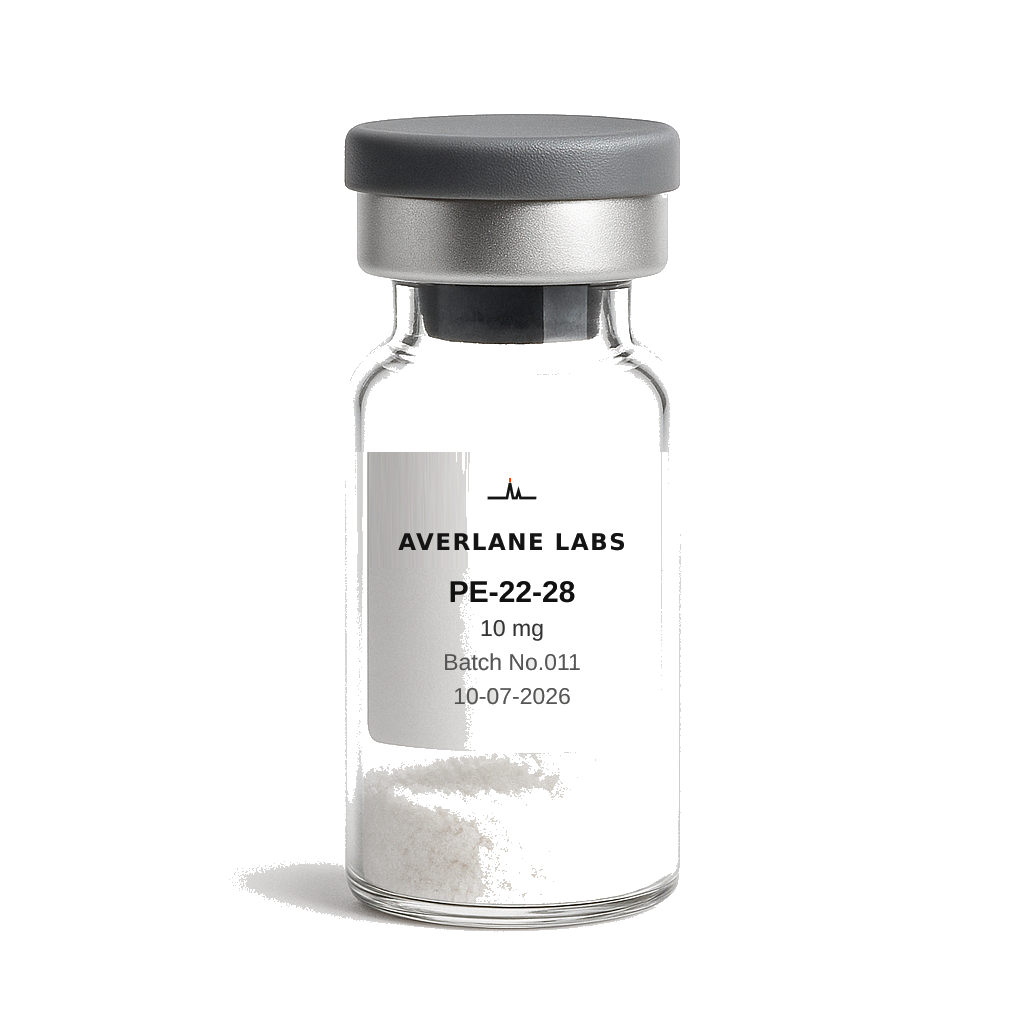
PE-22-28 10mg vial
Certificate of analysis
Lot AL-PE2228-2627 · Purity 99.12% · Tested 2026-06-29
Complete the setup
Reconstitution and bench supplies researchers pair with PE-22-28 10mg vial
NOT FOR HUMAN CONSUMPTION
PE-22-28 is a heptapeptide with the sequence GVSWGLR (Gly–Val–Ser–Trp–Gly–Leu–Arg). It is widely described as the smallest active fragment derived from the endogenous peptide spadin, retaining potent antagonism of the TREK-1 (KCNK2) two-pore domain potassium channel.
Nomenclature origin: “PE(22-28)” refers to a peptide fragment numbering used in the parent propeptide context described in patents/literature; the peptide is associated with sortilin/NTSR3 propeptide → spadin → PE-22-28 fragments in the discovery chain.
2) Target biology: why TREK-1 matters
TREK-1 (KCNK2) is a background/leak K⁺ channel that helps set resting membrane potential and dampens excitability. In many neuron types, inhibiting TREK-1 tends to increase excitability and can shift network activity in ways that have been explored for antidepressant-like effects, neuroplasticity, and post-injury recovery.
PE-22-28’s importance is that it is a high-potency TREK-1 inhibitor reported at sub-nanomolar IC₅₀ (~0.12 nM) in vendor-compiled pharmacology summaries (which typically trace back to primary literature).
3) Molecular mechanism of action
3.1 Receptor/channel pharmacodynamics
-
Primary target: TREK-1 (KCNK2) inhibition (functional antagonism).
-
Immediate electrophysiologic consequence (conceptual): reduced K⁺ leak conductance → membrane depolarization tendency → greater neuronal responsiveness (cell-type and state dependent).
3.2 Downstream neurobiology (hypothesis map)
| Domain | Putative consequence | Mechanistic rationale |
|---|---|---|
| Mood / antidepressant-like effects | faster-acting behavioral effects in models | TREK-1 inhibition increases excitability/plasticity in relevant circuits |
| Neurogenesis | ↑ hippocampal neurogenesis signals in models | plasticity/BDNF-linked pathways often rise downstream of excitability shifts (model dependent) |
| Stroke / ischemia recovery | improved motor/cognitive outcomes in rodent stroke models | excitability + plasticity + potentially reduced apoptosis in injured tissue contexts |
| β-cell survival under stress | reduced apoptotic β-cell death in ischemia models | TREK-1 is expressed beyond brain; protection signals reported in rodent contexts |
Important interpretation constraint: Many of the “downstream” benefits are preclinical outcomes; PE-22-28 is best thought of as a research tool compound for TREK-1 biology and related phenotypes, not as a clinically validated therapy.
4) Chemistry and structure
-
Sequence: GVSWGLR
-
CAS: commonly listed as 1801959-12-5 in reagent catalogs.
-
Design notes: Patents describe PE(22-28) as a base peptide used to design analogs (e.g., N-terminal modifications, substitutions, C-terminal derivatizations) to tune activity, stability, or labeling.
Quality-control note (practical): marketplace listings are not always consistent (some sites misreport the sequence). When writing professionally, it’s worth stating that authentic PE-22-28 is GVSWGLR, consistent with multiple reagent suppliers and patent language.
5) Pharmacokinetics and exposure considerations
There is no drug-label PK because PE-22-28 is not an approved medicine. As a 7-aa peptide, key PK realities typically include:
-
rapid proteolysis in plasma/tissues unless formulated/modified,
-
route dependence (systemic exposure and CNS exposure can differ substantially),
-
possible short half-life without stabilization strategies.
Patents explicitly discuss chemical modifications/analogs, which is often a sign that native peptide stability and deliveryare important development constraints.
6) Evidence base (what’s actually supported)
6.1 Strongest, most “anchored” claims
-
Potent TREK-1 inhibition (IC₅₀ around 0.12 nM) and use as a pharmacological tool.
-
Preclinical outcomes reported in rodent models (stroke recovery, hippocampal neurogenesis; β-cell apoptosis reduction in ischemia contexts) in supplier summaries referencing underlying studies.
6.2 What is not established
-
Robust, replicated human clinical efficacy for depression, cognition, stroke recovery, or metabolic endpoints.
-
Long-term safety in humans at therapeutically relevant exposures.
7) Safety and tolerability: scientific framing
Because PE-22-28 is investigational/research, safety is best discussed as mechanism-informed risk hypotheses:
Potential risks to consider in research translation:
-
CNS excitability shifts: TREK-1 inhibition can alter neuronal firing thresholds; depending on circuits, this can theoretically increase risk of adverse neuropsychiatric or sleep effects (speculative without human trials).
-
Off-tissue physiology: TREK-1 is expressed in multiple tissues; systemic dosing may have non-CNS electrophysiologic effects (context dependent).
-
Immunogenicity/impurities: small peptides are generally less immunogenic than proteins, but impurities and formulation can drive reactions, especially outside GMP medicine pathways.
8) Regulatory status and real-world positioning
PE-22-28 is sold primarily as a research reagent and is not FDA/EMA-approved for therapeutic use.
9) Future directions (what would make PE-22-28 “clinical-grade”)
-
Validated PK/PD: demonstrate exposure and target engagement (TREK-1 occupancy/functional biomarkers) in humans.
-
Route/formulation optimization: stabilizing analogs and delivery approaches (already implied by patent-driven analog design).
-
Function-first clinical endpoints: if pursued for mood or recovery, trials should prioritize clinically meaningful outcomes (e.g., depressive symptom scales, functional recovery metrics) plus mechanistic neuroplasticity readouts.
Selected references (most load-bearing)
-
TREK-1 inhibition potency and preclinical effects summary:
-
Sequence/identity and “smallest active spadin fragment” description:
-
Patent text specifying GVSWGLR and analog design built on PE(22-28):
-
Additional catalog confirmations (CAS/identity; research tool framing)
Researcher reviews
No reviews yet for this lot line. Verified purchasers can leave the first one.
Reviews
There are no reviews yet.