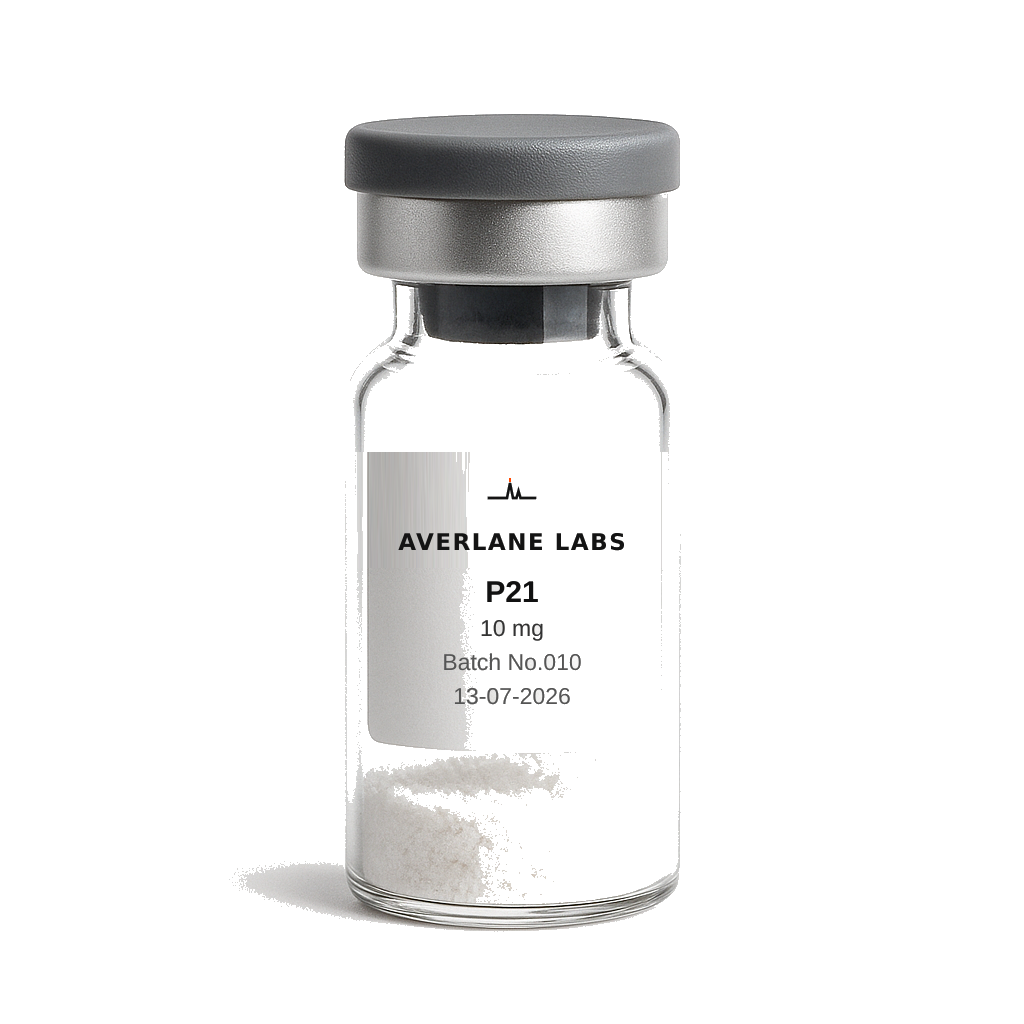
P21 with adamantane 10mg vial
Certificate of Analysis available on request for the current lot.
Complete the setup
Reconstitution and bench supplies researchers pair with P21 with adamantane 10mg vial
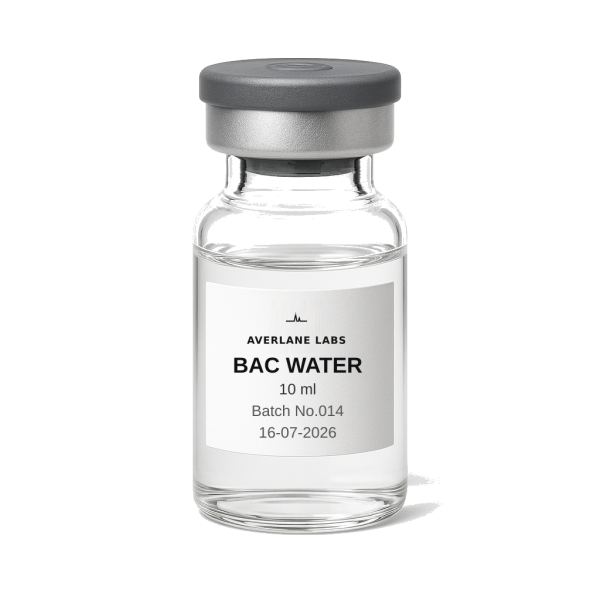
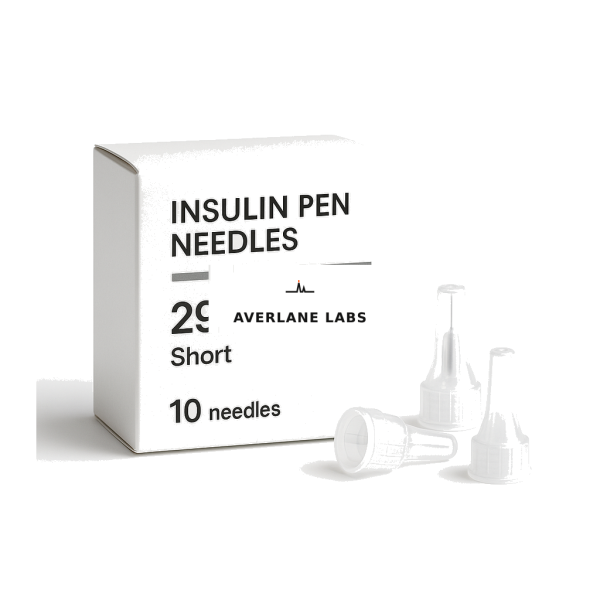
NOT FOR HUMAN CONSUMPTION
P21 with adamantane most commonly refers to Peptide 021 (P021), a small, CNS-directed, neurotrophic peptideengineered from a short active fragment of ciliary neurotrophic factor (CNTF) and chemically modified with an adamantane-based residue to increase lipophilicity, metabolic stability, and brain penetration.
In the original medicinal-chemistry / behavioral neuroscience line of work, P21 is described as an adamantane-incorporating peptidergic compound that improved learning and memory and promoted hippocampal neurogenesis in mice.
Important naming caveat: “P21” is also used in biology to mean p21 (CDKN1A), a cell-cycle protein, completely unrelated to the CNTF-derived nootropic peptide. When you say “P21 with adamantine,” the CNTF-derived P021interpretation is the one that matches the published “adamantane neurotrophic peptide” literature.
2) Chemical design and rationale
2.1 Structural concept
The design principle is: retain a minimal CNTF-derived “active” motif but add a highly lipophilic adamantane building block (or adamantane-containing amino acid/terminal substitution) to:
-
increase resistance to proteolysis,
-
improve pharmacokinetics, and
-
enhance blood–brain barrier (BBB) passage.
2.2 Why adamantane?
Adamantane is a rigid hydrophobic scaffold frequently used in CNS medicinal chemistry to improve membrane partitioning and stability. In this peptide program, the adamantane incorporation is explicitly framed as a brain-delivery enabling modification for a very small peptide therapeutic.
3) Molecular mechanism of action
3.1 Target pathway: CNTF/LIF-like signaling (IL-6 family cytokine axis)
CNTF belongs to the IL-6 cytokine family and signals via receptor complexes that converge on JAK/STAT pathways (notably STAT3). One mechanistic analysis of this peptide program describes P21 as acting relative to its parent motif by partially inhibiting LIF activity through the STAT3 pathway in a cellular model, consistent with the idea that these small CNTF-derived peptides can modulate cytokine-linked signaling rather than acting as classic receptor agonists.
3.2 Downstream neurotrophic biology (disease-relevant nodes)
Across summaries and preclinical discussions, P021 is repeatedly connected to neurodegeneration-relevant nodes including:
-
BDNF-linked effects and downstream reduction of GSK-3β activity, a major tau kinase (→ tau phosphorylation decreases),
-
changes consistent with synaptic plasticity support, and
-
neurogenic effects in hippocampal niches.
Interpretive note: Some of these pathway claims are synthesized from multiple preclinical reports and reviews; the field’s most consistent “direct” signal is neurogenesis + cognitive performance in mice plus mechanistic work implicating cytokine/STAT and tau-related pathways.
4) Pharmacokinetics and CNS exposure (what can be stated scientifically)
Because P021 is not an approved drug with a public label, PK details are largely derived from the design rationale and preclinical characterization:
-
BBB penetration: adamantane substitution is specifically described as facilitating BBB transport (lipophilicity-driven).
-
Stability: adamantane incorporation is used to improve resistance to enzymatic breakdown (common goal in peptide optimization for systemic dosing).
-
Route flexibility in animal work: published work includes peripheral administration in mice with CNS effects, implying sufficient exposure to impact hippocampal biology.
5) Preclinical and translational evidence
5.1 Cognition and neurogenesis in normal adult mice
A key preclinical report describes P21 administration leading to:
-
improved learning and memory (including object recognition and spatial reference memory paradigms), and
-
increased neurogenesis and maturation of newborn neurons in the dentate gyrus/subgranular zone.
This is one of the more concrete, behavior + histology linked datasets supporting “nootropic/neurogenic” claims.
5.2 Disease-model positioning (Alzheimer’s and related neurodegeneration)
A peptide society monograph-style overview describes P21/P021 as promising in preclinical AD-oriented contexts, emphasizing:
-
reduction of abnormal tau phosphorylation (via BDNF/GSK-3β framing),
-
reduction in amyloid-associated pathology signals (in preclinical reports), and
-
a general neuroprotective profile relative to larger neurotrophins.
(This is still preclinical positioning; it does not substitute for human efficacy.)
5.3 More recent translational use: neurodevelopmental disease model (CDKL5 deficiency)
A 2024 open-access paper reports chronic oral P021 treatment in Cdkl5−/Y mice, evaluating behavioral and related outcomes after extended dosing. This is relevant because it shows continued scientific interest beyond AD, using modern translational endpoints in a distinct CNS disorder model.
6) Safety, tolerability, and key uncertainties
6.1 What is known
-
The peptide is repeatedly described as designed to avoid limitations of full-length neurotrophins (size, delivery), but that does not establish clinical safety.
-
Published work is predominantly animal + mechanistic; there is no widely cited, definitive human safety dataset in the sources above.
6.2 What remains uncertain (high priority in any serious review)
-
Human safety and tolerability (dose-dependent adverse effects, chronic exposure risks).
-
Immunogenicity risk is generally lower for very small peptides than large proteins, but not zero, especially depending on formulation and impurities.
-
Cytokine-pathway modulation (STAT3-related signaling) could, in principle, have wide-ranging effects depending on exposure and tissue context; this is one reason controlled clinical development is essential.
7) Regulatory and clinical-development status
-
Investigational: P021/P21 (adamantane-modified CNTF fragment) is not FDA/EMA-approved as a therapeutic.
-
Current evidence base is preclinical, with ongoing academic/translational exploration (e.g., mouse studies).
8) How P21/P021 fits within the broader “neurotrophic peptide” landscape
8.1 What makes it attractive
-
Small size + CNS delivery engineering (adamantane) tackles the classic neurotrophin problem: “great biology, poor druggability.”
-
Targets repair/plasticity mechanisms rather than single-symptom neurotransmitter effects.
8.2 What typically blocks translation
-
Many compounds improve mouse cognition but fail in humans because of endpoint sensitivity, heterogeneity of disease biology, and insufficient target engagement measurement.
-
For neurogenic strategies, functional benefit often depends on timing, circuit context, and concurrent rehabilitation/training.
9) Future directions (what would make the science “clinical-grade”)
If this were being advanced as a serious therapeutic, the critical experiments would be:
-
Human PK/PD bridging: confirm CNS exposure and measurable target engagement biomarkers (STAT3 pathway modulation, BDNF/tau-related signatures where appropriate).
-
Robust functional endpoints: beyond memory tasks, include attention/executive function batteries, digital biomarkers, and imaging correlates.
-
Disease selection: pick indications with clear mechanistic alignment (tauopathies, synaptic dysfunction disorders) and measurable biomarkers.
-
Long-term safety: given neurotrophic pathway modulation, chronic safety is not optional.
Selected references (most load-bearing)
-
Adamantane neurotrophic peptide program; cognition + neurogenesis in mice (Li et al., 2010):
-
Patent describing P21/P22 and adamantane-containing design:
-
Peptide 021 (P021) description including adamantane substitution for BBB transport:
-
STAT3/LIF pathway mechanistic note (cell-based):
-
Modern translational mouse study using P021 (CDKL5 model):
Researcher reviews
No reviews yet for this lot line. Verified purchasers can leave the first one.
Reviews
There are no reviews yet.