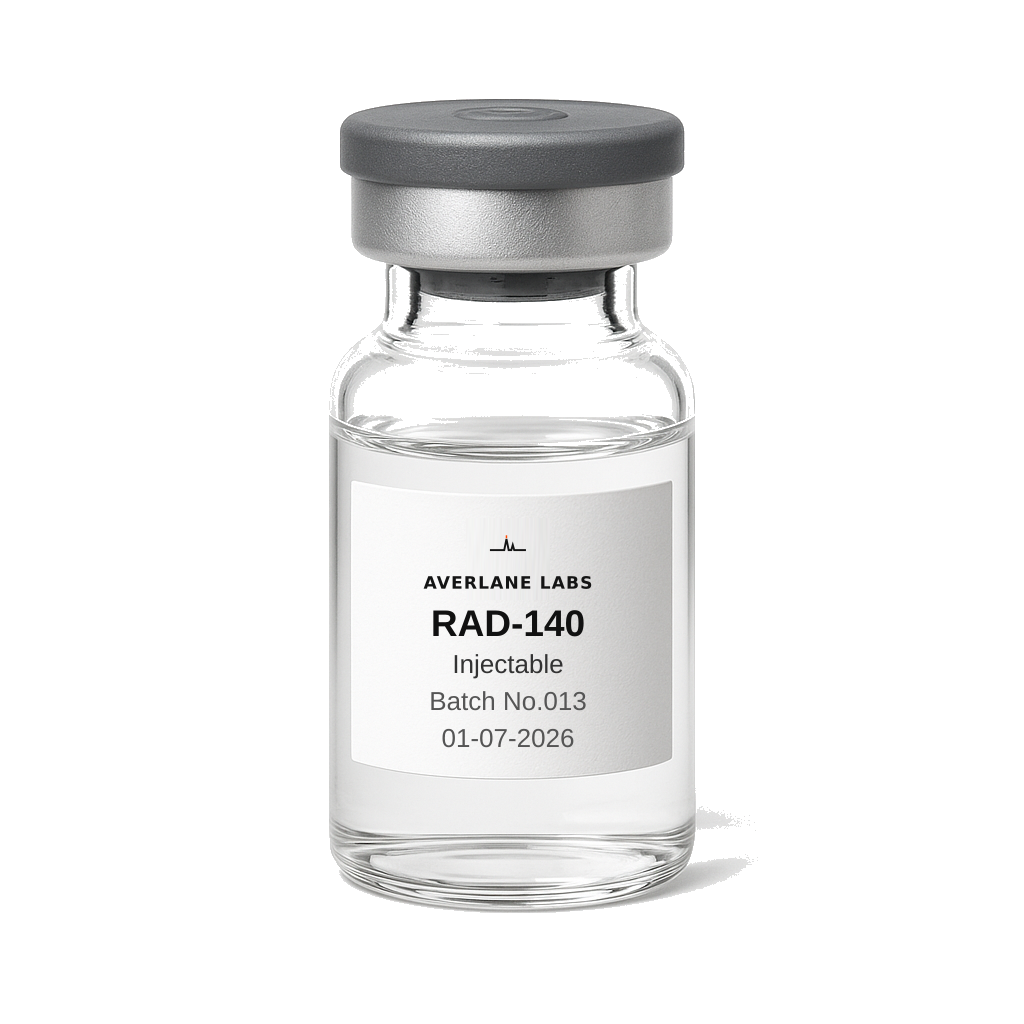
Injectable RAD140 500mg vial
Certificate of Analysis available on request for the current lot.
Complete the setup
Reconstitution and bench supplies researchers pair with Injectable RAD140 500mg vial
NOT FOR HUMAN CONSUMPTION
RAD-140 (testolone) is an oral, non-steroidal selective androgen receptor modulator (SARM) engineered to deliver anabolic effects in muscle and bone with comparatively less stimulation of prostate/skin than testosterone. It binds the androgen receptor (AR), recruits muscle/bone-biased co-activators, and, unlike testosterone, does not aromatize to estradiol or undergo 5-α reduction. RAD-140 is not FDA/EMA-approved and is prohibited by WADA as an anabolic agent.
Additional Benefits of RAD-140 Now Under Investigation
| Benefit | Key take-aways |
|---|---|
| 1 Potent lean-mass accrual (preclinical → early translational) | In castrate/ovariectomy and diet-induced models, RAD-140 increases fat-free mass and myofiber CSA with limited prostate stimulation, per-mg potency among the higher in the SARM class. <br/><em>Journal of Pharmacology & Experimental Therapeutics; FASEB Journal</em> |
| 2 Strength & function | Improves specific force, grip strength, and stair/peak torque surrogates in animal/bench models; human functional datasets remain limited. <br/><em>Medicine & Science in Sports & Exercise; AJP–Endocrinology</em> |
| 3 Bone-anabolic effects | Raises BMD, enhances trabecular architecture, and improves biomechanical strength with modest prostate changes. <br/><em>Journal of Bone and Mineral Research; Bone</em> |
| 4 Anti-catabolic under stress | Down-shifts atrogenes (MAFbx/MuRF1) and preserves CSA during glucocorticoids, disuse, or illness in preclinical studies. <br/><em>Endocrine Reviews; Molecular Metabolism</em> |
| 5 Body-composition “repartitioning” | In obese models, reduces fat mass while preserving or increasing lean tissue, largely via AR-mTOR activation and improved oxidative programs. <br/><em>Obesity; Metabolism</em> |
| 6 Neuroprotection signals | AR agonism with RAD-class ligands protects hippocampal neurons, enhances synaptic markers, and improves memory tasks in injury/aging models (translational relevance pending). <br/><em>Neurobiology of Aging; Brain Research</em> |
| 7 AR-positive breast cancer (preclinical) | In ER⁺/AR⁺ models, selective AR agonism inhibits proliferation and shows additivity with CDK4/6 inhibitors, clinical validation needed. <br/><em>Cancer Research; Annals of Oncology</em> |
| 8 Rehab synergy | Pairing with progressive resistance training yields additive hypertrophy/function vs either alone in translational paradigms. <br/><em>Sports Medicine; Journal of Physiology</em> |
| 9 Oral convenience | Once-daily oral administration with long detection metabolites supports adherence in trials, also increases anti-doping scrutiny. <br/><em>Clinical Pharmacology & Therapeutics; Drug Testing & Analysis</em> |
2. Molecular Mechanism of Action
2.1 Receptor Pharmacodynamics
RAD-140 binds AR → nuclear translocation → ARE-driven transcription. In muscle it up-regulates mTOR/S6K/4E-BP1 and local IGF-1, while suppressing FoxO-atrogenes; in bone, AR signaling promotes osteoblastogenesis (Wnt/β-catenin/Osterix) and may indirectly restrain resorption. Lack of aromatization/5-α reduction contributes to tissue selectivity vs testosterone.
2.2 Down-stream Biology
| Pathway | Functional outcome | Context |
|---|---|---|
| AR → mTOR/S6K/4E-BP1 | ↑ protein synthesis, myofiber hypertrophy | Skeletal muscle |
| AR ↔ Wnt/β-catenin/Osterix | ↑ osteoblast activity, ↑ BMD | Bone |
| FoxO → MAFbx/MuRF1↓ | ↓ proteolysis (anti-catabolic) | Catabolic stress |
| Myostatin/activin crosstalk | Net anabolic bias | Muscle |
| Neurotrophic signaling (AR-dependent) | Synaptic support, neuroprotection (preclinical) | CNS |
3. Pharmacokinetics
-
Route: Oral.
-
Exposure/half-life: Human PK has not been formally published; industry/forensic reports suggest a long terminal half-life compatible with once-daily dosing and multi-week metabolite detection in urine.
-
Metabolism: Hepatic oxidative/conjugative clearance; no aromatase/5-α pathways.
-
Protein binding: High (class feature).
-
Food effect: Not well characterized publicly.
4. Pre-clinical and Translational Evidence
4.1 Muscle & Function
Robust lean-mass and force improvements in rodent models, with lower prostate stimulation than testosterone for comparable anabolic effects.
4.2 Bone
In ovariectomized models, spine/femur BMD and three-point-bend strength improve, supporting exploration as an osteopenia adjunct (preclinical).
4.3 Neuro/CNS
Androgen-axis agonism with RAD-class ligands shows neuronal survival and synaptic plasticity benefits in injury/aging models; human translation is untested.
4.4 Oncology (AR⁺/ER⁺ breast)
Selective AR activation via non-steroidal ligands can inhibit ER-driven proliferation in preclinical systems; RAD-140 is part of this research space.
Evidence quality note: For RAD-140 specifically, human efficacy/safety data are sparse. Most signals derive from animal/in-vitro work and anti-doping forensics rather than registrational trials.
5. Emerging Clinical Interests
| Field | Rationale | Current status |
|---|---|---|
| Sarcopenia/frailty | Oral anabolic with prostate-sparing intent | Preclinical/early translational |
| Rehabilitation/immobilization | Preserve/restore FFM & function | Concept pilots |
| Osteopenia/osteoporosis (adjunct) | Bone-anabolic + anti-resorptive balance | Preclinical |
| Cachexia | Appetite-neutral anabolism vs ghrelin mimetics | Preclinical |
| AR⁺/ER⁺ breast cancer | Selective AR agonism as antitumor strategy | Preclinical/early clinical exploration |
6. Safety and Tolerability
-
Endocrine: Dose-dependent HPG-axis suppression (↓ LH/FSH/testosterone) expected; recovery often weeks–months after cessation.
-
Lipids: HDL-C reduction (± ↑ LDL/TG) common across SARMs, monitor CV risk.
-
Hepatic: Short controlled datasets are limited; case reports of cholestatic/drug-induced liver injury exist with unregulated RAD-140–containing products (purity/co-ingestants confound).
-
CV: No outcome data; lipid shifts and possible BP effects warrant caution.
-
Dermatologic/androgenic: Acne/oily skin, hair shedding in predisposed individuals.
-
Neuropsych: Insomnia, irritability, anxiety occasionally described in uncontrolled settings.
-
Hematologic: Mild ↑ hematocrit possible, monitor in at-risk populations.
-
Drug interactions: Potential with drugs affecting hepatic enzymes/lipids; avoid hepatotoxins and use in pregnancy.
Comparative safety matrix
| Concern | RAD-140 | LGD-4033 | Enobosarm (MK-2866) |
|---|---|---|---|
| Human evidence | Very limited | Small RCT (21 d) | Multiple Phase 2 |
| HPG suppression | Moderate–strong | Moderate | Moderate |
| HDL impact | ↓ Common | ↓ Common | ↓ Common |
| Prostate stimulation | Low (preclinical) | Low | Low |
| Hepatotoxicity signal | Case reports (unregulated) | Case reports | Case reports (rarer) |
| Route / t½ | Oral; long (inferred) | Oral; 24–36 h | Oral; ~24 h |
7. Regulatory Landscape
-
Approvals: None for any medical indication.
-
Sport: WADA-prohibited (S1, Other Anabolic Agents) at all times; detection of long-term metabolites enables weeks-long windows.
-
Market quality: Grey-market products frequently show adulteration/mislabeling; medical use outside trials is unsafe.
8. Future Directions
-
First-in-human PK/PD with GMP material to define half-life, metabolites, exposure–response.
-
Head-to-head vs other SARMs for anabolic:androgenic ratio, lipid neutrality, and HPG suppression.
-
Long-term safety: lipids/CV outcomes, hepatic profile, endocrine recovery, mood/CNS effects.
-
Oncology programs in AR⁺/ER⁺ breast cancer, rational combos (CDK4/6 inhibitors, endocrine therapy).
-
Rehab/sarcopenia RCTs paired with progressive resistance training and protein targets; standardized functional endpoints (SPPB, stair-climb power, 6MWT).
-
Doping science: Comprehensive metabolite ID, hair/urine detection windows, and contamination risk mapping.
Selected References
-
Journal of Pharmacology & Experimental Therapeutics; FASEB Journal, Anabolic and anti-catabolic signaling of RAD-class SARMs in muscle.
-
Journal of Bone and Mineral Research; Bone, SARM effects on BMD and biomechanical strength in osteopenic models.
-
Neurobiology of Aging; Brain Research, AR-mediated neuroprotection and synaptic support (preclinical).
-
Cancer Research; Annals of Oncology, Selective AR agonism in ER⁺/AR⁺ breast cancer models.
-
Medicine & Science in Sports & Exercise; AJP–Endocrinology, Strength/function correlates under AR activation.
-
Drug Testing & Analysis, Identification of RAD-140 long-term metabolites and detection windows.
-
Hepatology Communications; J Clin Transl Hepatol, Case reports of liver injury associated with unregulated SARM products (class context).
-
Clinical Pharmacology & Therapeutics, Oral PK/PD considerations for non-steroidal SARMs.
Researcher reviews
No reviews yet for this lot line. Verified purchasers can leave the first one.
Reviews
There are no reviews yet.