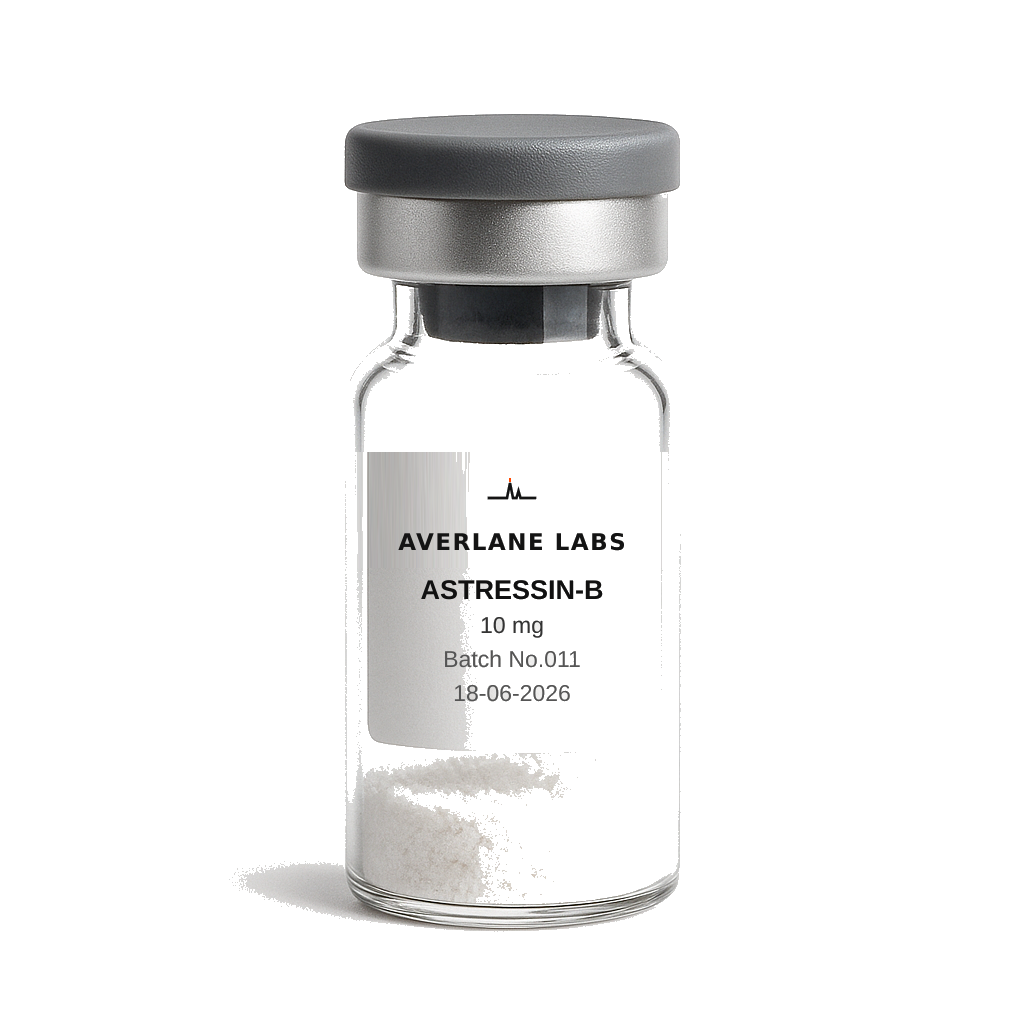
Astressin-B 10mg vial
Certificate of Analysis available on request for the current lot.
Complete the setup
Reconstitution and bench supplies researchers pair with Astressin-B 10mg vial
NOT FOR HUMAN CONSUMPTION
Astressin-B is best viewed as an investigational peptide antagonist of corticotropin-releasing factor (CRF) receptors, not a proven therapeutic or consumer hair-growth / anti-stress peptide. Pharmacologically, it is a potent, long-acting, nonselective CRF receptor antagonist that blocks both CRF1 and CRF2 receptors. The strongest evidence around Astressin-B is still preclinical, especially in stress-related GI physiology and the well-known mouse alopecia/hair-regrowth finding. There is no established human clinical efficacy for hair loss, mood, or broad “stress resetting.”
Additional benefits of Astressin-B under investigation
| Benefit | Take-away |
|---|---|
| 1. Stress-related alopecia / hair-regrowth interest | This is the most famous use case, but the evidence is from CRF-overexpressing mice, not established human trials. Astressin-B reversed and prevented alopecia in that model. |
| 2. CRF-dependent GI effects | Astressin-B emerged from the broader CRF-antagonist literature as a candidate for peripheral CRF-dependent disorders, including GI-stress phenotypes; this rationale is real, but still investigational. |
| 3. Peripheral stress-system modulation | Because it blocks both CRF1 and CRF2, Astressin-B is relevant to stress-linked peripheral physiology rather than being a simple cosmetic peptide. |
| 4. Pigmentation / hair-cycle effects in mice | In the mouse alopecia study, pigmentation changes appeared rapidly and were linked with later hair regrowth, suggesting hair-cycle resetting biology in that model. |
| 5. Human skin / hair-biology plausibility | Human skin and hair follicles do express CRF-system components, which makes translation biologically plausible, but plausibility is still not proof of clinical efficacy. |
| 6. Long-acting peptide antagonist profile | Compared with astressin, Astressin-B was designed as a long-acting analog with enhanced stability. |
| 7. Not a proven treatment for alopecia areata or androgenetic alopecia | The hair-regrowth excitement comes mainly from one mouse model and patents/news coverage, not established dermatology trials in humans. |
| 8. Not a validated anti-anxiety or antidepressant peptide | CRF biology is deeply tied to stress and mood, but Astressin-B itself is not an established psychiatric treatment. |
2. Molecular mechanism of action
2.1 Receptor pharmacodynamics
Astressin-B is a peptide CRF receptor antagonist. The key practical point is that it is nonselective across the two main CRF receptor subtypes, CRF1 and CRF2, and is considered potent and long-acting compared with earlier astressin analogs. That makes it a useful research tool for probing the role of the CRF system in stress-linked peripheral biology.
2.2 Downstream biology
| Pathway / theme | Functional outcome | Context |
|---|---|---|
| CRF1/CRF2 antagonism | Blocks stress-peptide signaling | General CRF-system pharmacology |
| Peripheral stress-axis modulation | Alters stress-linked GI and skin physiology | Peripheral CRF-dependent disorders |
| Hair-cycle / pigmentation effects in CRF-OE mice | Hair regrowth and skin pigmentation in that model | Stress-related murine alopecia |
| Pituitary/HPA-related effects | Can blunt exogenous CRH-driven ACTH/cortisol responses in primate work, though hair-regrowth effects in mice occurred without changing plasma corticosterone in that study | Endocrine-stress physiology |
These mechanisms are biologically coherent, but they still do not establish Astressin-B as a proven therapy for hair loss, GI disease, or systemic stress disorders.
3. Pharmacokinetics
Routes studied: mainly parenteral research dosing such as subcutaneous or intraperitoneal administration in animals. Astressin-B’s pharmacologic appeal is that it is a long-acting peptide antagonist, with design features intended to improve stability versus shorter-acting analogs. That is important scientifically, but it also highlights a limitation: this is still fundamentally a research peptide, not a simple consumer-ready drug platform.
4. Pre-clinical and clinical evidence
4.1 Hair growth / alopecia
This is the best-known niche, but also the most overinterpreted. In CRF-overexpressing mice with chronic-stress/Cushing-like phenotypes and alopecia, peripheral Astressin-B given daily for 5 days induced pigmentation and robust hair regrowth that persisted for months in that model. It also prevented hair loss in younger CRF-overexpressing mice. However, this was not a human alopecia trial, and the model is not the same thing as common androgenetic alopecia in humans.
4.2 GI / peripheral CRF disorders
Review literature positions Astressin-B as part of the broader effort to treat CRF-dependent peripheral disorders, including GI-stress conditions such as IBS-related physiology. That makes mechanistic sense because CRF signaling affects gut motility, secretion, and stress responses. But this is still better described as a research and translational rationale than an established clinical success story.
4.3 Human hair-biology plausibility
The translation case is helped by the fact that human skin and hair follicles express CRF, urocortins, and CRF receptors, and CRF signaling can inhibit hair shaft elongation / push follicles toward catagen in ex vivo human systems. That means the mouse hair result is not biologically absurd. Still, this only supports plausibility, not proof that Astressin-B works clinically for human hair loss.
4.4 Human evidence
This is the weak point. I did not find strong evidence of completed, published human efficacy trials of Astressin-B for hair loss, anxiety, or general stress disorders. The public evidence base is mainly animal studies, pharmacology reviews, and patent/news discussion. That absence is important and should heavily temper claims.
5. Emerging clinical interests
| Field | Rationale | Status |
|---|---|---|
| Stress-related alopecia | Mouse hair-regrowth finding in CRF-OE model | Preclinical only |
| Peripheral GI stress disorders | CRF-system role in gut function and IBS-like phenotypes | Investigational / translational |
| Skin stress biology | Human skin expresses CRF-system components | Mechanistically plausible, clinically unproven |
| Broad anti-stress / psychiatric use | CRF-system relevance to mood and stress | Not established for Astressin-B itself |
6. Safety and tolerability
There is no mature human safety database for Astressin-B comparable to an approved drug. Animal work and pharmacology development support that it is a workable experimental peptide, but that is not enough to claim established short-term or long-term human safety for cosmetic or medical use. In other words, the main limitation is not just efficacy uncertainty, but also the lack of robust human-use data.
7. Contraindications and cautions
Use extra caution with:
- Any claim that Astressin-B is a proven hair-loss treatment, because the headline result comes from a mouse CRF-overexpression model, not established human trials.
- Self-experimentation or gray-market peptide use, because formal human dosing, efficacy, and safety are not well established.
- Assuming stress biology equals clinical anti-anxiety benefit, because CRF antagonism is biologically relevant to stress but Astressin-B itself is not a validated psychiatric medicine.
- Using it instead of established dermatology or GI care, because Astressin-B remains investigational.
8. Comparative practical matrix
| Feature | Astressin-B |
|---|---|
| Main strength | Investigational long-acting CRF1/CRF2 antagonist |
| Best-supported use case | Preclinical stress-related alopecia and peripheral CRF biology |
| Clinical evidence depth | Very limited |
| Core limitation | Mostly animal and pharmacology evidence |
| Main mechanism | Nonselective CRF receptor blockade |
| Hair-growth evidence | Striking in one mouse model, unproven in humans |
| Main safety concern | Sparse human data |
| Best practical framing | Research peptide, not a proven hair-growth or anti-stress therapy |
9. Regulatory landscape
Astressin-B is best understood as a research / investigational peptide, not an approved drug or validated consumer peptide. The existence of patents and media attention around hair growth does not change the fact that there is no established approved indication for it.
10. Future directions
The most useful future work would be:
- actual human dermatology trials to test whether the mouse hair result translates,
- clearer separation of CRF1 vs CRF2 contributions to any hair effect,
- better delivery and dosing strategies for peripheral use,
- and more rigorous trials in GI stress disorders if the peripheral-CRF rationale continues to look promising.
Best balanced summary
Astressin-B is best viewed as a long-acting investigational CRF receptor antagonist with strong pharmacologic credibility and intriguing preclinical effects, especially in stress-related murine alopecia and peripheral CRF-dependent physiology. Its biology is plausible and the hair-regrowth mouse data are genuinely interesting, but the translation gap is large: human efficacy is unproven, robust safety data are lacking, and it should not be framed as an established hair-loss, anti-stress, or GI therapy.
Selected references
- Rivier JE, et al. Corticotropin-releasing factor peptide antagonists. Best high-level source for Astressin-B’s pharmacology as a potent, long-acting, nonselective CRF antagonist.
- Wang L, et al. CRF Receptor Antagonist Astressin-B Reverses and Prevents Alopecia in CRF Over-Expressing Mice. Best primary source for the mouse hair-regrowth finding.
- Rivier JE, et al. Prospective Clinical Applications of CRF Peptide Antagonists. Useful review placing Astressin-B in the broader translational CRF-antagonist landscape.
- Slominski AT, et al. Key Role of CRF in the Skin Stress Response System. Good source for why CRF biology is relevant to human skin and hair.
- Liang W, et al. Psychological stress induces hair regenerative disorders... Useful newer review connecting stress, CRH/CRFR signaling, and the Astressin-B mouse finding.
Researcher reviews
No reviews yet for this lot line. Verified purchasers can leave the first one.
Reviews
There are no reviews yet.