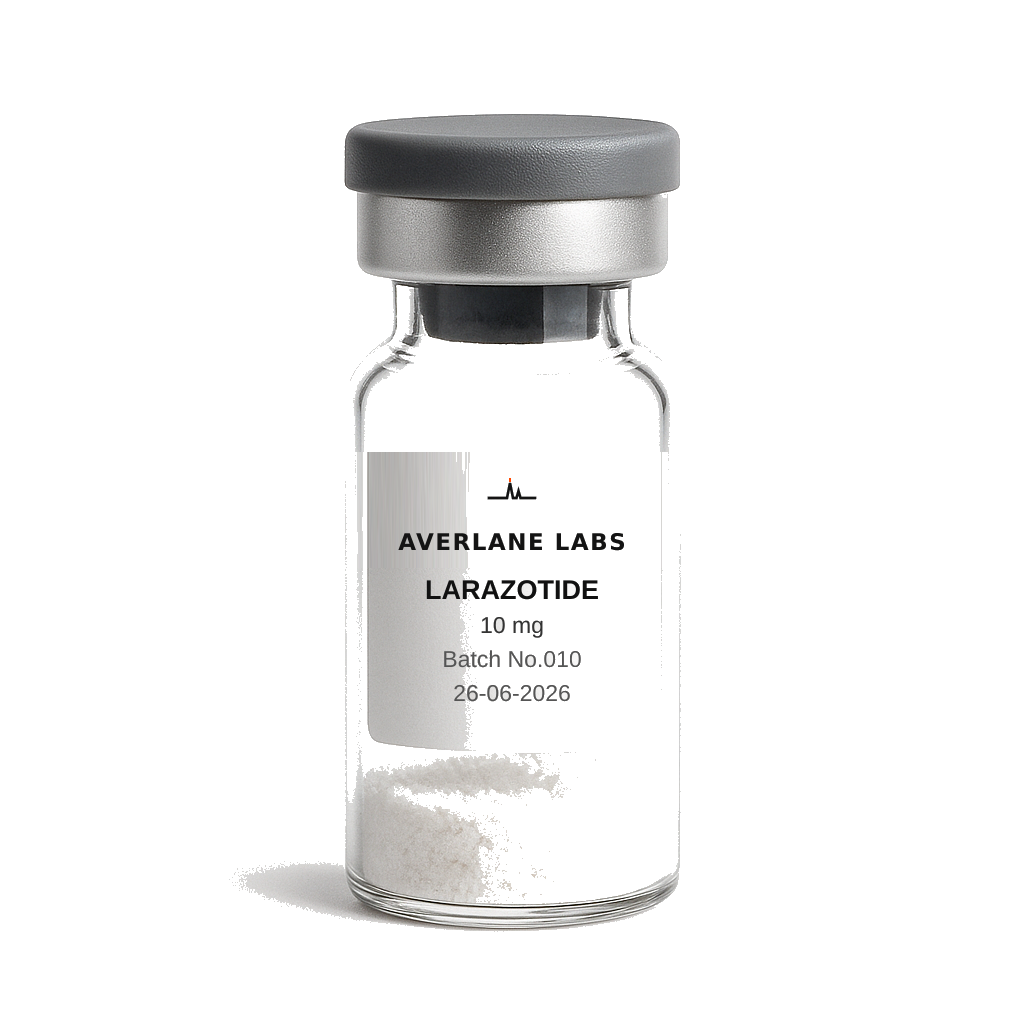
Larazotide 10mg vial
Certificate of analysis
Lot AL-LARAZO-2633 · Purity 92.36% · Tested 2026-06-25
Complete the setup
Reconstitution and bench supplies researchers pair with Larazotide 10mg vial
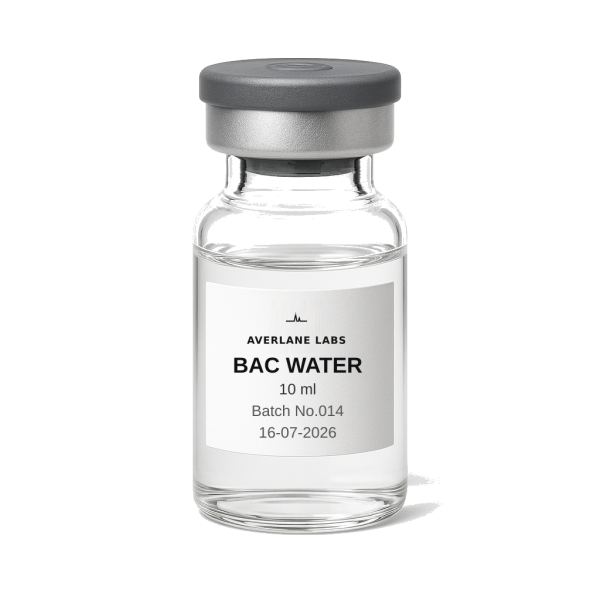

NOT FOR HUMAN CONSUMPTION
Larazotide acetate is best viewed as an investigational oral intestinal-barrier modulator, not an approved therapy. Its clearest and most studied use case is celiac disease as an adjunct to a gluten-free diet, where it was developed to reduce gluten-triggered increases in intestinal permeability and related symptoms. The overall clinical picture is mixed rather than definitive: several randomized trials suggested some symptom benefit, especially in selected settings, but the pivotal phase 3 celiac trial was terminated by the sponsor, and larazotide is not an approved treatment for celiac disease.
Additional benefits of larazotide under investigation
| Benefit | Take-away |
|---|---|
| 1. Celiac disease symptom support | This is the main use case. Trials suggest possible symptom improvement in some patients on a gluten-free diet, but results have been inconsistent and not practice-changing. |
| 2. Protection during gluten exposure / challenge | Early studies suggested reduced gluten-induced symptoms and some immune effects during gluten challenge, though permeability endpoints were less consistent. |
| 3. Tight-junction / barrier support | This is the main mechanistic rationale: larazotide is intended to counter pathologic tight-junction opening and reduce paracellular antigen trafficking. |
| 4. MIS-C interest | This is a newer, still niche area. Early proof-of-concept and subsequent translational work suggest possible benefit in MIS-C by reducing zonulin-mediated gut leak and antigenemia, but this is still investigational. |
| 5. General “leaky gut” interest | Mechanistically appealing, but broad use outside defined disease settings is much less established than marketing sometimes implies. |
| 6. Usually favorable short-term tolerability | Trials and reviews generally describe larazotide as reasonably well tolerated in the short term. |
| 7. Not a replacement for the gluten-free diet | Even in celiac disease, larazotide was developed as an adjunct, not a substitute for dietary treatment. |
| 8. Not a proven broad inflammatory-bowel or wellness therapy | The evidence base is still centered on celiac disease and selected barrier-related hypotheses, not broad GI or wellness claims. |
2. Molecular mechanism of action
2.1 Receptor pharmacodynamics
Larazotide does not have the profile of a classic receptor-targeted systemic drug. It is generally described as a tight-junction regulator and zonulin-pathway antagonist/modulator intended to limit abnormal opening of intestinal epithelial tight junctions. In practical terms, the key idea is that it may reduce the passage of gliadin fragments and other luminal antigens across the gut barrier.
2.2 Downstream biology
| Pathway / theme | Functional outcome | Context |
|---|---|---|
| Tight-junction regulation | Reduced paracellular permeability | Intestinal barrier biology |
| Zonulin-pathway antagonism | Counteracts pathologic junction opening | Celiac / barrier dysfunction interest |
| Reduced antigen trafficking | Possible reduction in gluten-driven signaling | Celiac disease context |
| Barrier restoration | Potential lowering of downstream inflammation in selected settings | Celiac, MIS-C, other investigational uses |
These mechanisms are biologically plausible and central to larazotide’s appeal, but they still do not by themselves prove strong clinical efficacy.
3. Pharmacokinetics
Route: oral.
The practical idea behind larazotide is local gut activity, not broad systemic exposure. It is used as an oral peptide intended to act at the intestinal barrier. That local-mechanism framing is one reason it remained attractive despite the broader challenges of peptide drug development. Human development has largely focused on repeated oral dosing in celiac disease and exploratory use in other barrier-related conditions.
4. Pre-clinical and clinical evidence
4.1 Celiac disease
This is the best-supported niche. Early randomized studies in celiac disease found that larazotide could reduce gluten-induced symptoms and immune reactivity during gluten challenge and was generally well tolerated, although permeability measures were not consistently improved across trials. Later phase 2 work in symptomatic patients on a gluten-free diet suggested that 0.5 mg performed better than placebo for some symptom outcomes, but the broader trial program remained mixed.
4.2 Overall evidence quality in celiac disease
A 2022 systematic review and meta-analysis concluded that larazotide was generally well tolerated and appeared somewhat better than placebo for gastrointestinal symptoms in some settings, but this still falls short of definitive proof. Importantly, the first phase 3 celiac trial was later terminated by the sponsor, which substantially weakens any claim that larazotide is close to established clinical use.
4.3 MIS-C
Larazotide has also been explored in multisystem inflammatory syndrome in children (MIS-C), based on the hypothesis that zonulin-mediated gut leak contributes to systemic passage of SARS-CoV-2 antigens. Early proof-of-concept work and a later translational study suggested faster spike-antigen clearance and clinical improvement with adjuvant larazotide, but this remains an emerging, investigational application rather than an established indication.
4.4 Broader barrier-dysfunction use
Review literature often discusses larazotide in the context of other conditions involving epithelial barrier dysfunction, but those uses are much less mature clinically than celiac disease. So outside celiac disease, the right phrasing is interesting and biologically plausible, but not established.
5. Emerging clinical interests
| Field | Rationale | Status |
|---|---|---|
| Celiac disease adjunct therapy | Main historical development path | Supportive but mixed; phase 3 terminated |
| Gluten-exposure mitigation | Barrier tightening during accidental exposure | Plausible, limited by mixed clinical endpoints |
| MIS-C | Zonulin-mediated antigen leak hypothesis | Early translational / investigational |
| Other barrier-disorder uses | General tight-junction rationale | Exploratory / speculative |
6. Safety and tolerability
The short-term safety picture is fairly reassuring. Trials and reviews generally found larazotide to be well tolerated, with adverse-event rates that were broadly comparable to placebo in the celiac literature. But this should be framed as encouraging short-term tolerability, not as proof of broad long-term safety across multiple conditions.
7. Contraindications and cautions
Use extra caution with:
- Treating larazotide as an approved celiac drug, because it is not approved and the phase 3 program was terminated.
- Replacing the gluten-free diet, because larazotide was developed only as an adjunct, not a substitute.
- Broad “leaky gut” marketing claims, because the strongest evidence remains narrow and disease-specific.
- Assuming MIS-C data generalize to other inflammatory illnesses, because that literature is still early and condition-specific.
8. Comparative practical matrix
| Feature | Larazotide acetate |
|---|---|
| Main strength | Investigational intestinal-barrier modulator |
| Best-supported use case | Adjunctive symptom-focused use in celiac disease |
| Evidence for active disease modification | Limited / unproven |
| Core limitation | Mixed clinical results and failed/terminated phase 3 path |
| Short-term tolerability | Generally favorable |
| Main safety concern | More about uncertain efficacy and lack of approval than clear major toxicity |
| Best practical framing | Narrow investigational GI barrier therapy, not a proven broad “leaky gut” treatment |
9. Regulatory landscape
Larazotide is best understood as an investigational drug candidate, not an approved therapy. The most important regulatory reality is that, despite substantial interest and multiple trials, it has not become an approved treatment for celiac disease, and the phase 3 study designed to support that path was terminated by the sponsor.
10. Future directions
The most useful future work would be:
- better-defined symptom responder subgroups in celiac disease,
- clearer separation of barrier effects vs symptom effects,
- more rigorous study of MIS-C and other zonulin-related settings,
- and trials that show whether local barrier improvement translates into meaningful long-term clinical outcomes.
Best balanced summary
Larazotide acetate is best viewed as a narrow-purpose investigational oral peptide aimed at improving intestinal barrier function, with its clearest application in celiac disease as an adjunct to a gluten-free diet. The mechanism is biologically plausible and the short-term safety profile appears reasonably favorable, but clinical efficacy has been mixed and the celiac phase 3 program was terminated. Outside celiac disease, uses such as MIS-C remain early and exploratory.
Selected references
- Leffler DA, et al. A randomized, double-blind study of larazotide acetate to prevent the activation of celiac disease during gluten challenge. Early key trial on gluten challenge, symptoms, and permeability.
- Kelly CP, et al. Larazotide acetate in patients with coeliac disease undergoing a gluten challenge. Strong follow-up clinical trial source showing reduced gluten-induced immune reactivity and symptoms with mixed permeability findings.
- Leffler DA, et al. Larazotide acetate for persistent symptoms of celiac disease despite a gluten-free diet: a randomized controlled trial. Best direct source for symptomatic celiac patients on a GFD.
- Hoilat GJ, et al. Larazotide acetate for treatment of celiac disease: A systematic review and meta-analysis of randomized controlled trials. Best higher-level synthesis of efficacy and safety.
- Kounatidis D, et al. Treatment Approaches Beyond the Gluten-Free Diet. Good recent review noting that the phase 3 larazotide trial was terminated.
- Yonker LM, et al. Zonulin Antagonist, Larazotide, as an Adjuvant Treatment for Multisystem Inflammatory Syndrome in Children. Best source for the MIS-C exploratory application.
Researcher reviews
No reviews yet for this lot line. Verified purchasers can leave the first one.
Reviews
There are no reviews yet.