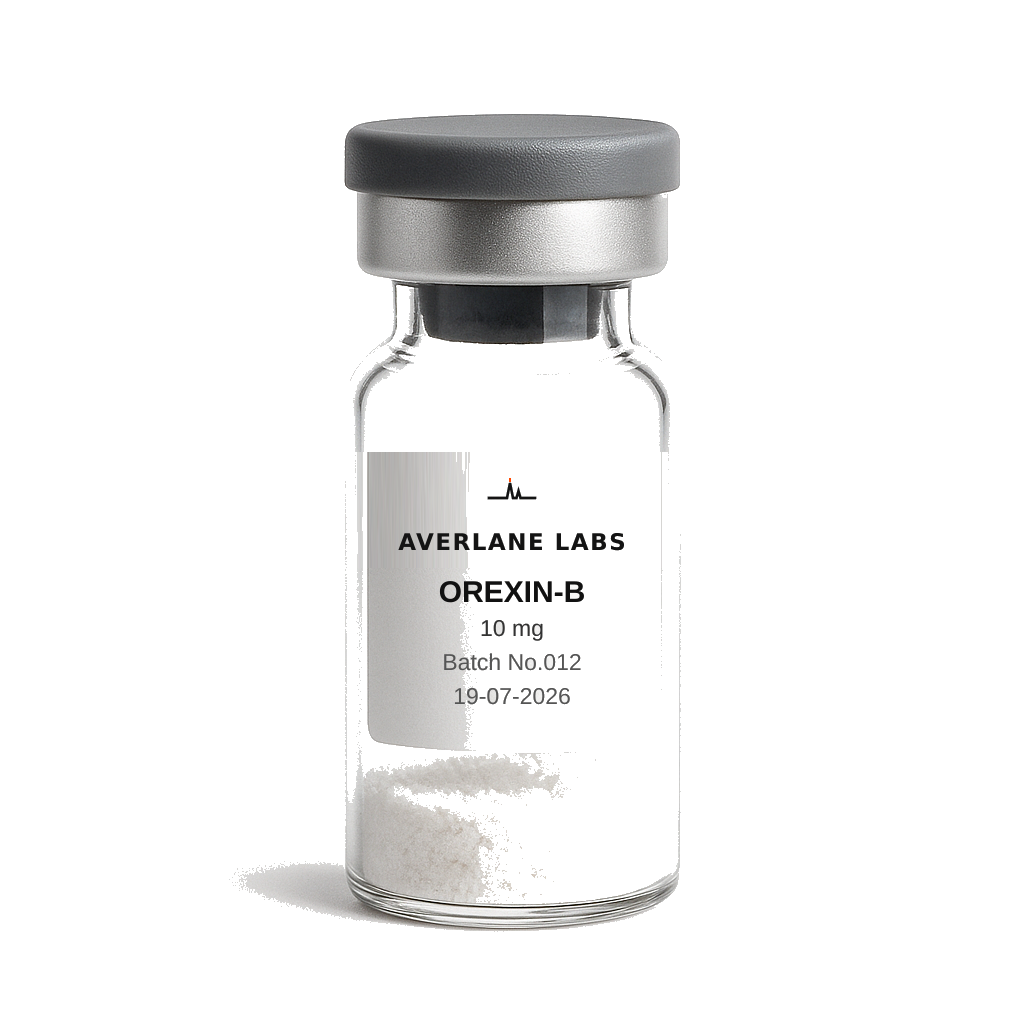
Orexin B 10mg vial
Certificate of Analysis available on request for the current lot.
Complete the setup
Reconstitution and bench supplies researchers pair with Orexin B 10mg vial

NOT FOR HUMAN CONSUMPTION
Orexin B (hypocretin-2) is best viewed as an endogenous neuropeptide involved in wakefulness, arousal, feeding, stress, and autonomic regulation, not as a practical supplement or established standalone therapeutic agent. Compared with orexin A, orexin B is generally considered more OX2R-preferring, which is important because OX2R signaling is strongly linked to wake promotion and narcolepsy biology. The clearest medical relevance of orexin B is therefore pathophysiologic and target-based, especially in sleep-wake disorders, rather than direct use of orexin B itself as a treatment.
Additional benefits / roles of orexin B under investigation
| Benefit / role | Take-away |
|---|---|
| 1. Wakefulness / arousal regulation | This is the clearest core function. Orexin signaling is crucial for stabilizing wakefulness and preventing inappropriate REM intrusions. |
| 2. Narcolepsy relevance | Orexin deficiency is central to narcolepsy type 1, making orexin pathways highly relevant therapeutically, though treatment development has focused more on OX2R agonists than orexin B itself. |
| 3. Feeding / energy-homeostasis signaling | Orexin peptides are involved in food intake, energy balance, and motivated behavior, but this is a physiologic role rather than a proven therapeutic use for orexin B. |
| 4. Stress / autonomic activation | Orexin signaling contributes to stress responses, cardiovascular activation, and hyperarousal. |
| 5. Reward / motivation interest | The orexin system has been implicated in reward-seeking and addiction-related behavior, though this is broader orexin-system biology, not a validated orexin B treatment use. |
| 6. Mood / psychiatric interest | Orexin pathways are being explored in psychiatric disorders, but this remains exploratory and system-level rather than orexin-B-as-a-drug evidence. |
| 7. Anti-inflammatory / neuroprotective interest | Reviews discuss possible neuroprotective and immunomodulatory roles for orexin signaling, but these remain early and not orexin-B-specific clinical indications. |
| 8. Not a practical broad “biohacking peptide” | Marketing or informal peptide discussions can overstate the case. Orexin B is mainly important as a native signaling peptide and drug-target clue, not as a proven wellness therapy. |
2. Molecular mechanism of action
2.1 Receptor pharmacodynamics
Orexin B does not act like a classic small-molecule drug with one narrow application. It is one of the two endogenous orexin neuropeptides, signaling through orexin receptor 1 (OX1R) and orexin receptor 2 (OX2R). The key practical point is that orexin B binds preferentially to OX2R relative to OX1R, whereas orexin A is less selective across the two receptors. That matters because OX2R appears especially important for maintaining wakefulness and suppressing REM-related instability.
2.2 Downstream biology
| Pathway / theme | Functional outcome | Context |
|---|---|---|
| OX2R-dominant signaling | Wake promotion / REM stability | Sleep-wake regulation |
| Orexin-system arousal drive | Vigilance, alertness, motivated behavior | CNS arousal |
| Stress / autonomic signaling | Cardiovascular and stress-response activation | Hyperarousal / autonomic control |
| Feeding / metabolic regulation | Food intake and energy-homeostasis relevance | Metabolic physiology |
These mechanisms explain why orexin B is physiologically important, but they do not mean that giving orexin B directly is an established therapy. Most translational work has instead moved toward orexin receptor agonists and antagonistsdesigned to target the system more practically.
3. Pharmacokinetics
Route in nature: endogenous central neuropeptide.
Practical therapeutic problem: orexin B is a peptide with poor drug-like practicality. Older transport work found that, unlike orexin A, orexin B did not rapidly enter the brain intact from blood and was rapidly degraded in blood after peripheral administration. That is a major reason orexin B itself has not become a straightforward peripheral therapeutic.
So the main pharmacokinetic lesson is that orexin B is best understood as a biologic signaling molecule rather than a convenient drug candidate. Modern drug development has therefore focused more on synthetic OX2R agonists or orexin receptor antagonists than on orexin B dosing itself.
4. Pre-clinical and clinical evidence
4.1 Wakefulness / narcolepsy biology
This is the best-supported niche. The strongest case for orexin B comes from the broader orexin-deficiency story in narcolepsy type 1 and from evidence that selective OX2R activation can restore wakefulness-related phenotypes in preclinical models. This strongly supports orexin B’s biologic relevance because orexin B is the more OX2R-oriented endogenous ligand.
4.2 Direct therapeutic use of orexin B
Evidence here is weak to limited. The clinical development story in sleep medicine has not centered on administering orexin B itself; instead it has centered on small-molecule orexin receptor agonists for narcolepsy and dual orexin receptor antagonists for insomnia. That distinction matters because it means orexin B is more of a physiologic templatethan a clinically established medicine.
4.3 Feeding / metabolism / stress
Orexin-system biology clearly touches feeding, energy homeostasis, and stress responses, but these are mostly mechanistic and preclinical observations. They do not justify treating orexin B as a proven therapy for obesity, anxiety, depression, or metabolic dysfunction.
4.4 Broader neurologic / psychiatric interest
There is real interest in orexin-targeted treatments across psychiatric and neurologic conditions, including addiction, mood disorders, and possibly neuroprotection. But this remains target-level and drug-development-level evidence, not clinical proof that orexin B itself is an established intervention.
5. Emerging clinical interests
| Field | Rationale | Status |
|---|---|---|
| Narcolepsy / hypersomnolence | Orexin deficiency is central; OX2R is key | Strong target rationale; direct orexin B use limited |
| Insomnia | Opposite side of the system via antagonism | Clinically established for antagonists, not orexin B itself |
| Addiction / reward disorders | Orexin-system role in motivation and relapse | Exploratory |
| Mood / stress disorders | Arousal and stress circuitry involvement | Exploratory |
| Neuroinflammatory / neuroprotective uses | Early orexin-system literature | Preclinical-heavy / speculative |
6. Safety and tolerability
There is not a mature, routine safety literature for orexin B as a direct therapeutic peptide comparable to what exists for approved drugs. The practical safety story in this area comes more from orexin-system modulators than from orexin B administration itself. For example, dual orexin receptor antagonists are approved for insomnia, while OX2R agonist development for narcolepsy has shown both promise and setbacks, including hepatotoxicity with one investigational oral agonist. That reinforces the point that manipulating the orexin system can be powerful, but direct clinical translation is not simple.
7. Contraindications and cautions
Use extra caution with:
- Any attempt to frame orexin B as a routine peptide supplement or self-experiment drug, because the evidence base does not support that practical use.
- Sleep, cardiovascular, or psychiatric overclaiming, because orexin signaling influences arousal and autonomic tone in complex ways.
- Peripheral dosing assumptions, because orexin B is rapidly degraded in blood and does not appear to be a straightforward peripherally delivered CNS therapy.
- Replacing established sleep-medicine care, because the clinically meaningful advances in this area come from validated receptor-targeting drugs, not from routine orexin B use itself.
8. Comparative practical matrix
| Feature | Orexin B |
|---|---|
| Main strength | Core endogenous arousal / wakefulness peptide |
| Best-supported use case | Physiologic relevance to wakefulness and narcolepsy biology |
| Direct clinical evidence as therapy | Limited |
| Core limitation | Peptide PK and degradation make direct use impractical |
| Main receptor emphasis | Relative preference for OX2R |
| Short-term practical framing | Research / target-biology molecule, not everyday therapy |
| Main safety concern | Complex arousal-system manipulation; limited direct clinical use data |
| Best practical framing | Endogenous neuropeptide and therapeutic target clue, not a proven supplement or broad treatment |
9. Regulatory landscape
Orexin B is not best understood as an approved mainstream therapeutic ingredient. The clinically important regulatory story in this area is instead the emergence of orexin receptor antagonists for insomnia and the ongoing development of orexin receptor agonists for narcolepsy and related disorders. In other words, the field has validated the orexin systemas medically important, but not orexin B itself as a common therapeutic product.
10. Future directions
The most useful future work is likely to focus on:
- better OX2R-selective agonists rather than orexin B itself,
- improved CNS delivery and pharmacokinetics,
- clearer disease targeting in narcolepsy and hypersomnolence,
- and more precise mapping of orexin-system roles in mood, addiction, metabolism, and neuroinflammation.
Best balanced summary
Orexin B is best viewed as an endogenous OX2R-leaning neuropeptide that plays an important role in wakefulness, arousal, feeding, and stress biology. Its strongest practical significance is as part of the orexin-system explanation for narcolepsy and as a guide for therapeutic target development, especially OX2R agonism. Direct use of orexin B itself is limited by peptide pharmacokinetics and lack of established clinical evidence, so it should not be framed as a proven general treatment or consumer peptide therapy.
Selected references
- Scammell TE, Winrow CJ. Orexin Receptors: Pharmacology and Therapeutic Opportunities. Strong foundational review on orexin receptor pharmacology, including the point that orexin B signals mainly through OX2R.
- Xia LB, et al. A review of physiological functions of orexin. Useful recent review covering sleep, feeding, addiction, depression, and anxiety, including OX2R preference of orexin B.
- Mahoney CE, Cogswell A, Koralnik IJ, Scammell TE. The neurobiological basis of narcolepsy. Best higher-level source for why orexin deficiency matters clinically.
- Kastin AJ, Akerstrom V, Pan W. Orexin A but not orexin B rapidly enters brain from blood by simple diffusion.Key source for the pharmacokinetic limitation of orexin B.
- Abdel-Magid AF. The present and future of synthetic orexin receptor agonists. Good source on why drug development has moved toward receptor agonists rather than the native peptide itself.
Researcher reviews
No reviews yet for this lot line. Verified purchasers can leave the first one.
Reviews
There are no reviews yet.